
Room to train
Room to train is one word each morning for how much hard training you can take today. Aera builds it from your heart, your recent training and your last nights, each held against your own usual.
What does Room to train show?
One word each morning for how much training your body can take today: No room, Some room, Good room or Plenty of room.
Each morning Aera gives you one of four words: No room, Some room, Good room or Plenty of room. When Recovery is not below your usual, Home's headline can be the word itself, and the training row says why.
The morning notification ends with the same call in a sentence, such as Go easy today. No screen shows the score behind the word.
What goes into it?
Your heart over the last week, your recent training and your last nights, each held against your own usual.
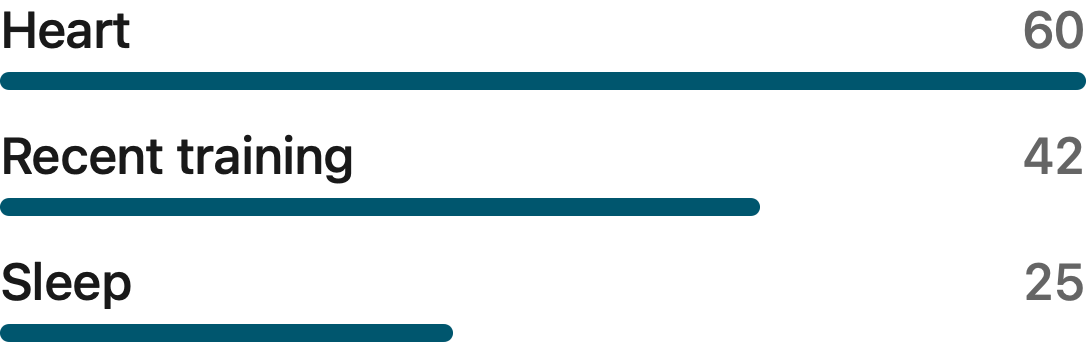
Heart is your heart rate variability, the beat-to-beat swing, read overnight, plus a little from your resting heart rate. Recent training is how much your workouts asked of your heart lately. Sleep is how far your last nights fell short of your need.
Your Recovery and Stress scores are not inputs: they re-counted the same heart signal. Each part is judged against your own recent days, never against other people.
The sizes, weights and cut-offs below are Aera's own, set on one person's 240 days of data, not on published cut-offs. Where a study backs a rule, the text names it.
How is your heart read?
Your last week of mornings, against the band your recent nights drew. Only a week below the band costs room.
Aera takes your HRV from the last 28 nights and draws a band around your usual. The band is your average, give or take half of how much your nights usually swing. Then it averages your last 7 mornings and asks where that average sits.
Why a week and not one morning? In 10 runners who improved with training, changes in speed and 10-kilometre time lined up well with HRV averaged over a week. They barely matched a single day's reading.1
How many mornings is enough? In trained triathletes, the changes levelled off after a few days of averaging. The authors advised at least 3 valid readings a week. Aera needs the same from your last 7 mornings, or heart sits out.2
A personal band has been tried in training. In 40 recreational runners, one group ran moderate or hard sessions only when morning HRV sat inside their own smallest worthwhile change. They did fewer of them. Their running over a short test distance improved by 2.1% against 1.1%, a small gap. Aera's band width is its own choice.3
A week below the band costs room. A week above it adds nothing and takes nothing. The cost rises fast at first, then flattens. Heart can take at most 60 points, the most of any part, so heart alone can bring No room.
Your resting heart rate can add up to 15 points inside that same 60. It does so when its week runs above your usual by more than half a spread. If heart sits out, resting heart rate adds nothing.
A night with under 3 hours asleep is skipped, so a short night never reads as a low one. Aera also uses one kind of HRV across the window, never a mix. It takes the first of three that has 7 nights: its overnight reading, the HRV measured asleep, or your day's HRV.
One study found Apple Watch HRV about 8 ms below a chest strap, so Aera compares your number only with your own nights (HRV tells why).4
How are training and sleep read?
Training compares your recent workouts with your usual load. Sleep compares your last nights with your sleep need.
Recent training reads each day's Cardio load, from workouts only. Aera takes the 28 days before today, and newer days count more. Today's workout is left out.
That recent load is divided by your usual, the average daily load from 8 to 35 days back. The last week stays out of it, so the week is not compared with itself. At least three quarters of those 28 days need a record.
Up to 1.2 times your usual costs nothing. Above that, the cost climbs, then flattens at 42 points. At worst, training alone brings Some room. The 1.2 is Aera's own choice.
This ratio is close kin to the acute:chronic workload ratio. A 2020 paper argued there is no evidence for using that ratio to plan training or lower injury risk (Training load tells it). So this part is a rough guide to how loaded you are. Aera makes no claim about injury.5
Sleep compares your last 3 nights with your sleep need. The latest night counts 50%, the one before 30% and the oldest 20%. Only a shortfall counts, and sleeping past your need adds nothing.
Sleep can take at most 25 points, the least of the three, so alone it never takes you below Good room. Aera treats sleep as a nudge because the dose is unclear.
Why count sleep at all? A review of 69 studies, mostly of men, found exercise performance 7.6% lower on average after short sleep. The studies varied widely, and morning tasks were largely unaffected. A review of endurance studies found a moderate fall, larger for exercise over 30 minutes.6,7
That first review counted only sleep of 6 hours or less. Aera's sleep part also reacts to smaller shortfalls.6,7
How do the parts become a word?
Aera starts from a usual day, takes each part's cost off, and reads the result against fixed cut-offs.
The start is 88, a usual day, Aera's own choice. The costs of heart, training and sleep come off it, and the result stays between 0 and 100.
Under 35 is No room. From 35 to 54 is Some room, from 55 to 79 Good room, and 80 or more Plenty of room. These cut-offs are Aera's own, not taken from a study.
Near a line, small daily wobbles could flip the word back and forth. So when today's score is within 5 points past the line from yesterday's word, Aera keeps yesterday's word. It moves only once the score has clearly crossed.
The call is set each morning from your nights and training up to yesterday. A workout today counts from tomorrow.
An off night overrides all of it. Aera watches five overnight readings: heart rate asleep, HRV, breathing rate, blood oxygen and wrist temperature. If two or more sit clearly outside your usual, the word is No room and the score is held at 30 or less.
A reading counts as clearly outside when Aera's overnight check marks it a concern, or off the wrong way by 1.5 times your usual spread. After a workout 1,500 metres or more above your usual altitude in the last 3 days, heart rate and breathing are not counted.
On No room or Some room, Home can name the reason: Sleep debt when sleep is the biggest drag, Carrying load when recent training is. A part must take 8 points or more to be named. Heart is never named there.
When does it show nothing?
Until Aera has a first week of overnight data. After that, any part with too little data takes nothing off.
The first read needs 7 nights of HRV with your watch on, among the last 28. Until then Home has no training row.
After the first read, a part with too little data sits out. Heart sits out without enough valid mornings, training without enough recorded days or with a usual load near zero, and sleep when Aera does not know your sleep need.
A part that sits out takes nothing off. So it can only make the call kinder, never harsher.
What can't it tell you?
How you feel, what is sore, or what is wrong. It is an estimate from watch numbers, and your own judgement outranks it.
It cannot see sore legs, a tweak in your knee or a bad week at work. It reads only your heart, workouts, sleep and overnight vitals. One review found athletes' own reports followed training load more sensitively than measured values did (Training load tells it).8
The studies behind the heart read are small and follow runners and triathletes. Aera applies the same rules to everyone.1,2,3
An off night is not a diagnosis. In people with symptoms, one study scored symptoms alone at 0.71 for telling positive from negative cases of COVID, on a scale where 1.0 is perfect. Adding watch data lifted it to 0.80, which helps but does not settle it (Resting heart rate tells the wider picture). So the rule never calls an off night illness.9
Room to train and Recovery can disagree, since each answers its own question. If you feel unwell, how you feel matters more than any reading.
Sources
The studies behind this article. Where a number is Aera's own choice, the text says so. Checked 12 November 2026.
- Plews DJ, Laursen PB, Kilding AE, Buchheit M (2013). Evaluating training adaptation with heart-rate measures: a methodological comparison. International Journal of Sports Physiology and Performance. doi:10.1123/ijspp.8.6.688 · PubMed
- Plews DJ, Laursen PB, Le Meur Y, Hausswirth C, Kilding AE, Buchheit M (2014). Monitoring training with heart rate-variability: how much compliance is needed for valid assessment? International Journal of Sports Physiology and Performance. doi:10.1123/ijspp.2013-0455 · PubMed
- Vesterinen V, Nummela A, Heikura I, Laine T, Hynynen E, Botella J, Häkkinen K (2016). Individual endurance training prescription with heart rate variability. Medicine & Science in Sports & Exercise. doi:10.1249/MSS.0000000000000910 · PubMed
- O'Grady B, Lambe R, Baldwin M, Acheson T, Doherty C (2024). The validity of Apple Watch Series 9 and Ultra 2 for serial measurements of heart rate variability and resting heart rate. Sensors. doi:10.3390/s24196220 · PubMed
- Impellizzeri FM, Tenan MS, Kempton T, Novak A, Coutts AJ (2020). Acute:chronic workload ratio: conceptual issues and fundamental pitfalls. International Journal of Sports Physiology and Performance. doi:10.1123/ijspp.2019-0864 · PubMed
- Craven J, McCartney D, Desbrow B, Sabapathy S, Bellinger P, Roberts L, Irwin C (2022). Effects of acute sleep loss on physical performance: a systematic and meta-analytical review. Sports Medicine. doi:10.1007/s40279-022-01706-y · PubMed
- Lopes TR, Pereira HM, Bittencourt LRA, Silva BM (2023). How much does sleep deprivation impair endurance performance? A systematic review and meta-analysis. European Journal of Sport Science. doi:10.1080/17461391.2022.2155583 · PubMed
- Saw AE, Main LC, Gastin PB (2016). Monitoring the athlete training response: subjective self-reported measures trump commonly used objective measures: a systematic review. British Journal of Sports Medicine. doi:10.1136/bjsports-2015-094758 · PubMed
- Quer G, Radin JM, Gadaleta M, Baca-Motes K, Ariniello L, Ramos E, et al. (2021). Wearable sensor data and self-reported symptoms for COVID-19 detection. Nature Medicine. doi:10.1038/s41591-020-1123-x · PubMed
Read next
- Heart rate variabilityWhy can an uneven heartbeat be a good sign?
- Training loadHow much training is too much?
- How much sleep you needIs eight hours right for you?
- Recovery scoreHow does Aera turn your night into Recovery?
- Resting heart rateWhat does a low resting heart rate say?
- Cardio loadHow hard was your week, really?