
Recovery score
Recovery is one number for how your heart and breathing looked overnight. Aera reads them against your own usual, never against other people, and keeps your sleep score out of it.
What does Recovery show?
A number and a word for how your night read on your heart and breathing, set against your own usual.
Recovery is a number from 1 to 100, scored each morning from the night before. Home shows its word. The Recovery page shows the number, a sentence on what moved, and last night's heart rate variability (HRV), resting heart rate and breathing against your usual.
The word is one of four: Primed, Ready, Tired or Run down. Ready means inside your usual range: the middle of your last 28 scored mornings, with room either side for how much they swing, at least 8 points. Primed is above that range and Tired is below it. Run down is more than twice that room below it.
Until 5 mornings are scored, the word is Still learning. That wait, and the cut-offs above, are Aera's choice. The word depends on your own mornings, so a score that reads Ready for one person can read Tired for another.
What these numbers are is told in Recovery, Heart rate variability and Resting heart rate.
What goes into it?
HRV, resting heart rate, heart rate asleep, breathing rate and wrist temperature, plus a low oxygen reading.
Aera starts every morning at 58. Each signal then adds points or takes them away, depending on where it sits against your usual. Higher HRV adds points. Higher resting heart rate, heart rate asleep, breathing rate or wrist temperature takes points away.
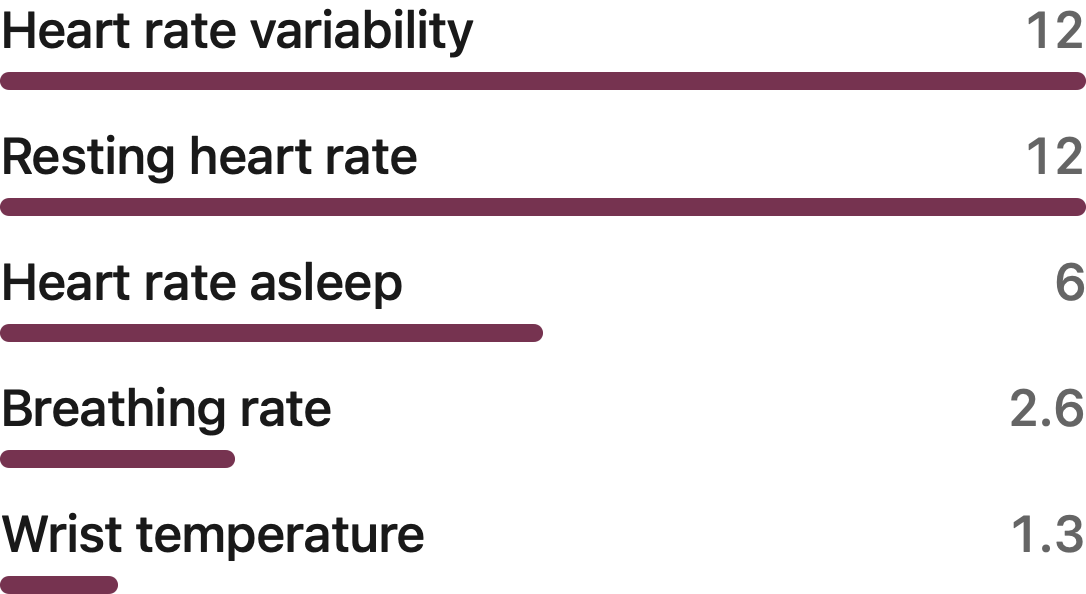
HRV and resting heart rate count the most, and they count the same. The weights and the 58 are Aera's choice, not taken from a study.
Heart rate asleep counts for less, and there is a reason it counts at all. In small studies of healthy men, heart rate overnight ran higher after exercise: after a marathon in ten men, and after harder or longer runs in 14. Aera's own tests on real mornings found it followed the day before's Strain more closely than HRV and resting heart rate did.1,2
A blood oxygen reading under 94 percent takes 8 points off. At 94 or above it takes nothing off. Both numbers are Aera's choice, not taken from a study.
Your sleep score is not one of the signals. Recovery reads how your heart and breathing look after the night, not how the night was scored. That lets Recovery and your sleep score disagree: a good night can still leave a tired heart.
How is the number worked out?
Each signal is compared with your own recent mornings. The gaps, weighted, are added to the starting point.
For each signal, Aera takes the middle of your last 28 days and how much it usually swings around that middle, its typical swing. How far this morning sits from the middle, counted in typical swings, sets that signal's push. Every morning is read against the 28 days before it, never after.
One signal can push by at most 2.5 swings, so one strange night cannot wreck the number. The pushes are added to the 58, and the result is kept between 1 and 100.
A 2014 review of heart rate monitoring in athletes argues that a change should be read against the error of the measure and the smallest change that matters. Aera's typical swing, its 28-day window and its cap are its own choice, not taken from the review.3
HRV comes first from the day's average, and from other readings only when that is missing. For your first 14 days of HRV, Aera blends your own swing with a typical one Aera chose, so early mornings do not jump to the top or the bottom of the scale.
Your watch keeps adding readings through the day, so the same morning could read very differently at waking and at bedtime. Aera keeps the HRV and resting heart rate a morning was first read from, and scores from them again later. If the night's sleep changes, because the watch hands over more of it, it reads the morning again. A 2022 study of recreational runners found night-time heart rate and HRV repeated closely from one night to the next after easy sessions, and changed after a hard running test.4
What does Aera say beside Recovery?
On Home, a short clause about the night or day beside it. On the Recovery page, a sentence about what moved.
The line on Home that says why can open with Recovery, as in Recovery is below your usual, and add what sits beside it. Aera checks a fixed list and uses the first that fits: a week behind your need, a short night, a restless night, a hard day yesterday, a night just under your need, a late night, heart rate up overnight, HRV down overnight, stress up, then a full or normal night. When Recovery is down and nothing else follows, the line ends with Still catching up. Your week or your stress can lead the line instead.
A hard day yesterday means its Strain was more than 1.4 times the middle of your Strain days, and above 8. Aera needs 3 days of Strain before it calls any day hard. These limits are Aera's choice.
The Recovery page names what moved in last night's HRV, resting heart rate and breathing. A reading counts as a bit off when it sits outside your usual range, and as plainly off when it sits more than twice as far from the middle as that range reaches. A plainly off reading leads the sentence. That cut-off is Aera's choice.
On a low morning after a big day, a plainly worse reading says so, for example Your HRV dipped below usual, a sign of strain after yesterday's ride. A day is big when it had an outing and either the outing ran 100 minutes or more or the day's Strain was 60 or more. Those limits are Aera's choice. These lines say what came before, not what caused it.
What does Recovery say after a workout?
A card on the workout page sets the mornings after it against your usual.
On a workout page, the card Your recovery shows the next morning's score beside your usual range. That is the middle of your scored mornings over the last 180 days, with 5 points either side. If the morning lands below it, the card follows up to 4 mornings and says Back to your usual by a weekday, or Under your usual through one.
The card needs 14 scored mornings, and 5 earlier days whose Strain came within 25 percent of this day's. After 3 low mornings have come back within those 4, a quiet line adds the usual climb: After a day like this, a low first morning is usually back by a weekday morning. These limits, and the 180 days and 5 points above, are Aera's choice, not taken from a study.
That climb counts only the low mornings that did come back, so it can read kinder than your own recovery.
When does it show nothing?
Until Aera has enough of your nights, or when a night has no heart reading.
The first score comes on the morning after 5 earlier nights, with HRV on at least 3 of them or resting heart rate on at least 5. A morning with no HRV and no resting or overnight heart rate shows nothing. Until then the Recovery page reads Aera is learning your usual.
If you usually record sleep, 7 nights or more in the last 28 days, a morning with no recorded night shows nothing either. A missing breathing, wrist temperature, heart rate asleep or oxygen reading counts as no push, not as a bad one. The night counts in this chapter are Aera's choice.
When Apple Health holds no resting heart rate for a day, Aera uses your heart rate asleep in its place, against your own usual, and counts it once. It cannot make up HRV that your device does not share.
What can't it tell you?
Why your numbers moved. Aera sees readings from a night, not the cause behind them.
A watch can see that your HRV dropped or your resting heart rate rose. It cannot say what moved them. The 2014 review adds that heart rate measures cannot inform on every aspect of wellness, fatigue and performance, and suggests using them beside training logs and questionnaires. Recovery reads where your body is, not why, and it is not a medical tool.3
The Recovery number is not an input to Room to train, Aera's read of how much training suits you today. Room to train reads HRV itself, so Aera leaves Recovery out rather than count the same heart signal a second time.
Sources
The studies behind this article. Where a number is Aera's own choice, the text says so. Checked 12 November 2026.
- Hynynen E, Vesterinen V, Rusko H, Nummela A (2010). Effects of moderate and heavy endurance exercise on nocturnal HRV. International Journal of Sports Medicine. doi:10.1055/s-0030-1249625 · PubMed
- Myllymäki T, Rusko H, Syväoja H, et al. (2012). Effects of exercise intensity and duration on nocturnal heart rate variability and sleep quality. European Journal of Applied Physiology. doi:10.1007/s00421-011-2034-9 · PubMed
- Buchheit M (2014). Monitoring training status with HR measures: do all roads lead to Rome? Frontiers in Physiology. doi:10.3389/fphys.2014.00073 · PubMed
- Nuuttila OP, Seipäjärvi S, Kyröläinen H, Nummela A (2022). Reliability and sensitivity of nocturnal heart rate and heart-rate variability in monitoring individual responses to training load. International Journal of Sports Physiology and Performance. doi:10.1123/ijspp.2022-0145 · PubMed