
Resting heart rate
Your resting heart rate is how fast your heart beats when you are calm and still. It differs widely between people but little within one, and in large groups a lower rate goes with a lower risk of dying.
What is resting heart rate?
How fast your heart beats when you are calm and still. It is steady in one person but differs widely between people.
Your resting heart rate is how many times your heart beats in a minute when you are awake, calm and still. Wearables now report it day by day. How much the gaps between beats vary is a different measure, covered in Heart rate variability.1
Researchers in California gathered the readings of about 92,000 American adults who wore a fitness tracker for months. Each person had an average resting rate, and these ran from 40 to 109 beats a minute. The wearers were users of one brand, and nothing was known about their health.1
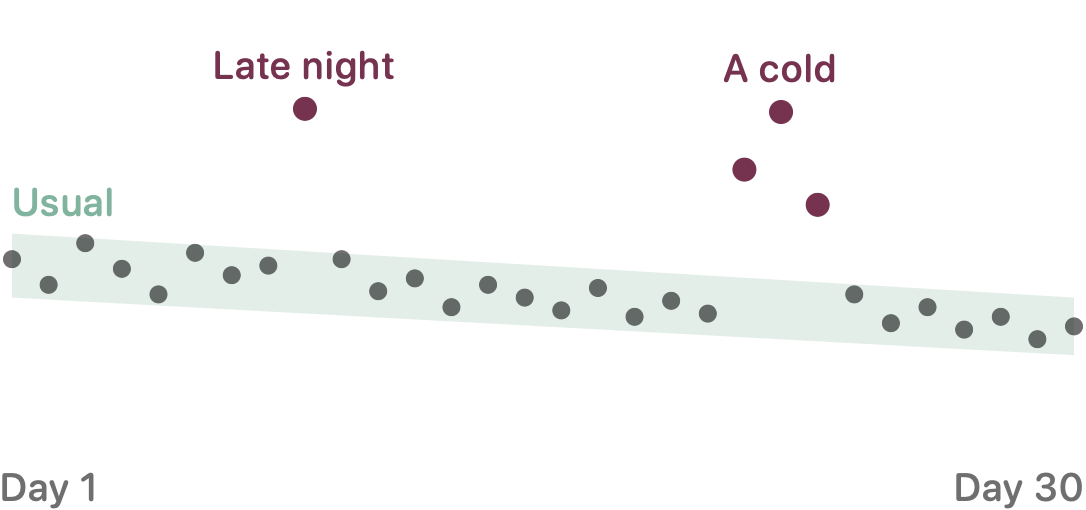
The surprise was how steady each person was. Week to week, the typical change was about 3 beats, even though two people's usual numbers can sit as much as 70 beats apart.1
One person in five did have a week when theirs swung by 10 beats or more, so a single odd week is part of normal life. A fair yardstick for a change is your own usual, not anyone else's.1
Why do some people's hearts beat so slowly?
The heart's own pacemaker runs slower, through training and through genes. Endurance athletes often sit at the slow end.
Among 465 elite endurance athletes who wore a heart monitor for a day, 38% dipped to 40 beats a minute or lower at some point. Pauses of two seconds or longer were also common, yet neither the slow rates nor the pauses went with more health problems over 5.5 years. In these athletes, slow hearts were well tolerated.2
One explanation was that training strengthens the nerves that calm the heart. A 1982 experiment suggested otherwise. In eight world-class oarsmen and ten non-athletes, doctors used drugs to cancel the nerves' effect on the heart. The oarsmen's hearts still ran slower on their own, by about 20 beats a minute.3
In 2014, an experiment in mice traced this to the pacemaker cells. Training turned down one of their channels, a doorway for charged particles called HCN4. Blocking the current through that channel erased the gap in heart rate between trained and sedentary mice.4
Genes play a part too. The athletes were scored on genes that go with a slower heart. In the quarter with the slowest-heart scores, the typical lowest rate was 41 beats. In the quarter with the fastest-heart scores, it was 45.2
If you start training, the change is likely to be small. A review of 191 controlled trials found that exercise lowered it by about 3 beats more than no exercise. The drop was larger in people who started higher, and smaller in older people.5
What moves it from week to week?
Fever raises it most. The menstrual cycle, pregnancy and the seasons nudge it, from about 2 beats to about 10.
In a 1986 study, 27 young men wore a heart monitor for 24 hours while ill with a fever, and again after they recovered. Their hearts averaged 84 beats a minute during the fever and about 67 afterwards. The rate stayed high even in sleep.6
Each degree Celsius of temperature added about 8.5 beats, on average. So if your number runs high while you feel unwell, a fever may be part of the reason.6
Hormones move it as well. In a study of 91 women, a wrist sensor read their pulse in sleep. It ran about 4 beats higher in the middle of the cycle's second half than during the period. That is close to the size of an ordinary week-to-week wobble in the wearers above.1,7
Pregnancy pushes it further. A study that tracked 10,318 pregnancies with a ring found heart rate rising steadily, to a peak about 10 beats above baseline at week 32.8
Your own number follows the calendar too. The wearers' average was about 2 beats higher in January than in July.1
Can it warn you before you feel ill?
Sometimes: in one look-back study, a rise above a person's own usual would have flagged most COVID-19 cases before symptoms. It cannot say why.
In 2020, researchers went through the smartwatch data of nearly 5,300 people, 32 of whom caught COVID-19. In 26 of those 32, heart rate, daily steps or sleep had changed.9
Looking back, an alert built only on big jumps in resting heart rate above each person's own baseline would have flagged 63% of the cases before symptoms began.9
The group was small, and the alert was tested after the fact, not live. A rise above your own usual says that something has changed, not what.9
Does a low resting rate mean a longer life?
In large groups, a lower rate goes with lower risk of dying. Genes give no sign that a slower heart is the cause.
In 2016, a team in China pooled the prospective studies it could find that had measured resting heart rate in ordinary adults and followed them for years. The 40 that counted deaths from any cause covered about 1.2 million people and 78,000 deaths. Studies of people picked for a disease were left out.10
For every 10 beats a minute higher at rest, the risk of dying during follow-up was about 9% higher. That is a share of the risk, not 9 people in every 100.10
People above 80 beats had about 45% higher risk than the lowest group. Risk rose steadily from the slowest rates, with no single line between safe and unsafe. A second review found a steeper slope, about 17% per 10 beats.10,11,12
Fit people have slow hearts, so fitness could explain the link. In healthy middle-aged men in Copenhagen followed for 16 years, it did not erase it. Men resting above 90 beats had about three times the risk of the slowest group, though that top group was small. Fitness had been measured long before the heart-rate reading, and only men were studied.13
Treat the sizes with care before you apply them to your own number. The studies disagree a lot with one another, and the 2016 review saw signs that small studies with weak results may have gone unpublished. After correcting for that, its figure fell from about 9% to about 4% per 10 beats: still there, but smaller.10
Genes offer a test of cause. They are handed out at conception, before habits and illness have a say. In 2023, researchers pooled 100 studies of more than 800,000 people to find the genetic variants that set resting heart rate. They found no evidence that the genes for a higher resting rate went with a higher risk of dying. An earlier study had found a link, and the authors blame a weakness in its method.14
What can you do with this?
Know your own usual and watch for big changes from it. Ask a doctor about a very low or stubbornly high rate.
- Know your own usual. Your number is steady within you but differs widely between people, so a change from it says more than a comparison with a friend.1
- Look for jumps. One odd day or week is ordinary. In the smartwatch study, an alert built on big jumps above a person's own usual would have caught infections early.1,9
- Training helps a little. Endurance training and yoga lowered resting rate in both sexes in the exercise review. The change is a few beats.5
- Slow can be fine. A rate that is very low with dizziness or fainting, or high and staying high with no clear reason, is worth showing a doctor.
Sources
Every number in this article comes from these studies. Checked 12 November 2026.
- Quer G, Gouda P, Galarnyk M, Topol EJ, Steinhubl SR (2020). Inter- and intraindividual variability in daily resting heart rate and its associations with age, sex, sleep, BMI, and time of year: retrospective, longitudinal cohort study of 92,457 adults. PLoS One. doi:10.1371/journal.pone.0227709 · PubMed
- D'Ambrosio P, De Paepe J, Spencer LW, et al. (2026). Bradycardia in athletes: prevalence, mechanisms, and risks. Circulation. doi:10.1161/circulationaha.125.076170 · PubMed
- Katona PG, McLean M, Dighton DH, Guz A (1982). Sympathetic and parasympathetic cardiac control in athletes and nonathletes at rest. Journal of Applied Physiology. doi:10.1152/jappl.1982.52.6.1652 · PubMed
- D'Souza A, Bucchi A, Johnsen AB, et al. (2014). Exercise training reduces resting heart rate via downregulation of the funny channel HCN4. Nature Communications. doi:10.1038/ncomms4775 · PubMed
- Reimers AK, Knapp G, Reimers CD (2018). Effects of exercise on the resting heart rate: a systematic review and meta-analysis of interventional studies. Journal of Clinical Medicine. doi:10.3390/jcm7120503 · PubMed
- Karjalainen J, Viitasalo M (1986). Fever and cardiac rhythm. Archives of Internal Medicine. doi:10.1001/archinte.1986.00360180179026 · PubMed
- Shilaih M, Clerck V, Falco L, Kübler F, Leeners B (2017). Pulse rate measurement during sleep using wearable sensors, and its correlation with the menstrual cycle phases, a prospective observational study. Scientific Reports. doi:10.1038/s41598-017-01433-9 · PubMed
- Adaimi R, Thigpen N, Clausel A, Gotlieb N, Patel K, de Zambotti M (2025). Temporal trajectories in sleep, temperature trends, cardiorespiratory, and activity metrics measured via Oura Ring during pregnancy: large-scale observational analysis. JMIR mHealth and uHealth. doi:10.2196/80213 · PubMed
- Mishra T, Wang M, Metwally AA, et al. (2020). Pre-symptomatic detection of COVID-19 from smartwatch data. Nature Biomedical Engineering. doi:10.1038/s41551-020-00640-6 · PubMed
- Zhang D, Shen X, Qi X (2016). Resting heart rate and all-cause and cardiovascular mortality in the general population: a meta-analysis. CMAJ. doi:10.1503/cmaj.150535 · PubMed
- Fox K, Borer JS, Camm AJ, et al. (2007). Resting heart rate in cardiovascular disease. Journal of the American College of Cardiology. doi:10.1016/j.jacc.2007.04.079 · PubMed
- Aune D, Sen A, Ó'Hartaigh B, et al. (2017). Resting heart rate and the risk of cardiovascular disease, total cancer, and all-cause mortality: a systematic review and dose-response meta-analysis of prospective studies. Nutrition, Metabolism and Cardiovascular Diseases. doi:10.1016/j.numecd.2017.04.004 · PubMed
- Jensen MT, Suadicani P, Hein HO, Gyntelberg F (2013). Elevated resting heart rate, physical fitness and all-cause mortality: a 16-year follow-up in the Copenhagen Male Study. Heart. doi:10.1136/heartjnl-2012-303375 · PubMed
- van de Vegte YJ, Eppinga RN, van der Ende MY, et al. (2023). Genetic insights into resting heart rate and its role in cardiovascular disease. Nature Communications. doi:10.1038/s41467-023-39521-2 · PubMed