
How much sleep you need
Your sleep need is the length your sleep settles at when nothing cuts it short. Expert panels advise about seven to nine hours for adults, but need differs between people and changes with age.
What is sleep need?
The length your sleep settles at once nothing cuts it short. An alarm and a full evening hide it.
In one experiment, healthy young adults spent 14 hours in bed in the dark every night for four weeks. In the first nights they slept long. Then their sleep shortened, night after night, until it stopped falling.1,2
That settling point is sleep need. A later reanalysis put it at about 8.6 hours a night for this group.2
It was 15 people, almost all men, and single nights still ran from about 5 to 11 hours. So the figure is an average, not a rule for any one night.2
An alarm and a full evening decide when most nights end, which is why need is hard to read from an ordinary week. What a run of six-hour nights does has its own article.2
Does your need change with age?
It seems to. In a long-night experiment, older adults settled at about 1.5 hours less sleep than younger adults.
Researchers gave older and younger healthy adults far more time in bed than usual, for several days. Total sleep started long, then declined and settled. It levelled off at about 7.4 hours a day in the older group and 8.9 in the younger.3
At the start, the older adults also fell asleep by day less easily than the younger ones. Older sleep did not stretch to fill the extra time: it has a lower ceiling. But this was a lab study of 53 healthy people, and it measures the most sleep older adults could get. By itself it does not show how much they need.3
What do the experts advise?
Seven to nine hours for most adults, a little less for older adults. Both panels read the evidence; neither ran a trial.
In the US, the National Sleep Foundation convened a panel of experts from many fields to weigh the evidence by age. For adults it advised 7 to 9 hours a night, for older adults 7 to 8, and for teenagers 8 to 10.4
The panel also named a wider band that may suit some people: 6 to 10 hours for most adults, and 5 to 9 from age 65. That is the thin line in the figure.4
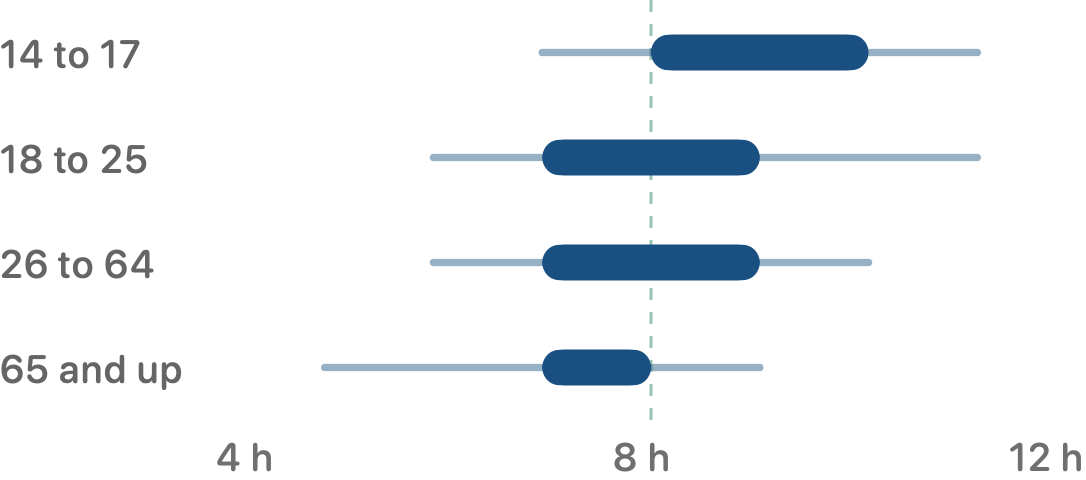
A second group, the American Academy of Sleep Medicine with the Sleep Research Society, reached a similar view. It said adults aged 18 to 60 should sleep 7 or more hours a night on a regular basis. That is a floor with no ceiling attached. Both statements are expert judgement, not the result of a trial.5
The Foundation's panel stressed that need varies from person to person and that sleeping far outside the range is rare. If you habitually do, the panel warned, it may be a sign of a health problem.4
Why is it a range?
Need is partly built into you, and it differs between people. A few rare gene changes shorten it.
Researchers described a small family in which two people carried a change in a gene called DEC2. They reported sleeping about six and a quarter hours a night on average, against about eight for relatives without the change. The change was not found in more than 250 comparison people, and sleepers this short are rare. Mice given the change also slept less.4,6
In one pair of non-identical twins, the twin with a different change in the same gene slept less. That twin also slept less when recovering from lost sleep and made fewer mistakes when kept awake. It is one pair, so it shows that such changes exist, not how common they are.7
How long you sleep also depends on what came before. In the dark experiment, the long sleep of the first nights was read as catching up on earlier short sleep, and it took several nights to settle. So a long sleep after a hard week may be catch-up, not a new need.2
What do less and more sleep do to you?
In large studies, both short and long sleep were linked with a higher risk of dying. A small study saw athletes improve with more.
A review pooled studies that followed well over a million adults for years. Compared with people who slept about seven hours, short sleepers had a 12% higher risk of dying in that time, and long sleepers 30%. That is a share of the risk, not a count of extra deaths.8
What counted as short or long differed between studies. Short ran from four hours or less to just under seven, and long from over eight hours up. People reported their own sleep, and long sleep may be a sign of illness, not a cause of harm.8
A Dutch study followed older adults for dementia. Sleeping nine hours or more went with dementia only when the diagnosis came soon after sleep was measured, which the authors read as early dementia changing sleep. Sleeping six hours or less went with dementia mainly when it came 15 or more years later.9
At Stanford, 11 college basketball players stretched their nights by nearly two hours for several weeks. Their sprints got faster, and free throws and three-point shots each improved by about 9%. It was small and had no comparison group, so it shows what may be possible, not what to expect.10
What can you do with this?
Start from the advised band, and let free days show where your own sleep settles.
- Treat eight hours as a middle, not a rule. It sits in the middle of the panels' range, and need differs from person to person.4
- Look at days without an alarm. In the dark experiment sleep took some days to settle, so a stretch of free mornings may show where yours does. A watch can log it.2
- Judge by weeks, not one night. Even at the settled point, single nights varied a lot.2
- Older sleep has a lower ceiling. Older adults in the lab study settled at shorter sleep, though that measures what they could sleep, not what they need.3
- Mention big changes to a doctor. This follows the panel's warning above about habitual sleep far outside the range.4
Your sleep is more than its length. The body clock helps time when it falls, and has its own article.
Sources
Every number in this article comes from these studies. Checked 12 November 2026.
- Wehr TA. (1991). The durations of human melatonin secretion and sleep respond to changes in daylength (photoperiod). Journal of Clinical Endocrinology and Metabolism. doi:10.1210/jcem-73-6-1276 · PubMed
- Klerman EB, Barbato G, Czeisler CA, Wehr TA. (2021). Can people sleep too much? Effects of extended sleep opportunity on sleep duration and timing. Frontiers in Physiology. doi:10.3389/fphys.2021.792942 · PubMed
- Klerman EB, Dijk DJ. (2008). Age-related reduction in the maximal capacity for sleep: implications for insomnia. Current Biology. doi:10.1016/j.cub.2008.06.047 · PubMed
- Hirshkowitz M, Whiton K, Albert SM, et al. (2015). National Sleep Foundation's sleep time duration recommendations: methodology and results summary. Sleep Health. doi:10.1016/j.sleh.2014.12.010 · PubMed
- Watson NF, Badr MS, Belenky G, et al. (2015). Recommended amount of sleep for a healthy adult: a joint consensus statement of the American Academy of Sleep Medicine and Sleep Research Society. Sleep. doi:10.5665/sleep.4716 · PubMed
- He Y, Jones CR, Fujiki N, et al. (2009). The transcriptional repressor DEC2 regulates sleep length in mammals. Science. doi:10.1126/science.1174443 · PubMed
- Pellegrino R, Kavakli IH, Goel N, et al. (2014). A novel BHLHE41 variant is associated with short sleep and resistance to sleep deprivation in humans. Sleep. doi:10.5665/sleep.3924 · PubMed
- Cappuccio FP, D'Elia L, Strazzullo P, Miller MA. (2010). Sleep duration and all-cause mortality: a systematic review and meta-analysis of prospective studies. Sleep. doi:10.1093/sleep/33.5.585 · PubMed
- Alders P, Kok A, van Zutphen EM, Claassen JAHR, Deeg DJH. (2025). The effect of sleep disturbances on the incidence of dementia for varying lag times. The Journal of Prevention of Alzheimer's Disease. doi:10.1016/j.tjpad.2024.100024 · PubMed
- Mah CD, Mah KE, Kezirian EJ, Dement WC. (2011). The effects of sleep extension on the athletic performance of collegiate basketball players. Sleep. doi:10.5665/sleep.1132 · PubMed