
Heart rate variability
Heart rate variability is the tiny change in time from one heartbeat to the next, made by the nerves that steer your heart. A healthy heart at rest keeps varying, low variation has gone with early death in heart patients, and your own usual is the fair comparison.
What is heart rate variability?
The small differences in time between one heartbeat and the next. A healthy heart at rest is not a metronome.
Put a finger on your pulse and your heart feels as even as a clock. It is not. At 60 beats a minute the gaps between beats average one second, yet no two are quite alike. The tiny differences are heart rate variability, or HRV.1
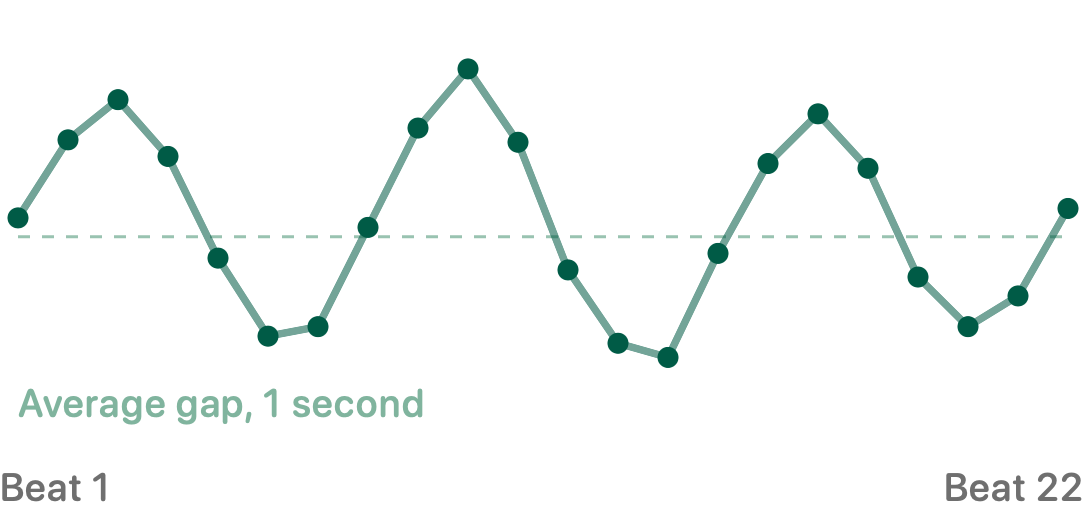
One historical review traces the first clinical reports to the mid 1960s. It cites two doctors who noticed in unborn babies that stress showed in the timing between beats before the average heart rate changed.2
The differences are far too small to feel. So a watch times each gap and boils the gaps down to one number, in milliseconds, which are thousandths of a second.1
Where does the variation come from?
From the nerves that steer your heart, above all with each breath. Without them there is little or no variation.
In 1733 the Rev. Stephen Hales was the first to report that the gap between beats changed with the breath. In 1847 Carl Ludwig recorded it in a dog: the pulse quickened as the animal breathed in and slowed as it breathed out.2
Two sets of nerves adjust your heartbeat all day. One side speeds the heart up for action. The other, mostly through the vagus nerve, slows it down for rest. One review says the calming side acts in under a second, the speeding side in more than five seconds. How much each side adds to HRV is still debated.1,2
A donor heart arrives without its nerves, so no signals from the brain reach it. In 216 transplant patients followed over the years, only 16 showed a clear variation again. Most had little or none, and in the great majority the nerves had not grown back.3
Think of a driver on a straight road. They still turn the wheel a little, all the time. A wheel held rigid would mean the corrections had stopped. A healthy heart's constant small adjustments, one review says, let it react quickly to sudden demands.1
What changes it?
Age lowers it, and slow breathing makes your heart's swings bigger.
In 260 healthy people aged 10 to 99, recorded for 24 hours, HRV fell with age, but not at one speed. Each decade was a different group of people, not the same people followed through life.4
SDNN is the overall spread of the gaps. It fell gently, to about 60% of the youngest group's level by the nineties. RMSSD is the size of the quick changes from one beat to the next. It fell faster, to about 47% by the fifties, then levelled off.4
The same study found a sex gap that fades. Women started lower than men among the young, but the gap narrowed and was gone after 50.4
Breathing pace matters too. One review reports that the heart's swings are largest at about six breaths a minute, and that the best pace differs from person to person.5
For you, the age decline means the same number can be low for a young adult and ordinary for someone older. Your own readings may drift down over the years, so a recent usual is a fairer yardstick than a younger you. Resting heart rate falls with age much more slowly (it is covered in Resting heart rate), so your pulse may change less than your HRV.4
Is a higher number better?
After a heart attack, low variation has gone with early death. Among healthy adults, normal covers a huge range.
Doctors recorded 24 hours of heartbeats in 808 people soon after they survived a heart attack. Over the next two and a half years, those with the least variation were about five times as likely to die as those with the most.6
Here the least meant under 50 milliseconds on the overall-spread measure, and the most over 100. The link held after allowing for other signs of how ill each person was. But it came from 24-hour recordings in heart patients, not a short reading from a wrist in healthy people.6
The authors' idea was that low variation goes with a weaker calming side or a stronger speeding side, which could make dangerous heart rhythms more likely.6
Cutoffs from patients do not transfer neatly. In one study of healthy people, 4% to 25% of those over 65 fell below published risk cutoffs, depending on the measure.4
Normal is wide. A review pooling many studies of healthy adults found one common measure averaging 42 milliseconds, with single studies' averages from 19 to 75. Another review warns that norms depend on recording length, age and sex, and are not interchangeable.1,7
So a friend's number tells you little about yours. Your own usual, measured the same way, is the fair comparison.1,7
How far can you trust one reading?
Not far. It shifts from day to day, so a week's average says more than one morning.
In 15 healthy young men tested on four occasions, the common simple measures of HRV varied by 4 to 17% from one test to the next.8
Averaging helps. In 10 runners who improved on a 9-week programme, changes in speed and 10-kilometre time lined up well with their one-week HRV average, but barely with a single day's reading. It was a very small group.9
Some athletes let the morning number choose between a hard day and an easy one. In a small four-week trial, top running speed rose more in men guided by daily HRV than in men on a fixed plan. Their gains in peak oxygen use did not differ clearly. In 17 cyclists, only the guided group improved, but the gap between the groups could be chance.10,11
A watch is less exact for HRV than for heart rate. Against a chest strap, two recent Apple Watch models read HRV about 8 milliseconds low on average in 39 adults, an average error of nearly 30%. Their resting heart rate was right on average, though single readings could be a few beats off.12
What can you do with this?
Compare yourself with your own usual, measured the same way, and read weeks rather than single mornings.
Sources
Every number in this article comes from these studies. Checked 12 November 2026.
- Shaffer F, Ginsberg JP (2017). An overview of heart rate variability metrics and norms. Frontiers in Public Health. doi:10.3389/fpubh.2017.00258 · PubMed
- Billman GE (2011). Heart rate variability: a historical perspective. Frontiers in Physiology. doi:10.3389/fphys.2011.00086 · PubMed
- Beckers F, Ramaekers D, Speijer G, et al. (2004). Different evolutions in heart rate variability after heart transplantation: 10-year follow-up. Transplantation. doi:10.1097/01.tp.0000141093.04132.41 · PubMed
- Umetani K, Singer DH, McCraty R, Atkinson M (1998). Twenty-four hour time domain heart rate variability and heart rate: relations to age and gender over nine decades. Journal of the American College of Cardiology. doi:10.1016/s0735-1097(97)00554-8 · PubMed
- Lehrer PM, Gevirtz R (2014). Heart rate variability biofeedback: how and why does it work? Frontiers in Psychology. doi:10.3389/fpsyg.2014.00756 · PubMed
- Kleiger RE, Miller JP, Bigger JT, Moss AJ (1987). Decreased heart rate variability and its association with increased mortality after acute myocardial infarction. American Journal of Cardiology. doi:10.1016/0002-9149(87)90795-8 · PubMed
- Nunan D, Sandercock GR, Brodie DA (2010). A quantitative systematic review of normal values for short-term heart rate variability in healthy adults. Pacing and Clinical Electrophysiology. doi:10.1111/j.1540-8159.2010.02841.x · PubMed
- Al Haddad H, Laursen PB, Chollet D, Ahmaidi S, Buchheit M (2011). Reliability of resting and postexercise heart rate measures. International Journal of Sports Medicine. doi:10.1055/s-0031-1275356 · PubMed
- Plews DJ, Laursen PB, Kilding AE, Buchheit M (2013). Evaluating training adaptation with heart-rate measures: a methodological comparison. International Journal of Sports Physiology and Performance. doi:10.1123/ijspp.8.6.688 · PubMed
- Kiviniemi AM, Hautala AJ, Kinnunen H, Tulppo MP (2007). Endurance training guided individually by daily heart rate variability measurements. European Journal of Applied Physiology. doi:10.1007/s00421-007-0552-2 · PubMed
- Javaloyes A, Sarabia JM, Lamberts RP, Moya-Ramon M (2019). Training prescription guided by heart-rate variability in cycling. International Journal of Sports Physiology and Performance. doi:10.1123/ijspp.2018-0122 · PubMed
- O'Grady B, Lambe R, Baldwin M, Acheson T, Doherty C (2024). The validity of Apple Watch Series 9 and Ultra 2 for serial measurements of heart rate variability and resting heart rate. Sensors. doi:10.3390/s24196220 · PubMed