
Heart rate zones
Your zones cut your working heart rate into steps, from very easy to maximum. Aera counts the time you spend in each, so you see the shape of a workout and not just its average.
What do your zones show?
Your effort as steps from very easy to maximum, cut from your own heart rates. Aera counts your time in each.
Open Settings, then Heart rate zones. Zones shows five steps: Very easy, Easy, Moderate, Hard and Maximum. Each step wears the heart rate it starts at. Tap one to read how it feels and its range. Under Heart rate reserve or Percent of max, History opens your zones month by month.
Based on lists the numbers your zones are cut from. A note under each says where it came from: Apple Health, last 4 weeks, From your age, Your highest in a workout, Set by you or Aera's estimate. A small pill on the Zones heading names the method, and its menu changes it.
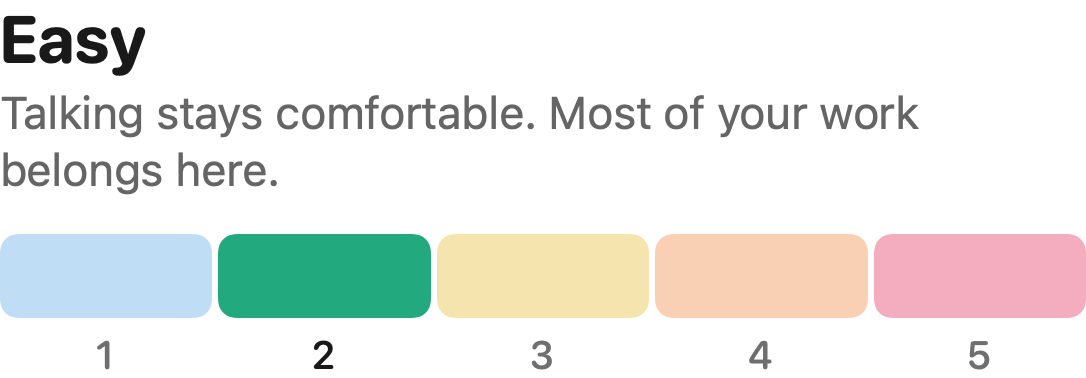
On a workout page, the Zones chapter shows your time in each step. Its door, named Your zones, opens this Settings page.
Where do your maximum and resting rates come from?
From what you type, else from Apple Health and your age, else from flat numbers Aera falls back on.
Your maximum heart rate is the top of your range. Tap it under Based on to type your own, from 100 to 220. Whatever you type wins over every estimate.
Without one, Aera starts from 220 minus your age, using the birth date in Apple Health. With no birth date it uses a flat 190, not taken from a study, and calls it Aera's estimate. Age formulas are rough, with a typical error of about 11 beats a minute. The formulas are compared in 220 minus your age.1
A recorded peak replaces the formula only when it is higher. Aera takes each workout's highest heart rate from the last 12 months, between 140 and 220. It trusts the highest one that a second workout came within 5 beats of, so one stray reading, like a loose band, cannot set your maximum for a year. The two workouts and the 5 beats are Aera's choice, not taken from a study.
Resting heart rate has its own row, shown under Heart rate reserve. Tap it to type yours, from 30 to 120. Without one, Aera takes the middle of up to 30 of your newest resting heart rate readings from Apple Health in the last 28 days, which steadies it. With no readings it uses 60. The 28 days, the 30 readings and the 60 are Aera's choices, not taken from a study.
How are the lines between zones drawn?
By the method you pick. Heart rate reserve is the default, and you can change it or type your own lines.
Heart rate reserve is the default. Reserve is your maximum minus your resting rate. The lines between zones sit at your resting rate plus 60, 70, 80 and 90 percent of the reserve. A line at 50 percent is the bottom of Zone 1.
Percent of max uses the same shares of your maximum alone, so it needs no resting rate.
Lactate threshold is for people who have had a test. You set a Threshold heart rate, and Zones 2 to 5 start at 85, 90, 95 and 100 percent of it. That is the running split of the coach Joe Friel, a coaching convention and not a finding of a study, and Aera uses it for every sport. Zone 1 keeps Aera's own easy line, the 50 percent line. If you have no threshold saved when you pick this method, Aera saves a start of 88 percent of your maximum at once, and the row reads Set by you. That start is Aera's choice, not taken from a study. The zones fit you once your tested number replaces it.
Your own lets you type the five starting heart rates yourself. Picking it starts from the five you see, and each must sit above the one below, between 30 and 220.
Why offer a choice? A review of the methods notes that a fixed share of maximum heart rate does not necessarily put everyone at the same intensity. Intensity tells the talk test and the thresholds.2
How are the minutes counted?
Each reading counts for the time until the next one. The workout page and the saved totals count a little differently.
On a workout page, each heart rate reading owns the time until the next one, up to 30 seconds. Paused time is left out. Heart rate under the Zone 2 line counts as Zone 1. If your watch lost your wrist, the zones add up to less than the workout, and Aera does not make up the rest.
The saved minutes that Fitness reads are counted when a workout syncs. That count joins two readings only when they are under 5 minutes apart, and it leaves out time under the first line, which does not count as training. So Zone 1 can show more time on a workout page than in Fitness. Unless you typed a maximum, the count also raises the maximum to that workout's own highest reading when that is higher, so one stray reading can move the lines for that workout alone. The 30 seconds and the 5 minutes are Aera's choices, not taken from a study.
Change a method or a number and your workout pages use it at once, because they re-read the heart rate each time they open. The saved minutes of past workouts catch up a little each time Aera opens, as the page tells you.
What do easy, moderate and hard add?
They fold the zones into bands and set each week against your own usual mix, never against a target.
Some pages fold the zones into three bands. Easy is Zones 1 and 2, Moderate is Zone 3 and Hard is Zones 4 and 5.
Training focus in Fitness reads your last 4 weeks as one and shows your share of easy time. Your usual is the middle of the 4-week readings that end in the 12 weeks before, once 3 of them exist.
Effort zones reads one week at a time. Your usual is the middle of your last 8 weeks, band by band. It calls a band out only when it sits 8 points from your usual, as in Harder than usual or Easier than usual. These cutoffs are Aera's own, not taken from a study, and no target line is drawn.
When does it show nothing?
When there is no heart rate, too little zone time, or too few earlier weeks to learn your usual.
A workout with no heart rate has no zone minutes. The workout page says so, and adds that a watch or a chest strap worn while you train fills in heart, effort and zones.
A week under 20 minutes of zone time shows no mix. Effort zones then says Still gathering this week's shape, or No recorded effort yet this week when there is none. Your usual stays hidden until 3 earlier weeks reach 20 minutes, and the page counts Week 1 of 3 while it learns.
On History, a month with fewer than 5 resting readings is left out: a gap, never a guess.
What can't it tell you?
Whether your maximum is right. Your zones are only as good as the numbers under them.
An age formula can miss your true maximum, and any miss moves every reserve line by 50 to 90 percent of it. A maximum you tested and typed removes the guess.1
Zones also count what your sensor reports. Tests against an ECG found that wrist accuracy varies with the kind of exercise, and that a chest strap agreed best, among athletic adults on a treadmill too. How a watch measures you tells more.3,4
History rebuilds each month from that month's data, because Aera keeps no log of past settings. A month uses the middle of its own resting readings and the workout peaks of the year up to its end, with your age as it is today. All of it is cut by today's method and any number you set. So the same heart rate can sit in a different zone from one month to the next.
Sources
The studies behind this article. Where a number is Aera's own choice, the text says so. Checked 12 November 2026.
- Nes BM, Janszky I, Wisløff U, Støylen A, Karlsen T (2013). Age-predicted maximal heart rate in healthy subjects: the HUNT fitness study. Scandinavian Journal of Medicine and Science in Sports. doi:10.1111/j.1600-0838.2012.01445.x · PubMed
- Mann T, Lamberts RP, Lambert MI (2013). Methods of prescribing relative exercise intensity: physiological and practical considerations. Sports Medicine. doi:10.1007/s40279-013-0045-x · PubMed
- Gillinov S, Etiwy M, Wang R, et al. (2017). Variable accuracy of wearable heart rate monitors during aerobic exercise. Medicine and Science in Sports and Exercise. doi:10.1249/MSS.0000000000001284 · PubMed
- Pasadyn SR, Soudan M, Gillinov M, Houghtaling P, Phelan D, Gillinov N, Bittel B, Desai MY (2019). Accuracy of commercially available heart rate monitors in athletes: a prospective study. Cardiovascular Diagnosis and Therapy. doi:10.21037/cdt.2019.06.05 · PubMed