
Intensity
As you speed up, your body changes gear at two points, and they split effort into easy, moderate and hard. Where they sit differs from person to person, and talking is a cheap way to find them.
What is exercise intensity?
How hard you are working, compared with what your body can keep up. Two turning points split it into easy, moderate and hard.
Speed up from a walk into a run and your body keeps score. At first you can talk in full sentences. Then a point comes where talking stops feeling comfortable. Later comes a second point, past which you cannot talk at all.1,2
Intensity is how hard you work compared with what your body can keep up. The two points split it into three ranges: easy below the first, moderate between them, and hard above the second. In the lab they are found from blood or from breathing.3,4
What happens at the two turning points?
At the first, lactate starts to build up in your blood. Past the second, your body can no longer hold a steady state.
Muscle makes lactate as effort rises. It is an energy source and a signal. Below the first point it does not pile up in the blood. At the first point it begins to, and that point is called the lactate threshold.4
The second point often sits far above the first. One review argues that it is the true edge of a steady state: below it your body keeps its balance, above it the balance slips. Right at that edge the effort lasts roughly 20 to 30 minutes at most.4,5
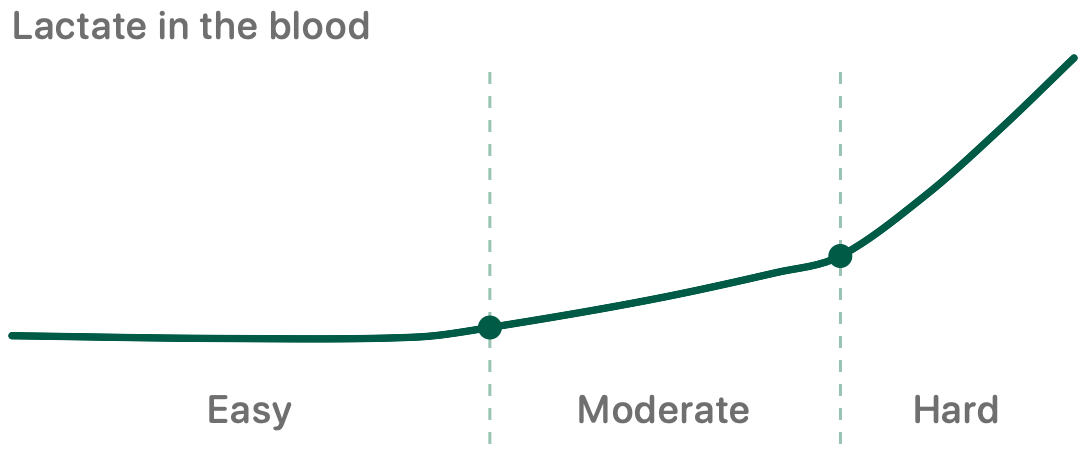
Think of a car's gears. In each one the engine note climbs smoothly, then changes at the shift. Breathing changes too as effort rises, so the first point can also be found from the air you breathe out.4
Labs name these points differently: lactate threshold, ventilatory threshold, critical power. They are close relatives, not twins. Nor is the highest steady blood lactate level a fixed number. In six young rowers it was lower on a rowing machine than on a bike, about 2.7 against 4.5 mmol/L.4,5,6
Can you find the line by talking?
Often, yes. In trained cyclists the stage where talking first felt uncertain matched the first point, and "cannot talk" matched the second.
Researchers had 18 highly trained cyclists ride a test that got harder in steps. On another day they repeated it, reading a standard paragraph aloud after each stage. The stage where talking first felt uncertain matched the first point, at about 150 beats a minute. The stage where they could not talk matched the second, at about 177.2
An earlier set of experiments in healthy young adults pushed the first point around on purpose, by blood donation and by training. The last comfortable talking stage moved with it.1
It takes time. In those experiments, once people were above the first point, talking took on average more than two minutes to fail. You may need to hold a pace for a while before the test tells you anything.1
The test has limits. Its errors lean one way: people sometimes still pass it when they are above the first point. The studies are small, and a review warns that it may not be practical for hard intervals.1,7
Why do the points sit in different places in different people?
Fitter people reach them at a higher share of top heart rate, so one fixed percentage is not the same effort for everyone.
A Spanish team put more than a thousand adults, in their mid-thirties on average, through a treadmill test that got steadily harder. They found where each person's two thresholds fell. On average the first came at about 75 to 83% of top heart rate, the second at about 91 to 96%, depending on sex and fitness. The fittest group sat highest at both.8
Within each group the spread was several points either way, and the test was a treadmill one, so read the percentages as rough guides. This is why one fixed share of top heart rate can leave one person below their first point and another above it. Your top heart rate is also usually a formula's guess, typically off by about 11 beats a minute.8,9,10
Why does my heart rate climb when the pace has not changed?
Over a long, steady effort heart rate creeps up while each beat pumps out less blood.
Seven active men cycled at a steady pace for an hour in a room kept at 27 °C. From minute 15 to minute 55 their heart rate rose 11%, while the blood pumped per beat fell 13%.11
This is cardiovascular drift. It starts after about 10 minutes of steady work. In a second trial the same men took a small dose of a drug that held their heart rate down. The fall in blood per beat did not happen either. So in that room it was tied to the faster beating, not to skin blood flow.11,12,13
So on a long effort, a heart rate that is higher at the end than at the start does not by itself mean you sped up. One review argues that, in heat, the extra heart rate does mean a higher relative effort.13
What do the ranges do for you?
Athletes spend most sessions in the easy range and a few in the hard one. No single range has been proven best.
Researchers tracked every session of eleven young cross-country skiers for a month, all nationally competitive. Three in four of their endurance sessions were easy, fewer than one in five were hard, and the middle was rare. That is one sport and one young group, so it describes a habit and does not show that it works. One review of many studies of competitive athletes describes a similar split, about 80% easy and 20% hard.3,14
A 9-week trial began with 48 well-trained athletes, split by chance into four ways of training. One was polarized training, the pattern the authors link to elite athletes: mostly easy work, some hard work well above the threshold, and little in between. It gained most in peak oxygen uptake, a standard measure of aerobic fitness: about 12%. Threshold training and simply more hours brought no further gains, apart from a slight one in efficiency with threshold training. Only 41 athletes finished, in mixed sports.15
Hard work has its own record. Across 28 controlled trials in healthy adults, interval training raised VO2 max, the most oxygen your body can use, by 1.2 points more than steady endurance training. The authors called that gap possibly small. On average the adults were in their mid-twenties. Both beat doing nothing, by about 5 points.16
Zone 2 is easy exercise below the lactate threshold, and it has become a trend. A 2025 narrative review argues that the evidence does not make it the best intensity for building the muscle's energy-making capacity, as it is often promoted to the public. It notes that the idea grew from observations of elite athletes, and says higher intensities matter for health, especially at lower training volumes.17
What can you do with this?
Talking is a rough guide, weekly minutes are what guidelines count, and heart rate numbers are estimates.
- The talk test. The cyclist study had people read the same paragraph at every stage.2,7
- Weekly minutes. The World Health Organization advises adults to do 150 to 300 minutes of moderate effort a week. The alternative is 75 to 150 minutes of vigorous effort, or an equivalent mix.18
- Easy and hard both. Both easy-heavy and interval programmes have support. No range is proven best.15,16,17
- Heart rate as an estimate. A fixed percentage is rough, and on a long or hot effort the number drifts up.8,13
- Heart condition, or a medicine that slows your heart? Ask your doctor how to set your effort.
A wrist cannot see lactate. It sees heart rate, movement and time, so the two turning points have to be inferred.
Sources
Every number in this article comes from these studies. Checked 12 November 2026.
- Foster C, Porcari JP, Anderson J, et al. (2008). The talk test as a marker of exercise training intensity. Journal of Cardiopulmonary Rehabilitation and Prevention. doi:10.1097/01.hcr.0000311504.41775.78 · PubMed
- Rodríguez-Marroyo JA, Villa JG, García-López J, Foster C (2013). Relationship between the talk test and ventilatory thresholds in well-trained cyclists. Journal of Strength and Conditioning Research. doi:10.1519/jsc.0b013e3182736af3 · PubMed
- Seiler KS, Kjerland GØ (2006). Quantifying training intensity distribution in elite endurance athletes: is there evidence for an "optimal" distribution? Scandinavian Journal of Medicine and Science in Sports. doi:10.1111/j.1600-0838.2004.00418.x · PubMed
- Poole DC, Rossiter HB, Brooks GA, Gladden LB (2021). The anaerobic threshold: 50+ years of controversy. Journal of Physiology. doi:10.1113/jp279963 · PubMed
- Jones AM, Burnley M, Black MI, Poole DC, Vanhatalo A (2019). The maximal metabolic steady state: redefining the 'gold standard'. Physiological Reports. doi:10.14814/phy2.14098 · PubMed
- Beneke R, Leithäuser RM, Hütler M (2001). Dependence of the maximal lactate steady state on the motor pattern of exercise. British Journal of Sports Medicine. doi:10.1136/bjsm.35.3.192 · PubMed
- Reed JL, Pipe AL (2014). The talk test: a useful tool for prescribing and monitoring exercise intensity. Current Opinion in Cardiology. doi:10.1097/hco.0000000000000097 · PubMed
- Benítez-Muñoz JA, Benito PJ, Guisado-Cuadrado I, Cupeiro R, Peinado AB (2025). Differences in the ventilatory thresholds in treadmill according to training status in 971 males and 301 females: a cross-sectional study. European Journal of Applied Physiology. doi:10.1007/s00421-024-05622-z · PubMed
- Mann T, Lamberts RP, Lambert MI (2013). Methods of prescribing relative exercise intensity: physiological and practical considerations. Sports Medicine. doi:10.1007/s40279-013-0045-x · PubMed
- Nes BM, Janszky I, Wisløff U, Støylen A, Karlsen T (2013). Age-predicted maximal heart rate in healthy subjects: the HUNT fitness study. Scandinavian Journal of Medicine and Science in Sports. doi:10.1111/j.1600-0838.2012.01445.x · PubMed
- Fritzsche RG, Switzer TW, Hodgkinson BJ, Coyle EF (1999). Stroke volume decline during prolonged exercise is influenced by the increase in heart rate. Journal of Applied Physiology. doi:10.1152/jappl.1999.86.3.799 · PubMed
- Coyle EF, González-Alonso J (2001). Cardiovascular drift during prolonged exercise: new perspectives. Exercise and Sport Sciences Reviews. doi:10.1097/00003677-200104000-00009 · PubMed
- Wingo JE, Ganio MS, Cureton KJ (2012). Cardiovascular drift during heat stress: implications for exercise prescription. Exercise and Sport Sciences Reviews. doi:10.1097/jes.0b013e31824c43af · PubMed
- Seiler S (2010). What is best practice for training intensity and duration distribution in endurance athletes? International Journal of Sports Physiology and Performance. doi:10.1123/ijspp.5.3.276 · PubMed
- Stöggl T, Sperlich B (2014). Polarized training has greater impact on key endurance variables than threshold, high intensity, or high volume training. Frontiers in Physiology. doi:10.3389/fphys.2014.00033 · PubMed
- Milanović Z, Sporiš G, Weston M (2015). Effectiveness of high-intensity interval training (HIT) and continuous endurance training for VO2max improvements: a systematic review and meta-analysis of controlled trials. Sports Medicine. doi:10.1007/s40279-015-0365-0 · PubMed
- Storoschuk KL, Moran-MacDonald A, Gibala MJ, Gurd BJ (2025). Much ado about zone 2: a narrative review assessing the efficacy of zone 2 training for improving mitochondrial capacity and cardiorespiratory fitness in the general population. Sports Medicine. doi:10.1007/s40279-025-02261-y · PubMed
- Bull FC, Al-Ansari SS, Biddle S, et al. (2020). World Health Organization 2020 guidelines on physical activity and sedentary behaviour. British Journal of Sports Medicine. doi:10.1136/bjsports-2020-102955 · PubMed