
How a watch measures you
A watch reads a few raw signals from your wrist: light bounced off your skin, your arm's movement and, on some models, an ECG. Pulse and steps come close to a lab in the right conditions, and numbers built on top of them are looser.
What does a watch actually measure?
Light bounced back from your skin, and the movement of your arm. Some watches add a one-lead ECG.
In 1937 a researcher named Hertzman, at St. Louis University, set a light against the fingers and toes of people. A photocell beside it caught the light that came back, and that light tracked the blood volume in the skin. It was the first description of the method a watch uses.1
A watch does the same from the back of your wrist. The method is called photoplethysmography, an optical way to track changes in blood volume under the skin. As the blood volume under the skin changes with each beat, so does the light that returns.1,2
Watches read the pulse with light shone from the back, and one small test compared colours. Eleven volunteers jumped and swung their arms while wearing sensors at several body sites, and pulse rates from green light matched an ECG better than rates from infrared light. The authors judged that green light may be useful for pulse monitoring.3
A second sensor feels how your arm moves. Some watches add electrodes that record a one-lead ECG, a trace of the heart's electrical activity. These are the raw signals. Many numbers on the screen are built from them.
When does the light read your pulse well?
At rest and in steady, rhythmic movement. There wrist watches usually land close to an ECG, though models differ.
A 2025 review pooled 56 studies that compared the Apple Watch with reference measures, for pulse, steps and calories. For pulse, the reading was off by a fraction of a beat on average. The range where most gaps fell was about 11 beats either side.4
At Stanford, 60 volunteers wore several wrist devices while sitting, walking, running and cycling, with a heart monitor as the reference. The study came out in 2017, so these are older models. While cycling, six of the seven had a typical error under 5%, and walking was the hardest activity.5
Does skin tone matter? A Duke team tested 53 people across the full range of skin tones, wearing six wearables against an ECG chest monitor. The gap between skin tones was too small to tell from chance. Error during activity ran about 30% higher than at rest.2
The picture is not settled. The Stanford test reported more error with darker skin, and also with a higher body mass index and in men. The Duke group was small, so a modest gap could hide in it, and a published reply argued that darker tones were under-represented.2,5
In your week, that makes a resting reading, or a steady jog or ride, the easy case. Apple's own guidance says rhythmic movement such as running or cycling gives better results than irregular movement.2,6
When does it lose your pulse?
When effort changes fast, your arm moves unevenly, or too little blood reaches the skin. Then it lags, jumps or gives nothing.
A Calgary team compared one optical watch with an ECG through a session of cycling, weights and treadmill intervals. On cycling intervals the watch stayed within 5 beats of the ECG 92% of the time. In weight circuits it did so only about a third of the time.6
The watch lagged when effort changed. It tended to read too low as the heart rate rose and too high as it fell. Only one watch, an older model, was tested, on 36 people, and it was accurate in steady cycling, walking and running.6
A Cleveland Clinic team had 50 adults wear a chest strap, a forearm band and wrist watches on a treadmill, a bike and an elliptical trainer. Over all the exercise, the chest strap agreed with the ECG almost perfectly, then the Apple Watch, and the Fitbit Blaze least. On the elliptical with arm levers, no optical monitor was accurate.7
Apple's support pages add the physical limits. The ink, pattern and saturation of some tattoos can block the light, and in the cold too little blood may reach your wrist skin for a reading. Apple also says that even in ideal conditions a watch may not get a reliable reading every time for everybody.
So a strange number on a cold run, or in a weights session, can be the sensor losing its view. It does not have to mean your heart changed.6
Why can a watch miss steps when your arm is still?
A wrist infers steps from arm movement. Hold a stroller and it can miss many; fold laundry and it can count steps nobody took.
A Taiwanese team had 30 young adults wear older wristband monitors while they walked or jogged on a treadmill and did everyday tasks. On the treadmill the step counts were off by under 10%. Pushing a stroller, every monitor undercounted by more than 33%. Folding laundry, they still registered a substantial number of steps.8
Elsewhere the picture is kinder. In the same Apple Watch review, step counts were generally accurate, though some groups of results were off by more than 10%.4
So time spent pushing a stroller can leave your step count lower than your legs would say. Time spent folding laundry can add steps you never took.8
How do you tell what is measured from what is worked out?
Ask whether the number comes straight from a signal or is built from several. Built numbers, such as calories, ran looser.
Pulse and steps stay close to the signals. Calories, sleep stages and scores take those signals as ingredients and add a calculation. Each added step is a place for error to creep in.4,5
The Apple Watch review shows the gap: calorie results were off by more than 10% in every group, and heart-rate results in none.4
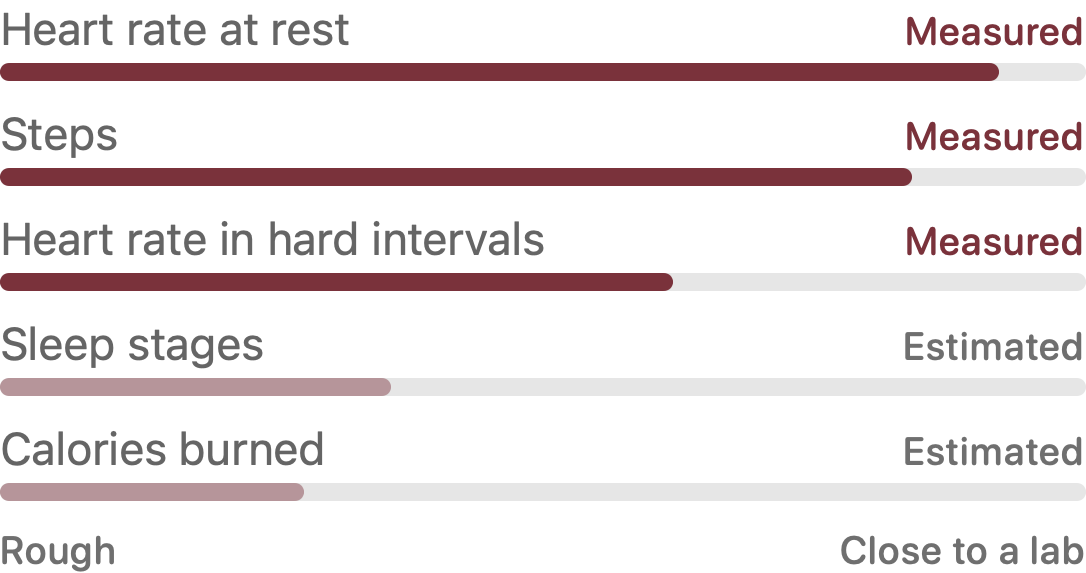
Sleep tracking is built from signals too. A review of sleep trackers describes devices that combine several sensors and rely on proprietary algorithms, calculations the maker keeps to itself. Calories and sleep stages each have an article of their own here.9
What can you do with this?
Lean on the calm readings, and treat anything built from them as a rough guide.
- Calm readings. Resting pulse and steady effort are where studies find wrist watches closest.2,4
- Like with like. Set rest against rest and a steady run against a steady run. Weight circuits and sudden changes of effort are where the one tested watch lagged and wandered.6
- A chest strap for exactness. The Cleveland Clinic authors advise chest monitors with electrodes when an exact heart rate is imperative.7
- A snug band. Apple asks for a band that is snug, neither tight nor loose.
- Built numbers. Calories and sleep stages are estimates, so each one is a guide.4,9
- A worry about your heart. Ask a doctor. Apple says its ECG app cannot detect a heart attack.
When a number looks wrong, your pulse is still there under the watch. What failed can be the light's view of it.
Sources
Every number in this article comes from these studies. Checked 12 November 2026.
- Hertzman AB (1937). Photoelectric plethysmography of the fingers and toes in man. Proceedings of the Society for Experimental Biology and Medicine. doi:10.3181/00379727-37-9630
- Bent B, Goldstein BA, Kibbe WA, Dunn JP (2020). Investigating sources of inaccuracy in wearable optical heart rate sensors. NPJ Digital Medicine. doi:10.1038/s41746-020-0226-6 · PubMed
- Maeda Y, Sekine M, Tamura T (2011). Relationship between measurement site and motion artifacts in wearable reflected photoplethysmography. Journal of Medical Systems. doi:10.1007/s10916-010-9505-0 · PubMed
- Choe JP, Kang M (2025). Apple watch accuracy in monitoring health metrics: a systematic review and meta-analysis. Physiological Measurement. doi:10.1088/1361-6579/adca82 · PubMed
- Shcherbina A, Mattsson CM, Waggott D, et al. (2017). Accuracy in wrist-worn, sensor-based measurements of heart rate and energy expenditure in a diverse cohort. Journal of Personalized Medicine. doi:10.3390/jpm7020003 · PubMed
- Horton JF, Stergiou P, Fung TS, Katz L (2017). Comparison of Polar M600 optical heart rate and ECG heart rate during exercise. Medicine and Science in Sports and Exercise. doi:10.1249/mss.0000000000001388 · PubMed
- Gillinov S, Etiwy M, Wang R, et al. (2017). Variable accuracy of wearable heart rate monitors during aerobic exercise. Medicine and Science in Sports and Exercise. doi:10.1249/MSS.0000000000001284 · PubMed
- Chen MD, Kuo CC, Pellegrini CA, Hsu MJ (2016). Accuracy of Wristband Activity Monitors during Ambulation and Activities. Medicine and Science in Sports and Exercise. doi:10.1249/MSS.0000000000000984 · PubMed
- de Zambotti M, Cellini N, Goldstone A, Colrain IM, Baker FC (2019). Wearable sleep technology in clinical and research settings. Medicine and Science in Sports and Exercise. doi:10.1249/MSS.0000000000001947 · PubMed