
Wrist temperature
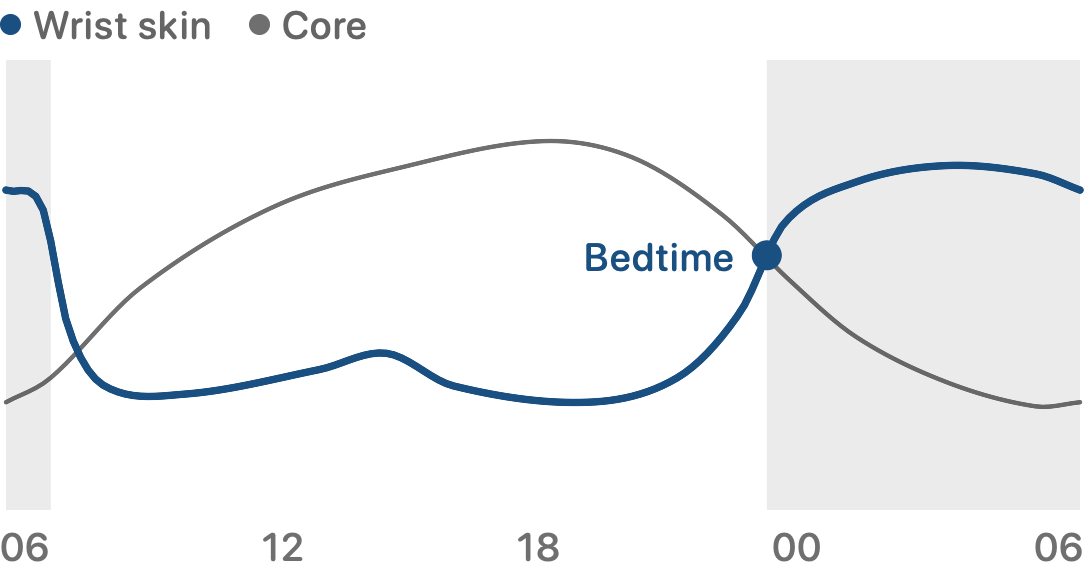
At night the skin of your wrist warms while your core cools, because skin is where the body lets heat out. A watch reports how tonight compares with your own usual nights, not a temperature.
What is wrist temperature?
The temperature of the skin at your wrist, which is not the heat deep inside you. At night wrist and core run opposite.
A sensor on the back of a watch cannot see inside you. It reads the skin at your wrist. That is a different thing from your core temperature, the heat deep in your body.1,2
In 99 university students, a small logger on a wristband recorded wrist skin temperature during normal life. It ran opposite to their mouth temperature, about 60 minutes ahead of it. It began to rise around bedtime and dropped sharply after waking. The mouth stood in for the core here, so this is a rough comparison.2
Why does the wrist warm as the core cools?
Skin is where the body lets heat out. At night the blood vessels in your hands and feet open, and the core falls.
A car engine is cooled by hot liquid pumped through a radiator, and the radiator is warm because it passes the engine's heat on. Your body does something similar at night. The skin of your hands and feet opens its blood vessels and gives off heat, and your core falls. One review says sleep usually begins when the core is cooling fastest, and that losing heat this way promotes sleepiness.1
In a 2007 paper, adults fell asleep faster with bed socks put on after lights-off, and the more their feet warmed, the sooner sleep came. In older people the warming was weaker, and in older people with insomnia none of the foot-warming methods sped up sleep.3
Which causes which is still argued: cooling may bring on sleep, or sleep may bring on cooling. One review adds a twist, that warmth may itself trigger the blood-vessel opening that cools the body. Most of this work is small and done in laboratories.1,3,4
What is a normal temperature?
There is no single number. It depends on where you measure, how old you are and who you are.
In 1992 a team in Baltimore took the mouth temperature of 148 healthy young adults. The average was 36.8 degrees Celsius, not the 37.0 made famous by the 19th-century physician Carl Wunderlich. The team argued that this old figure should be dropped as a reference point for clinical thermometers.5
Where you measure and how old you are matter most. A review of 36 studies in healthy adults found the usual range sat about a degree lower under the arm than in the rectum. Adults 60 and older ran about a quarter of a degree cooler on average.6
Your own normal is personal. In 35,488 clinic patients with no infection, age, sex and every other measured factor together explained only about 8% of the differences between people. In a second large clinic study, the average mouth temperature never reached 37 in any group.7,8
Inside one day, mouth temperature in healthy young adults also swings by about half a degree. These are mouth and clinic numbers, not wrist numbers, but they show why a single reading is hard to interpret.5
What does a watch report?
Not a temperature. It reports how tonight's skin reading differs from your own usual, and one maker says it is not a thermometer.
In one maker's design, a sensor on the watch's back, close to your skin, takes a reading every five seconds while you sleep. What you see is not a temperature but a change from your baseline, the usual level the watch works out over about five nights. The maker adds that the feature is not a thermometer.
Wrist skin is not the core, and even clinic thermometers miss it. Pooling 75 studies of 8,682 patients, a review found that thermometers at the ear, forehead, armpit and mouth were not accurate enough for decisions that depend on core temperature. The errors were larger still in people with a fever or a very low temperature. None of those studies used a wristwatch on a sleeper, and the maker's help page gives no accuracy figure.9
What moves it from night to night?
The menstrual cycle shows up clearly. Pregnancy, alcohol, illness, your sleeping environment and a loose strap can move it too.
One maker lists diet, exercise, alcohol, the sleeping environment, the menstrual cycle, illness and a loose fit as things that can change a night's reading. Any of them could be part of your week.
The menstrual cycle gives a regular signal. In 57 women who wore a bracelet at the wrist during sleep, wrist skin temperature rose by about 0.5 degrees after ovulation, against 0.2 for mouth temperature taken on waking. It fell back at the period. Some of the authors work or worked for the bracelet's maker.10
Pregnancy shows up too. In a large study of pregnancies, women wore a ring on the finger, not the wrist. Skin temperature peaked about 0.3 degrees above baseline by week 9, then declined steadily toward birth. Most of the authors work or worked for the ring's maker.11
Alcohol can flush the skin while the core falls. In eight men in a warm room, a dose of alcohol raised skin blood flow within 10 minutes. Deep body temperature eventually fell 0.3 degrees lower than after water. The study did not measure the wrist or a night's sleep.12
Can a wrist sensor tell you about ovulation or a fever?
Ovulation only after it has happened, and a fever only on average, with misses both ways.
The temperature rise follows ovulation, so a wrist sensor can only pick it out afterwards, and one maker calls its estimates retrospective. In a 2026 study of 225 cycles, ovulation was confirmed by a blood test. A Galaxy Watch 5's wrist sensor put the date within 3 days of the true one in 78% of them.10,13
Within 2 days it did so in 64%, but the authors say that result could be chance. Three days is a wide window for anyone timing a conception, and the authors report equipment and research support.13
Illness can show on a skin sensor, but only on average. In the first 50 people with self-reported COVID-19 who wore a ring on the finger, skin temperature was about 0.6 degrees higher around the symptoms.14
The study was small, and fever was self-reported. By its own rule for a fever-like day, some people who reported a fever had none, and 7 of the 12 who reported none had one.14
What can you do with this?
Read it as a pattern over weeks. Nothing here supports using it as a fever or birth-control test.
- Patterns, not nights. A single night is a weak signal. Whether a long run of nights above your own line means anything has not been tested in the studies above, so take it as a sensible guess.
- Warmth before bed. A review of 17 studies linked a warm shower or bath with better self-rated sleep, and with falling asleep sooner when taken 1 to 2 hours before bed. The authors say the evidence is limited, especially on the best timing.15
- Not a fever check. A wrist reading cannot settle whether you have a fever, and the maker says the feature is not for diagnosis or treatment. If you are ill or pregnant and worried, ask a doctor.9
- Cycle estimates. One maker's page says ovulation estimates need about two cycles of data, can miss an ovulation that came without a step up, and should not be used as birth control.
Sources
Every number in this article comes from these studies. Checked 12 November 2026.
- Kraeuchi K (2007). The thermophysiological cascade leading to sleep initiation in relation to phase of entrainment. Sleep Medicine Reviews. doi:10.1016/j.smrv.2007.07.001 · PubMed
- Sarabia JA, Rol MA, Mendiola P, Madrid JA (2008). Circadian rhythm of wrist temperature in normal-living subjects: a candidate of new index of the circadian system. Physiology & Behavior. doi:10.1016/j.physbeh.2008.08.005 · PubMed
- Raymann RJ, Swaab DF, Van Someren EJ (2007). Skin temperature and sleep-onset latency: changes with age and insomnia. Physiology & Behavior. doi:10.1016/j.physbeh.2006.09.008 · PubMed
- Harding EC, Franks NP, Wisden W (2019). The temperature dependence of sleep. Frontiers in Neuroscience. doi:10.3389/fnins.2019.00336 · PubMed
- Mackowiak PA, Wasserman SS, Levine MM (1992). A critical appraisal of 98.6 degrees F, the upper limit of the normal body temperature, and other legacies of Carl Reinhold August Wunderlich. JAMA. PubMed
- Geneva II, Cuzzo B, Fazili T, Javaid W (2019). Normal body temperature: a systematic review. Open Forum Infectious Diseases. doi:10.1093/ofid/ofz032 · PubMed
- Obermeyer Z, Samra JK, Mullainathan S (2017). Individual differences in normal body temperature: longitudinal big data analysis of patient records. BMJ. doi:10.1136/bmj.j5468 · PubMed
- Ley C, Heath F, Hastie T, Gao Z, Protsiv M, Parsonnet J (2023). Defining usual oral temperature ranges in outpatients using an unsupervised learning algorithm. JAMA Internal Medicine. doi:10.1001/jamainternmed.2023.4291 · PubMed
- Niven DJ, Gaudet JE, Laupland KB, Mrklas KJ, Roberts DJ, Stelfox HT (2015). Accuracy of peripheral thermometers for estimating temperature: a systematic review and meta-analysis. Annals of Internal Medicine. doi:10.7326/M15-1150 · PubMed
- Zhu TY, Rothenbuhler M, Hamvas G, et al. (2021). The accuracy of wrist skin temperature in detecting ovulation compared to basal body temperature: prospective comparative diagnostic accuracy study. Journal of Medical Internet Research. doi:10.2196/20710 · PubMed
- Adaimi R, Thigpen N, Clausel A, Gotlieb N, Patel K, de Zambotti M (2025). Temporal trajectories in sleep, temperature trends, cardiorespiratory, and activity metrics measured via Oura Ring during pregnancy: large-scale observational analysis. JMIR mHealth and uHealth. doi:10.2196/80213 · PubMed
- Yoda T, Crawshaw LI, Nakamura M, et al. (2005). Effects of alcohol on thermoregulation during mild heat exposure in humans. Alcohol. doi:10.1016/j.alcohol.2005.09.002 · PubMed
- Kim SE, Kim Y, Park B (2026). Evaluation of the accuracy of wrist skin temperature measured using an infrared sensor for prediction ovulation date. Biosensors and Bioelectronics. doi:10.1016/j.bios.2026.118755 · PubMed
- Smarr BL, Aschbacher K, Fisher SM, et al. (2020). Feasibility of continuous fever monitoring using wearable devices. Scientific Reports. doi:10.1038/s41598-020-78355-6 · PubMed
- Haghayegh S, Khoshnevis S, Smolensky MH, Diller KR, Castriotta RJ (2019). Before-bedtime passive body heating by warm shower or bath to improve sleep: a systematic review and meta-analysis. Sleep Medicine Reviews. doi:10.1016/j.smrv.2019.04.008 · PubMed