
Breathing rate
Your brain steers your breathing mainly by carbon dioxide, not oxygen. Outside dreaming sleep, healthy adults average about 15 breaths a minute, and one night's count is too noisy to read alone.
What is your breathing doing all night?
About 15 breaths a minute outside dreaming sleep. The rhythm is steadiest in deep sleep and more ragged in dreaming sleep.
Researchers at one wearable maker worked out the sleeping breathing of 10,000 adults from the timing of their heartbeats. Nine in ten of the readings for healthy adults fell between about 12 and 19 breaths a minute, and the average was 15.1
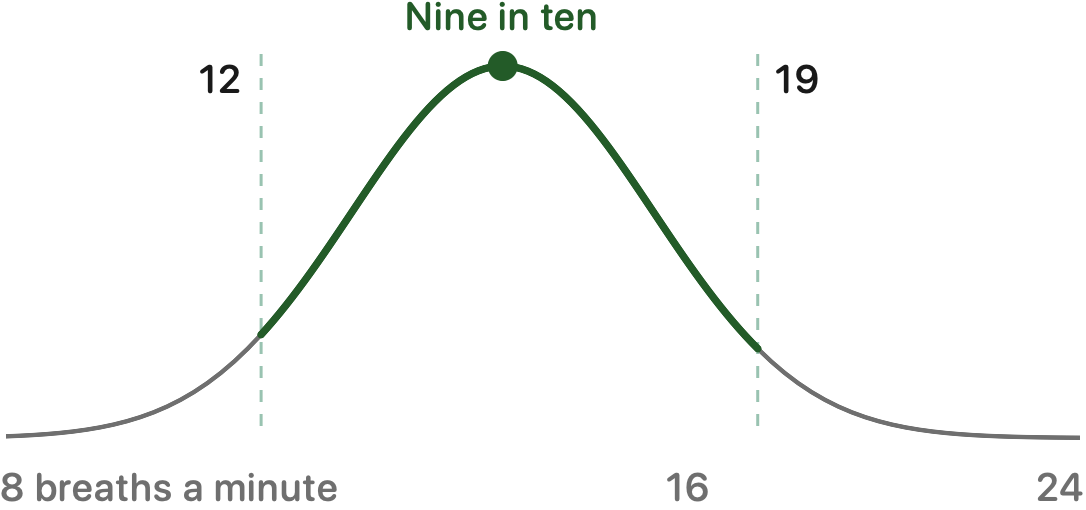
These were all users of one brand who wore it to sleep, and the rate was estimated from heartbeat timing, not counted from the air.1
You may have read that a normal resting count is 12 to 20. That band sits between cut-offs of a hospital warning score, the UK's National Early Warning Score. Hospital charts use those cut-offs to flag sick patients, and we found no source that measured the band across healthy people.2
Sleep changes the picture. In a lab study of 19 healthy adults, the air they moved each minute fell by about a sixth in dreaming sleep, compared with waking. Other lab studies found the rhythm steadiest from breath to breath in deep sleep and more variable in dreaming sleep than in non-dreaming sleep. They disagree on whether the count itself is lower asleep than awake.3,4,5
The team left dreaming sleep out of that range, and noted that some other studies had found a higher rate in it. A night with more dreaming sleep may therefore average a little higher. How sleep works covers the stages.1
What sets the pace?
Mainly carbon dioxide, not oxygen. Sensors in your brain and body read it and tune your breathing to keep it steady.
At rest, your body runs breathing like a thermostat. A thermostat does not read the fuel in the boiler. It reads the temperature of the room. Sensors in your brain and elsewhere in your body read the carbon dioxide and acidity of your blood, and fast reflexes called chemoreflexes adjust your breathing to hold both steady.6
The idea is old. In 1905 the physiologist J. S. Haldane and a colleague measured carbon dioxide in the air deep in people's lungs under many conditions. It showed carbon dioxide to have a critical role in controlling breathing.7
Oxygen has a part too, but the reviews cited here put carbon dioxide first: at rest, the reflexes hold carbon dioxide and acidity steady. That is the picture for ordinary breathing. Lung disease and altitude are different cases.6,7
So the count on your wrist reflects the carbon dioxide thermostat at work, not how much oxygen you take in. Oxygen has its own number, covered in Blood oxygen.6
What moves it?
Illness, effort and the menstrual cycle can all nudge it. Your own nights stay close to each other.
Your own nights stay close together. In adults in their early twenties, nine in ten had a night-to-night spread of about 2 to 9% of their own average. In people in their late sixties the top of that range reached about 22% in men.1
Set against a 15-breath average, a typical spread of 5% is under one breath a minute.1
In people later diagnosed with COVID-19, a typical count around the first symptoms was higher than about three in four of their own healthy nights.1
Yet a clear jump was the exception. Take the week around the first symptoms or a positive test. Only about a third of people with symptoms, and about a quarter of those without, had even one night 3 or more breaths a minute above their usual. Most did not. It was one infection, tracked by one family of watches.1
In 7,279 naturally cycling women who logged their cycles and wore a watch, nightly breathing varied by about 0.6 breaths a minute between phases. It was highest just before a period and lowest near ovulation. Cycle timing was self-reported, so the phases are assumed. The effect is smaller than an ordinary night-to-night spread, and the Wrist temperature article tells the same cycle's story in temperature.1,8
Hard effort moves it too. A perspective article and a review argue that breathing rate tracks how hard an effort feels. The review adds that it is more sensitive to stressors such as heat, cold, mental load and effort than most other vital signs. Neither is a trial.9,10
What does it mean for your health?
In hospital a fast rate warns of trouble. For healthy people, no study we found links a watch's nightly count to later illness.
In a Midwestern hospital, researchers looked back at 59 patients who had a cardiopulmonary arrest and 91 matched patients who did not. Just over half of those who had an arrest had at least one count above 27 breaths a minute in the days before. Among the others, about one in six did. Their pulse and blood pressure did not predict an arrest.11
That put the odds of an arrest more than five times higher. It is a ratio of odds, not a count of patients, and it comes from one centre's records looked at afterwards.11
A 2008 review called respiratory rate the neglected vital sign: there is substantial evidence that an abnormal rate predicts serious events, yet hospitals often do not record it.12
All of this is about hospital patients. We found no study linking a healthy person's overnight count from a watch to later disease, so your own number is a pattern to know, not a verdict. Breathing pauses at night are a different matter, in Blood oxygen.
How well can a watch count your breaths?
Within about a breath on a night's average, in studies. Counting by hand is shakier.
A watch or ring does not count air. Some work the rate out from the timing of your heartbeats, which each breath nudges, as the heart rate variability article explains. Another uses motion and pulse-light sensors. A review of such methods notes that breathing is still widely measured by counting by hand.1,13,14
Counting by hand is shakier than it sounds. A review of 49 studies found five sources of error, among them that knowing you are watched lowers the real rate and short counts miss breaths. In recordings of acutely ill patients, repeat counts of one person often differed by more than 3 breaths a minute.2,15
In 28 people, one maker's method was off by about half a breath a minute on average, against a tube under the nose. Another watch, tested on sleep-clinic patients, was off by about one breath on a night's average, and was less accurate in severe sleep apnea.1,14
Staff of both device makers helped write those studies. A pooled review of 84 studies of wearable and contactless devices in clinical settings rated the evidence low quality: small, and often not blinded.1,14,16
What can you do with this?
Judge a night against your own usual, and wait for a run of nights. One night a little off sits inside the noise.
- Know your own range. Your sleeping rate swings within a few per cent, more as you age. Judge a night against your own weeks, not against 12 to 20.1,2
- Wait for a run. A night a little off your usual sits inside the noise of cycle, dreaming sleep and watch error. Several nights above your range, with a higher resting heart rate, is a stronger hint. That is reasoning from these numbers; no study has tested it as a rule.1,8,14
- Do not count your own. A watched breath is a changed breath, and short counts miss breaths. The best count is one you never noticed.15
- Breathless or unwell? Ask a doctor. A watch's nightly number is not a test for that.
Sources
Every number in this article comes from these studies. Checked 12 November 2026.
- Natarajan A, Su HW, Heneghan C, Blunt L, O'Connor C, Niehaus L (2021). Measurement of respiratory rate using wearable devices and applications to COVID-19 detection. NPJ Digital Medicine. doi:10.1038/s41746-021-00493-6 · PubMed
- Drummond GB, Fischer D, Arvind DK (2020). Current clinical methods of measurement of respiratory rate give imprecise values. ERJ Open Research. doi:10.1183/23120541.00023-2020 · PubMed
- Douglas NJ, White DP, Pickett CK, Weil JV, Zwillich CW (1982). Respiration during sleep in normal man. Thorax. doi:10.1136/thx.37.11.840 · PubMed
- Gutierrez G, Williams J, Alrehaili GA, et al. (2016). Respiratory rate variability in sleeping adults without obstructive sleep apnea. Physiological Reports. doi:10.14814/phy2.12949 · PubMed
- Rostig S, Kantelhardt JW, Penzel T, et al. (2005). Nonrandom variability of respiration during sleep in healthy humans. Sleep. doi:10.1093/sleep/28.4.411 · PubMed
- Guyenet PG, Bayliss DA (2015). Neural control of breathing and CO2 homeostasis. Neuron. doi:10.1016/j.neuron.2015.08.001 · PubMed
- West JB (2008). J.S. Haldane and some of his contributions to physiology. Advances in Experimental Medicine and Biology. doi:10.1007/978-0-387-73693-8_2 · PubMed
- Heneghan C, Lafon B, Schneider L, Young-Lin N (2026). Assessing the impact of menstrual cycle phase on respiration rate, resting heart rate, heart rate variability, nocturnal oxygenation and sleep time using wearable devices. Women's Health. doi:10.1177/17455057261503611 · PubMed
- Nicolo A, Massaroni C, Passfield L (2017). Respiratory frequency during exercise: the neglected physiological measure. Frontiers in Physiology. doi:10.3389/fphys.2017.00922 · PubMed
- Nicolo A, Massaroni C, Schena E, Sacchetti M (2020). The importance of respiratory rate monitoring: from healthcare to sport and exercise. Sensors. doi:10.3390/s20216396 · PubMed
- Fieselmann JF, Hendryx MS, Helms CM, Wakefield DS (1993). Respiratory rate predicts cardiopulmonary arrest for internal medicine inpatients. Journal of General Internal Medicine. doi:10.1007/BF02600071 · PubMed
- Cretikos MA, Bellomo R, Hillman K, Chen J, Finfer S, Flabouris A (2008). Respiratory rate: the neglected vital sign. Medical Journal of Australia. doi:10.5694/j.1326-5377.2008.tb01825.x · PubMed
- Charlton PH, Birrenkott DA, Bonnici T, et al. (2018). Breathing rate estimation from the electrocardiogram and photoplethysmogram: a review. IEEE Reviews in Biomedical Engineering. doi:10.1109/RBME.2017.2763681 · PubMed
- Jung H, Kim D, Choi J, Joo EY (2023). Validating a consumer smartwatch for nocturnal respiratory rate measurements in sleep monitoring. Sensors. doi:10.3390/s23187976 · PubMed
- Kallioinen N, Hill A, Christofidis MJ, Horswill MS, Watson MO (2021). Quantitative systematic review: sources of inaccuracy in manually measured adult respiratory rate data. Journal of Advanced Nursing. doi:10.1111/jan.14584 · PubMed
- Chan PY, Ryan NP, Chen D, McNeil J, Hopper I (2022). Novel wearable and contactless heart rate, respiratory rate, and oxygen saturation monitoring devices: a systematic review and meta-analysis. Anaesthesia. doi:10.1111/anae.15834 · PubMed