
Your body clock
Your body keeps its own time, a little over 24 hours a day, even with no daylight. Light resets it each day, and it shapes when you feel awake, sleepy, warm and cool.
What is your body clock?
A clock in your brain that keeps time without daylight and tells your body when to be alert, sleepy, warm and cool.
In the summer of 1962 a French cave explorer, Michel Siffre, went down into the Scarasson cavern in the Alps for two months, with no clock and no daylight. He slept at later and later hours, and by the end he had lost about two weeks of time. One man is a demonstration, not a measurement, but it showed a body keeping its own rhythm with no sun to guide it.1
Scientists call this inner rhythm circadian, meaning about a day long. It times when you feel alert and sleepy, when your temperature rises and falls, and when your hormones are released. Daylight does not drive it. Light sets it each day.1,2
Where does the clock sit?
In a small cluster of brain cells that takes its cue from your eyes. In mice, other organs keep their own time too.
The main clock is a cluster of about 20,000 nerve cells deep in the brain, called the suprachiasmatic nucleus. That count is for mammals, and the study behind it used mouse brain tissue, so it is not a count in people. The cluster has no view of the sky. In mammals it relies on the eyes to report what the sky is doing.3,4
The eyes do this with cells that are not used for seeing. A 2000 study found a light-sensing pigment, melanopsin, in the inner eye, not in the cells that form images. In 2002, experiments in rats showed that retinal cells reaching the clock respond to light on their own, even with input from the rods and cones blocked. They may be the clock's main light sensors.4,5
The brain's clock is not the only one. In 12 mouse organs, 43% of the genes that make proteins rose and fell on a daily rhythm somewhere in the body, mostly organ by organ. That was in mice, so it shows that organs can keep time, not how many of your own genes do.6
What does the clock run?
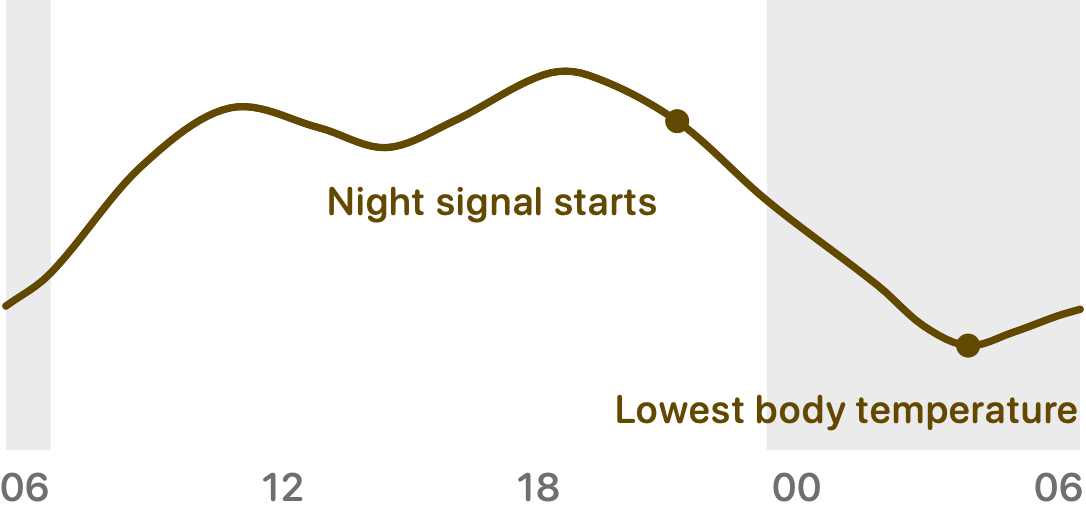
Your body temperature, your night hormone and even your muscle power rise and fall with it.
Body temperature follows the clock. Its low point comes late in the night, not at the start of it: about 3 to 4.5 hours before you wake, if you sleep eight hours. After that it climbs toward the day.7,8
Melatonin, the hormone that works as your night signal, begins to rise in the evening. In 170 healthy adults it began, on average, between two and three hours before the bedtime the study set. The spread was wide: for one person it began about 6 hours before, for another a little after.9
If you train, time of day shows up in your muscles too. A review of sports performance found that muscle strength and power tend to peak in the early evening, near the daily high in body temperature. Some other measures peak in the morning.10
How does light set the clock?
Light after your body's temperature low pulls the clock earlier, and light before it pushes it later.
Left alone, the human clock does not run to exactly 24 hours. In a lab study, young and older adults lived in carefully controlled light. Both groups averaged 24.18 hours, about 11 minutes over a day. After a week, that leaves the clock more than an hour out.2
Light is the daily correction, and when it arrives matters. In a lab study of 21 healthy people, each got 6.7 hours of very bright light at a different point on their clock. Light before the body's temperature low pushed the clock later. Light after it pulled the clock earlier. From the biggest push to the biggest pull, the shifts in the clock's timing spanned about 5 hours.11
The temperature low falls a few hours before you wake, so in daily life the rule is plain. Bright light in the evening and early night tends to move your clock later. Bright light after you wake tends to move it earlier.7,11
Why are some people larks and others owls?
Clocks sit earlier in some people and later in others: typical early and late types differed by about two hours in one study.
An early hint that clocks differ came from two men. In 1938 the researcher Nathaniel Kleitman and a student, Bruce Richardson, lived 32 days in Mammoth Cave, Kentucky, on a day 28 hours long. At the end, Kleitman's temperature rhythm had stayed essentially the same, while Richardson's had moved toward the new schedule. Two men prove little.1
The same spread shows in ordinary life. In 172 young adults, core body temperature was recorded day and night for days on end. Its daily low came near 4 in the morning in early types and near 6 in late types.8
If you are a late type, going to bed at the usual hour means sleeping on an earlier part of your temperature cycle than an early type does. The authors suggest that may be why late types feel more alert at bedtime and sleepier after waking.8
Larks and owls also perform best at different hours. In athletes, the hours since waking predicted peak performance better than the time on the wall clock, and performance varied by as much as 26% over a day.12
What happens when your clock and the day disagree?
The clock shifts only an hour or two a day, so flights, night shifts and clock changes leave it out of step.
A flight across time zones moves the day faster than the clock can follow. Early estimates from real travellers are that the clock shifts about 92 minutes a day after flying west and about 57 after flying east. East is harder because most people already drift a little later each day.7
Night shift work keeps the day and the clock apart for as long as the shifts last. In 2019 the cancer agency IARC rated it as probably carcinogenic to humans, its Group 2A. The evidence in people was limited, and the rating reflects how strong the evidence is, not how big the risk is.13
The clock change in spring is like a small jet lag for a whole region. A Michigan registry of heart attacks treated by opening a blocked artery counted 24% more on the Monday after the clocks went forward. On the Tuesday after they went back in autumn, it counted 21% fewer. The weekly totals did not change, so the shift probably moved when heart attacks happened, not how many. These were hospital records from one state.14
What can you do with this?
Know that light has a time of day, and that your clock only moves a little each day.
- Mind when the light comes. The effect of light depends on its timing, as above. Studies of evening lamps, bright days and a week of camping test it in real life, and they have their own articles.11
- Travelling. A review of jet lag describes lab work in which bright light at the right time let the clock shift faster after an abrupt change of sleep schedule. Another review bases its travel advice on which way you fly and how many time zones you cross.7,15
What your watch shows is the pattern of your sleep: when you fall asleep and wake. Steady times fit a clock and a day that agree, but they are not a measurement of the clock itself.
Sources
Every number in this article comes from these studies. Checked 12 November 2026.
- Hussey KD (2023). Timeless spaces: field experiments in the physiological study of circadian rhythms, 1938-1963. History and Philosophy of the Life Sciences. doi:10.1007/s40656-023-00571-w · PubMed
- Czeisler CA, Duffy JF, Shanahan TL, et al. (1999). Stability, precision, and near-24-hour period of the human circadian pacemaker. Science. doi:10.1126/science.284.5423.2177 · PubMed
- Zhang Z, Wang Z, Yu J, et al. (2026). Interpretable machine learning reveals hemispheric asymmetry of state switching in the suprachiasmatic nucleus. Patterns. doi:10.1016/j.patter.2026.101617 · PubMed
- Berson DM, Dunn FA, Takao M (2002). Phototransduction by retinal ganglion cells that set the circadian clock. Science. doi:10.1126/science.1067262 · PubMed
- Provencio I, Rodriguez IR, Jiang G, Hayes WP, Moreira EF, Rollag MD (2000). A novel human opsin in the inner retina. Journal of Neuroscience. doi:10.1523/jneurosci.20-02-00600.2000 · PubMed
- Zhang R, Lahens NF, Ballance HI, Hughes ME, Hogenesch JB (2014). A circadian gene expression atlas in mammals: implications for biology and medicine. Proceedings of the National Academy of Sciences. doi:10.1073/pnas.1408886111 · PubMed
- Eastman CI, Burgess HJ (2009). How to travel the world without jet lag. Sleep Medicine Clinics. doi:10.1016/j.jsmc.2009.02.006 · PubMed
- Baehr EK, Revelle W, Eastman CI (2000). Individual differences in the phase and amplitude of the human circadian temperature rhythm: with an emphasis on morningness-eveningness. Journal of Sleep Research. doi:10.1046/j.1365-2869.2000.00196.x · PubMed
- Burgess HJ, Fogg LF (2008). Individual differences in the amount and timing of salivary melatonin secretion. PLoS One. doi:10.1371/journal.pone.0003055 · PubMed
- Atkinson G, Reilly T (1996). Circadian variation in sports performance. Sports Medicine. doi:10.2165/00007256-199621040-00005 · PubMed
- Khalsa SB, Jewett ME, Cajochen C, Czeisler CA (2003). A phase response curve to single bright light pulses in human subjects. Journal of Physiology. doi:10.1113/jphysiol.2003.040477 · PubMed
- Facer-Childs E, Brandstaetter R (2015). The impact of circadian phenotype and time since awakening on diurnal performance in athletes. Current Biology. doi:10.1016/j.cub.2014.12.036 · PubMed
- IARC Monographs Vol 124 Group (2019). Carcinogenicity of night shift work. The Lancet Oncology. doi:10.1016/s1470-2045(19)30455-3 · PubMed
- Sandhu A, Seth M, Gurm HS (2014). Daylight savings time and myocardial infarction. Open Heart. doi:10.1136/openhrt-2013-000019 · PubMed
- Waterhouse J, Reilly T, Atkinson G, Edwards B (2007). Jet lag: trends and coping strategies. The Lancet. doi:10.1016/s0140-6736(07)60529-7 · PubMed