
VO2 max
VO2 max is the most oxygen your body can use in a minute of all-out effort, a measure of how well your heart, lungs and muscles work together. Doctors care because in large studies, the fitter people were, the lower their risk of dying, by a margin that rivals smoking.
What is VO2 max?
The most oxygen your body can use in a minute of all-out effort. It is the ceiling of your aerobic fitness.
In the early 1920s the physiologist A.V. Hill ran round an 85-metre grass track while the oxygen he breathed was measured. As he sped up, his oxygen use rose, then stopped rising. Hill wrote that however much faster he went beyond that limit, his oxygen intake could rise no further. He and his colleagues called it the maximum oxygen intake.1,2
That limit is VO2 max: the most oxygen you can take in and use in a minute. To compare people of different sizes, the score is usually given per kilogram of body weight, in millilitres of oxygen a minute. A lab finds it with a treadmill or bike test that gets harder until you cannot go on, while a gas analyser measures your breath.3,4
What sets your VO2 max?
One review argues it is mostly how much oxygen the heart delivers to muscle. Training raises it, by very different amounts in different people.
Oxygen has a long trip: from the air to your lungs, into your blood, through the heart and into the muscle that burns it. Picture a town with one road in. The workshops could use more, but only so many trucks arrive each minute. One review argues that delivery is the limit, not the muscle's own ability to take oxygen from the blood. It gives three reasons. Changing the supply, with blood doping, thin air or drugs that slow the heart, changes the score. Training raises it mainly by raising the most blood the heart can pump in a minute. And a small muscle given plenty of blood can use oxygen at a very high rate.5
How far training raises it differs enormously. In the HERITAGE study, 481 inactive adults followed the same 20-week cycling programme. On average their score rose by about 400 millilitres a minute. Some people gained almost nothing, and others gained more than a litre.6
So a friend who trains the same way and improves more is no proof that you are doing it wrong. The study's best estimate was that up to 47% of the differences in response were inherited. That describes groups, not any one person, and everyone in it was Caucasian.6
A high ceiling is not the whole story for a runner. Paula Radcliffe, who once held the women's marathon world record, scored about 70 from her late teens to age 29. Over those years the oxygen she needed to hold a steady pace fell by 15%.5,7
How does age change it?
It falls with age, and the fall speeds up in each later decade.
Where do you sit? In lab tests on thousands of American adults without heart disease, the typical man in his 20s scored about 48 and the typical woman about 38. By their 70s both had lost about half, a fall of roughly 10% a decade. Lab-tested people are not a random sample of the country.3
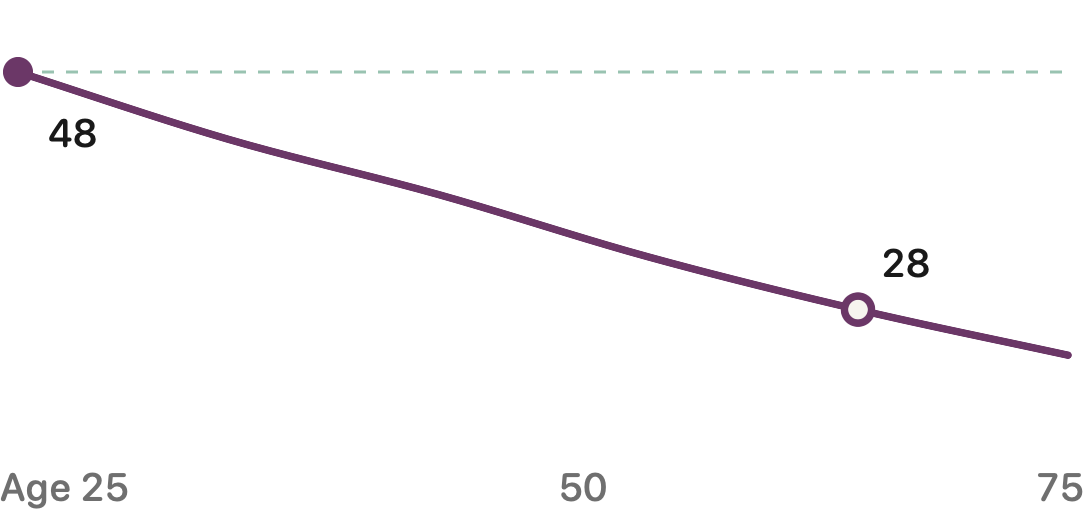
Following the same people shows the fall speeding up. In 810 healthy adults retested over about eight years, the score fell 3 to 6% a decade in their 20s and 30s. In their 70s and beyond it fell by more than 20% a decade, however active they said they were.8
In 1966 five healthy 20-year-old men spent three weeks in bed for a study. Forty years later the same men were tested again. Their total oxygen use had fallen by about a quarter since, about the same as after the three weeks in bed. That was five men from one lab, so it shows what can happen, not how often.9,10
Late in life the score starts to decide everyday things. One brief review judged that loss of independence seems likely below about 18 for men and 15 for women, levels typically reached at 80 to 85.11
Why do doctors care?
In large studies, the fitter people were, the lower their risk of dying. The gap rivals smoking and diabetes.
The Cleveland Clinic tests fitness on a treadmill that gets faster and steeper until the person has to stop. In 2018 a team there went back through the records of 122,007 adults referred for testing. They sorted them into five groups by fitness against others of the same age and sex, then counted deaths over a median of 8.4 years.12
The least fit group had about five times the risk of dying of the elite group, the fittest few percent, after allowing for other risk factors. The elite did better even than the next group down, with about a quarter less risk. A drop from above average to below average went with 41% more risk, about the same as smoking and diabetes. These are shares of the risk, not counts of extra deaths.12
A pooled analysis of 33 studies had already found the same pattern. Each step up in fitness, about the gain from running one kilometre an hour faster, went with 13% lower risk of dying.13
You might expect the benefit to run out. In 750,302 US veterans, the least fit fifth had four times the risk of the extremely fit. The extremely fit showed no rise in risk at the top. The group was mostly men, but 45,232 were women.14
In 2016 the American Heart Association made a case for treating fitness as a vital sign. Its statement called low fitness a potentially stronger predictor of death than smoking, high blood pressure, high cholesterol or type 2 diabetes.15
All of this is observational: these studies watched people and did not assign fitness. Fitter people differ in other ways, and the Cleveland patients were referred for testing, so they are not a random slice of the public. Fitness was estimated from treadmill performance, not from measured oxygen.12,13
Can you raise it, and does that change the odds?
Training raised it, even in a man past 100. Men who got fitter had lower risk of dying, though that is not proof.
The same five Dallas men trained for six months in middle age. Their total oxygen use rose by 14%, back to its level at 20. Per kilogram it stayed lower, because they weighed more. No man matched his own trained peak from decades earlier. In them the gain came from muscle taking up more oxygen, not from more blood pumped, so delivery may not be the whole story.9,10,16
A cyclist who set the one-hour record for riders over 100 trained for two years, mostly easy riding with some hard efforts, and lifted his score by 13%. At 103 he rode 11% further. He is a single, exceptional man, so he shows what is possible, not what is typical.17
The odds are harder to prove. In 9,777 men given two check-ups about five years apart, some went from unfit to fit. Their risk of dying was 44% lower than for men who stayed unfit. That is a share of the risk, and men who got fitter may also have changed other habits.18
What can you do with this?
Regular aerobic activity raises it. A watch's estimate is only a rough guide to it.
- Regular aerobic activity. The World Health Organization advises adults to do 150 to 300 minutes of moderate aerobic activity a week, or 75 to 150 minutes of vigorous activity.19
- Your watch is a rough guide. In three small tests against a lab, Apple Watch estimates ran several points low on average, with an average error of 13 to 16%. In the 2026 test, the watch put only 14% of people in their true fitness band. The 2026 authors say whether it tracks change over time still needs testing.4,20,21
- Heart condition or symptoms? Ask your doctor before starting hard efforts.
Sources
Every number in this article comes from these studies. Checked 12 November 2026.
- Hill AV, Lupton H (1923). Muscular exercise, lactic acid, and the supply and utilization of oxygen. QJM. doi:10.1093/qjmed/os-16.62.135
- Bassett DR Jr (2002). Scientific contributions of A. V. Hill: exercise physiology pioneer. Journal of Applied Physiology. doi:10.1152/japplphysiol.01246.2001 · PubMed
- Kaminsky LA, Arena R, Myers J (2015). Reference standards for cardiorespiratory fitness measured with cardiopulmonary exercise testing: data from the Fitness Registry and the Importance of Exercise National Database. Mayo Clinic Proceedings. doi:10.1016/j.mayocp.2015.07.026 · PubMed
- Caserman P, Yum S, Gobel S, Reif A, Matura S (2024). Assessing the accuracy of smartwatch-based estimation of maximum oxygen uptake using the Apple Watch Series 7: validation study. JMIR Biomedical Engineering. doi:10.2196/59459 · PubMed
- Bassett DR Jr, Howley ET (2000). Limiting factors for maximum oxygen uptake and determinants of endurance performance. Medicine and Science in Sports and Exercise. doi:10.1097/00005768-200001000-00012 · PubMed
- Bouchard C, An P, Rice T, et al. (1999). Familial aggregation of VO2max response to exercise training: results from the HERITAGE Family Study. Journal of Applied Physiology. doi:10.1152/jappl.1999.87.3.1003 · PubMed
- Jones AM (2006). The physiology of the world record holder for the women's marathon. International Journal of Sports Science and Coaching. doi:10.1260/174795406777641258
- Fleg JL, Morrell CH, Bos AG, et al. (2005). Accelerated longitudinal decline of aerobic capacity in healthy older adults. Circulation. doi:10.1161/CIRCULATIONAHA.105.545459 · PubMed
- McGavock JM, Hastings JL, Snell PG, et al. (2009). A forty-year follow-up of the Dallas Bed Rest and Training study: the effect of age on the cardiovascular response to exercise in men. Journals of Gerontology Series A. doi:10.1093/gerona/gln025 · PubMed
- McGuire DK, Levine BD, Williamson JW, et al. (2001). A 30-year follow-up of the Dallas Bedrest and Training Study: I. Effect of age on the cardiovascular response to exercise. Circulation. PubMed
- Shephard RJ (2009). Maximal oxygen intake and independence in old age. British Journal of Sports Medicine. doi:10.1136/bjsm.2007.044800 · PubMed
- Mandsager K, Harb S, Cremer P, Phelan D, Nissen SE, Jaber W (2018). Association of cardiorespiratory fitness with long-term mortality among adults undergoing exercise treadmill testing. JAMA Network Open. doi:10.1001/jamanetworkopen.2018.3605 · PubMed
- Kodama S, Saito K, Tanaka S, et al. (2009). Cardiorespiratory fitness as a quantitative predictor of all-cause mortality and cardiovascular events in healthy men and women: a meta-analysis. JAMA. doi:10.1001/jama.2009.681 · PubMed
- Kokkinos P, Faselis C, Samuel IBH, et al. (2022). Cardiorespiratory fitness and mortality risk across the spectra of age, race, and sex. Journal of the American College of Cardiology. doi:10.1016/j.jacc.2022.05.031 · PubMed
- Ross R, Blair SN, Arena R, et al. (2016). Importance of assessing cardiorespiratory fitness in clinical practice: a case for fitness as a clinical vital sign: a scientific statement from the American Heart Association. Circulation. doi:10.1161/CIR.0000000000000461 · PubMed
- McGuire DK, Levine BD, Williamson JW, et al. (2001). A 30-year follow-up of the Dallas Bedrest and Training Study: II. Effect of age on cardiovascular adaptation to exercise training. Circulation. PubMed
- Billat V, Dhonneur G, Mille-Hamard L, et al. (2017). Case studies in physiology: maximal oxygen consumption and performance in a centenarian cyclist. Journal of Applied Physiology. doi:10.1152/japplphysiol.00569.2016 · PubMed
- Blair SN, Kohl HW 3rd, Barlow CE, Paffenbarger RS Jr, Gibbons LW, Macera CA (1995). Changes in physical fitness and all-cause mortality: a prospective study of healthy and unhealthy men. JAMA. doi:10.1001/jama.1995.03520380029031 · PubMed
- Bull FC, Al-Ansari SS, Biddle S, et al. (2020). World Health Organization 2020 guidelines on physical activity and sedentary behaviour. British Journal of Sports Medicine. doi:10.1136/bjsports-2020-102955 · PubMed
- Lambe R, O'Grady B, Baldwin M, Doherty C (2025). Investigating the accuracy of Apple Watch VO2 max measurements: a validation study. PLoS One. doi:10.1371/journal.pone.0323741 · PubMed
- Lambe R, Schumann M, Donnelly L, et al. (2026). Accuracy of VO2 max estimates from Apple Watch Series 10. Mayo Clinic Proceedings: Digital Health. doi:10.1016/j.mcpdig.2026.100357 · PubMed