
The first minute after exercise
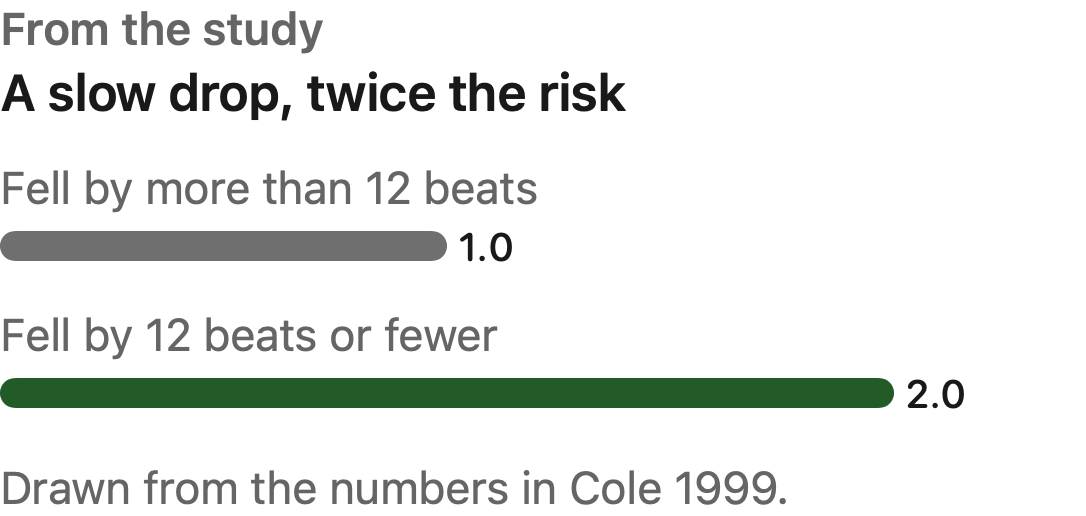
In 2,428 adults sent for a heart test, a drop of 12 beats or fewer in the first minute after effort went with about two times the risk of dying over six years. Later studies found the link held, though weaker.
Does how fast your heart settles say anything?
In 2,428 adults sent for a heart test, a slow drop in the first minute went with about two times the risk of dying.
In 1999 a team at the Cleveland Clinic in Ohio looked at the other end of an exercise test: how fast the heart slows once the effort stops. They followed 2,428 adults, average age 57, who came for an exercise test and a heart scan.1
Each person was taken to the limit of what they could do. The team noted heart rate at the peak and again one minute after stopping. That drop is called heart rate recovery. A drop of 12 beats a minute or fewer counted as abnormal.1
About 1 person in 4, 639 in all, had a drop that small. Over six years, 213 people died.1
Compared raw, those with a slow drop had 4 times the risk of dying. After allowing for age, sex, medicines, the scan, usual risk factors, resting heart rate, how far heart rate rose and workload, it was about twice. That is a relative figure, not 2 deaths in every 100 people.1
If your watch reports a one-minute recovery number after a workout, it is built on the same idea: a peak, then a figure a minute later.1
Why would the first minute matter?
The authors link the early fall to the vagus nerve, the heart's brake, taking hold again. A slow fall may mean a weaker brake.
Heart rate climbs in exercise partly because the vagus nerve, the heart's natural brake, eases off. The authors tie the early fall after stopping to that brake coming back. They also note that weak vagal activity in general is a known risk factor for death.1
This was the team's idea, not something they measured. They recorded heart rate, not the nerve, and wrote only that a slow fall may reflect weaker vagal activity.1
What they did show is that recovery told them something the other numbers did not. The link held independent of workload, of the heart scan, and of how much heart rate rose during exercise.1
You cannot feel the brake working. All you can see is the heart rate a minute after you stop, and that is only a hint of it.1
Does it hold with other tests and other people?
Mostly. It held with no cool-down and in healthy adults, though the gap was smaller in the healthy.
A later study from the same Cleveland Clinic department tested a different ending. It followed 5,438 patients sent for exercise echocardiography, a heart ultrasound after exercise. They lay on their left side after exercise, with no cool-down, and the line for abnormal was a drop of 18 beats a minute or fewer.2
In 3 years, 9% of the slow group died, against 2% of the rest. After allowing for age, sex, exercise capacity and how well the heart pumped, a slow drop still went with about twice the rate of death.2
Next came healthy adults. 5,234 people with no sign of heart disease, from primary care sites, took an easier submaximal test. Recovery was measured 2 minutes after the peak, and a drop of 42 beats a minute or fewer was abnormal.3
Over 12 years, a slow drop went with about 1.55 times the risk of dying, after allowing for risk factors, fitness, and resting and exercise heart rates. That is still a link, but smaller than the 2.0 in the first study.1,3
Three tests, three lines: 12 beats at one minute, 18 at one minute lying down, 42 at two minutes after an easier test. A line from one test does not carry over to another.1,2,3
A heart-rate reading after your own run is none of these tests, so the study lines were not built for it.1
How strong is the link across many studies?
Pooled, a slower recovery went with a higher death rate: about 9% more for each 10 beats slower.
A team from China and Germany pooled 9 cohort studies of people followed over time. They covered 41,600 people, of whom 2,082 died.4
A slower recovery against a fast one went with about 1.7 times the rate of death. For every 10 beats a minute slower, the rate was about 9% higher. That is a share of the rate, not 9 people in every 100.4
For cardiovascular events, 5 of those studies, with 34,267 people, found about 13% more for each 10 beats. The authors say the links with fatal cardiovascular events and with death from any cause were independent of traditional metabolic factors.4
The pooled gap is smaller than the 2.0 of the first study. The two do not measure quite the same thing: the pooled comparison is slower against faster recovery, not a 12-beat line. These studies watched people, so other habits may share the credit.1,4
These are comparisons between groups of people. They cannot say what one workout's reading means for you.4
Can training change it?
In people with heart disease, trials of aerobic training found more improvement in recovery than usual care. Whether that lowers risk was not shown.
A Dutch team pooled 8 trials, some not fully randomised, of aerobic training in 449 adults with established heart disease. Training was linked with more improvement in recovery than usual care.5
The evidence was mixed in quality. The reviewers rated the training adequate in 3 of the 8 trials and the risk of bias low in 5. Only 2 had both.5
These were patients. The review did not cover healthy adults. It looked at recovery itself, not at whether raising it lowers the risk of dying.5
If your own number creeps up with training, that fits what these trials saw in patients. It is not proof for you.5
What does this mean for you?
The study lines come from clinic tests, not watches. Aera sets your number against your own usual instead.
- A trend, not a verdict. The studies used set clinic tests, each with its own line. A watch reads recovery after whatever workout you did, so your number will not match them.1,2,3
- Your own usual. Aera sets your recovery against your own earlier readings, not against a study line. The three Cleveland Clinic studies used exercise tests, not watch readings.1,2,3
- Training. In patients with heart disease, aerobic training went with more improvement in recovery. For healthy adults these sources do not say.5
- A low number that stays low, or chest pain or dizziness with effort? Ask your doctor.
Sources
Every number in this article comes from these studies. Checked 12 November 2026.
- Cole CR, Blackstone EH, Pashkow FJ, Snader CE, Lauer MS (1999). Heart-rate recovery immediately after exercise as a predictor of mortality. New England Journal of Medicine. doi:10.1056/nejm199910283411804 · PubMed
- Watanabe J, Thamilarasan M, Blackstone EH, Thomas JD, Lauer MS (2001). Heart rate recovery immediately after treadmill exercise and left ventricular systolic dysfunction as predictors of mortality: the case of stress echocardiography. Circulation. doi:10.1161/circ.104.16.1911 · PubMed
- Cole CR, Foody JM, Blackstone EH, Lauer MS (2000). Heart rate recovery after submaximal exercise testing as a predictor of mortality in a cardiovascularly healthy cohort. Annals of Internal Medicine. doi:10.7326/0003-4819-132-7-200004040-00007 · PubMed
- Qiu S, Cai X, Sun Z, et al. (2017). Heart rate recovery and risk of cardiovascular events and all-cause mortality: a meta-analysis of prospective cohort studies. Journal of the American Heart Association. doi:10.1161/jaha.117.005505 · PubMed
- Snoek JA, van Berkel S, van Meeteren N, Backx FJ, Daanen HA (2013). Effect of aerobic training on heart rate recovery in patients with established heart disease; a systematic review. PLoS ONE. doi:10.1371/journal.pone.0083907 · PubMed