
An irregular pulse
In a study of 419,297 people, a smartwatch alert for an irregular pulse was rare: 0.52%. Among the alerted people who sent back a heart recording, 34% had atrial fibrillation, and it is not yet known whether screening for it prevents strokes.
What happened when 419,297 people let a watch check their pulse?
Few got an alert: 0.52%. Of the 450 who sent back a patch recording, 34% had atrial fibrillation.
Atrial fibrillation is the most common heart rhythm problem: the top chambers of the heart quiver instead of beating in time. It is a major risk factor for stroke. About 20% of people who have a stroke linked to it are first diagnosed at the time of the stroke or soon after.1
In the Apple Heart Study, researchers at Stanford signed up 419,297 adults across the United States. All had an Apple Watch and an iPhone, and none reported atrial fibrillation. Their average age was 41. If the watch found an irregular pulse, it sent an alert and offered a video visit with a study doctor. A heart monitor patch was then mailed out, to wear for up to 7 days.2
Over a typical 117 days of watching, 2,161 people received an alert. That is 0.52%, about 1 in 200. Of them, 450 sent back a patch recording that could be read, and 34% of those had atrial fibrillation: about 1 in 3.2
In the study, the watch checked the pulse in the background, from time to time, while people were at rest. You did not have to start a reading.2
How often was an alert right?
Among later alerts that came while a patch was on, 84% matched atrial fibrillation. A Fitbit study found 98%.
Researchers call this the positive predictive value: of the alerts that came, how many were right. It can only be checked when a heart recording was running at the moment the alert arrived.2
In the Apple study, 86 people who had already been alerted once were wearing a patch when another alert came. In 72 of them the patch showed atrial fibrillation at that same time. That gives 84%.2
A Fitbit study followed a similar plan with 455,699 adults. Its alert needed 11 irregular readings in a row. Of the 225 people who got another alert while wearing a patch, 98% had atrial fibrillation at that moment.3
Apple paid for the first study and Fitbit for the second, and some authors of each work for the company. The Apple study was not built to count the cases a watch misses.2,3
If an alert reaches you, neither figure is exact for you. The 34% looks days after the alert, when the rhythm may have settled. The 84% and 98% cover only a later alert while a patch was on.2,3
Why did most patches show nothing?
Atrial fibrillation can come and go, and patches went on about 13 days after the alert, so some episodes may have ended.
Two in three patches showed no atrial fibrillation. That does not by itself make those alerts false. On average the patch went on 13 days after the alert. The authors suggest that atrial fibrillation may come and go and be infrequent, so the episode behind the alert may have ended by then.2
The patches fit the on-and-off pattern. Of the 153 people whose patch did show atrial fibrillation, 20% had it all the time. Most of the others had it less than 50% of the time they were monitored.2
Nor was every irregular reading atrial fibrillation. The researchers looked at 600 irregular readings taken when the patch showed none. In 77% of them the patch showed frequent early beats from the top chambers, so the watch was often reacting to a different kind of irregular rhythm.2
If you get an alert and a later recording is clear, that does not settle it either way. The heart may have settled by then, or the alert may have been another kind of irregular rhythm.2
Who gets the alerts?
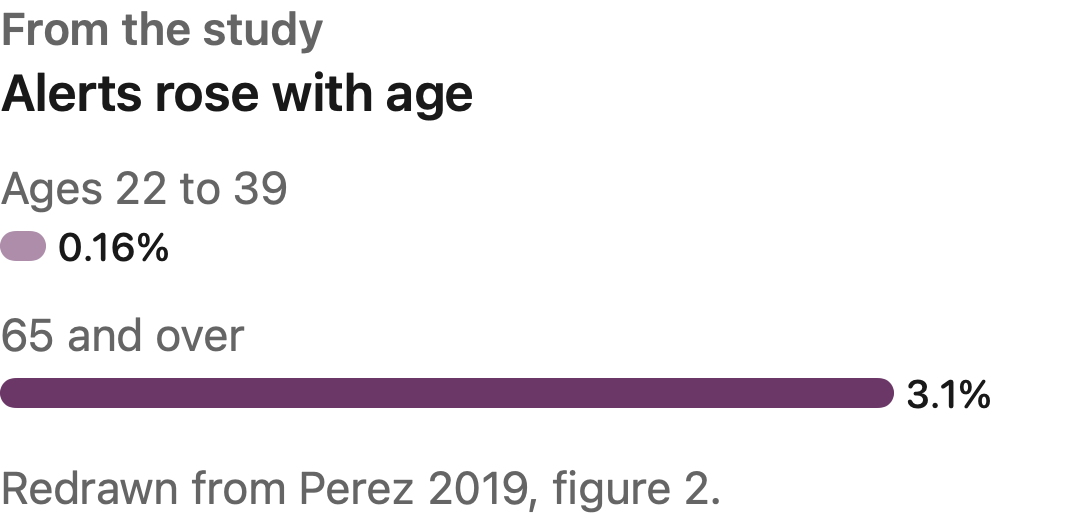
Older people, far more often than younger ones. Alerts rose steeply with age, as atrial fibrillation itself does.
Alerts followed age closely. Among people 65 and over, 3.1% got one. Among those aged 22 to 39, 0.16% did. The alerted were older on average, 57 years, and men made up a bigger share of them than of the whole study.2
That tracks the rhythm problem itself. The US Preventive Services Task Force puts it at under 0.2% of adults younger than 55, and about 10% of those 85 or older. It is commoner in men than in women. The Fitbit study saw the same pattern: alerts were much commoner among people 65 and over.1,3
Among alerted people 65 and over who wore a patch, 35% had atrial fibrillation. Among those under 40, 18% did. That rests on only 49 patches, so it is a rough figure.2
Your age changes what the same alert is likely to mean. A 30-year-old and a 70-year-old are not in the same position: the older person is likelier to get one and, in the patch results, likelier to have atrial fibrillation behind it.2
Does catching it early prevent strokes?
Not settled: a Danish trial found no clear drop in strokes, and a Swedish trial found a small net benefit.
The LOOP trial in Denmark enrolled 6,004 people aged 70 to 90 with a stroke risk factor such as high blood pressure. A quarter were given a monitor placed under the skin, which records the rhythm all the time. The rest had usual care. In the monitored group, blood thinners were advised if atrial fibrillation lasted 6 minutes or longer.4
Atrial fibrillation was found in about 32% of the monitored group and 12% of the others, and blood thinners were started more often too. Yet over about 5 years, a stroke or a clot in another artery happened in 4.5% against 5.6%, a gap that could be chance. Major bleeding was a little more common in the monitored group, also by a gap that could be chance.4
In Sweden, the STROKESTOP trial invited a randomly chosen half of all 75- and 76-year-olds in two regions to screening, 28,768 people in all. About half of those invited took part, recording short heart tracings over two weeks. The trial counted stroke, a blood clot, bleeding needing hospital care and death together. After a median follow-up of about 7 years, that had happened to 31.9% of the invited and 33.0% of the others. The gap was small and only just clear of chance. The authors read it as a small net benefit.5
Neither trial used a watch, and both studied people aged 70 and older. In 2022 the US Preventive Services Task Force concluded that the evidence was insufficient to judge screening for atrial fibrillation in adults 50 and over with no symptoms.1,4,5
If a check does find atrial fibrillation in you, the LOOP authors suggest that not every case needs blood thinners. That is a decision to make with a doctor.4
What does this mean for you?
An alert is a reason to have your heart recorded, not a diagnosis. No alert is not a clean bill of health.
- An alert is a prompt. The Apple authors say an alert should not be used for a definitive diagnosis of atrial fibrillation. It points to a check.2
- See a doctor. A doctor can record your rhythm properly and weigh your age and other conditions. Alerts and the rhythm problem both become commoner with age.1,2
- Silence is not clearance. The Apple authors note that no alert does not rule out an irregular rhythm. If you feel a racing or fluttering heart, tell a doctor, whatever your watch says.2
- Screening is still open. Whether screening adults with no symptoms does more good than harm is not known.1
Sources
Every number in this article comes from these studies. Checked 12 November 2026.
- US Preventive Services Task Force, Davidson KW, Barry MJ, et al. (2022). Screening for Atrial Fibrillation: US Preventive Services Task Force Recommendation Statement. JAMA. doi:10.1001/jama.2021.23732 · PubMed
- Perez MV, Mahaffey KW, Hedlin H, et al. (2019). Large-Scale Assessment of a Smartwatch to Identify Atrial Fibrillation. New England Journal of Medicine. doi:10.1056/NEJMoa1901183 · PubMed
- Lubitz SA, Faranesh AZ, Selvaggi C, et al. (2022). Detection of Atrial Fibrillation in a Large Population Using Wearable Devices: The Fitbit Heart Study. Circulation. doi:10.1161/CIRCULATIONAHA.122.060291 · PubMed
- Svendsen JH, Diederichsen SZ, Højberg S, et al. (2021). Implantable loop recorder detection of atrial fibrillation to prevent stroke (The LOOP Study): a randomised controlled trial. The Lancet. doi:10.1016/S0140-6736(21)01698-6 · PubMed
- Svennberg E, Friberg L, Frykman V, et al. (2021). Clinical outcomes in systematic screening for atrial fibrillation (STROKESTOP): a multicentre, parallel group, unmasked, randomised controlled trial. The Lancet. doi:10.1016/S0140-6736(21)01637-8 · PubMed