
Regular sleep
In tens of thousands of UK adults, more regular sleep went with a lower risk of dying over the next six years. It predicted deaths better than how long people slept.
Does regular sleep go with a longer life?
In one large study, the more regular a person's sleep, the lower their risk of dying. Regularity predicted deaths better than hours slept did.
Researchers at Monash University in Australia used the UK Biobank, a large health study of British volunteers. They analysed about 61,000 of them who had worn a wrist sensor for a week. Their average age was about 63.1
The team turned each person's week into a sleep regularity score. It compares each moment with the same clock time a day earlier. Was the person in the same state, asleep or awake? A score of 100 is perfectly regular, and zero is random.1
They sorted people into five equal groups by that score and tracked deaths for about six years. In that time, 1,859 people died.1
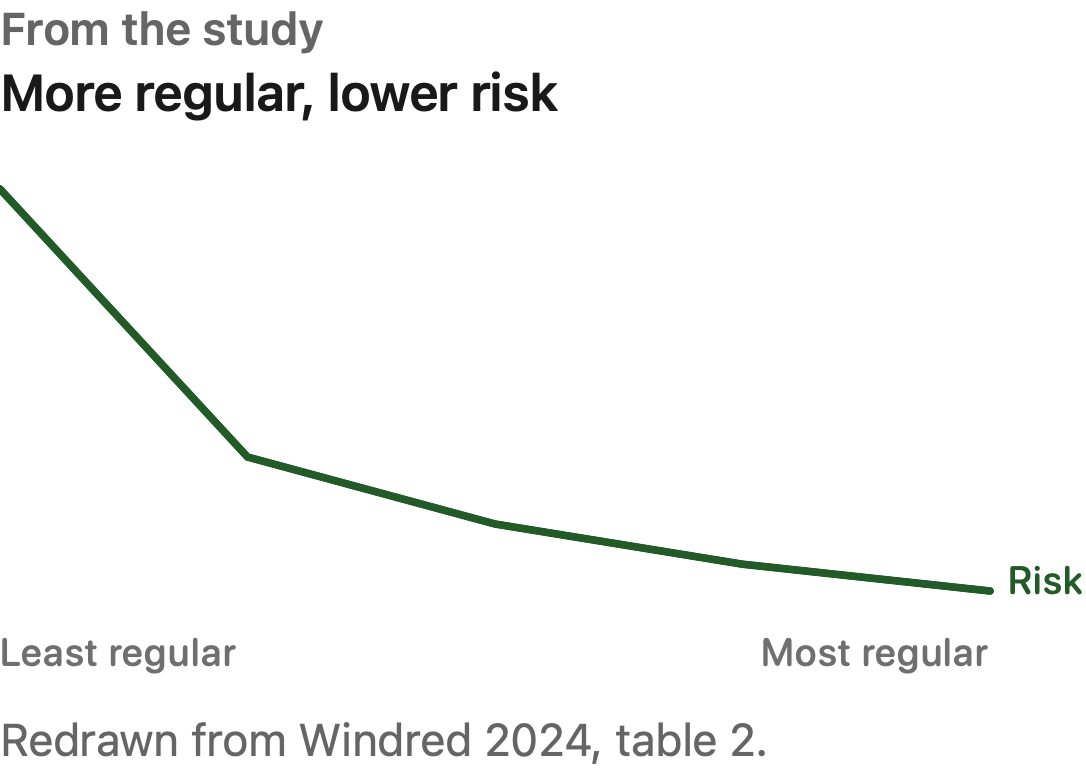
The least regular fifth had the highest risk of dying, and each more regular fifth did better. Deaths from cancer, and from heart and metabolic causes, pointed the same way.1
After allowing for age, sex, activity, smoking and more, the most regular fifth had about 30% lower risk of dying than the least regular. The second fifth had about 20% lower. That is a share of the risk, not a count of lives.1
With only age, sex and ethnicity allowed for, the gap for the most regular fifth was bigger: 48% lower.1
Think of the score as a daily match. Your Tuesday sleep is held against Monday's, and a late Saturday against Friday's. The more often they line up, the higher the score.1
Is it just a stand-in for sleeping enough?
Not in these data. Even people who slept enough hours had more heart-event risk if their sleep was very irregular.
Two people can sleep the same number of hours, one at the same times each night and the other whenever the day allows.
In this study, hours slept explained only about a tenth of how much people's regularity differed. The two were mostly separate habits.1
Which one predicted deaths better? Regularity did. A model with regularity alone beat one with hours alone, and adding hours to the regularity model did not clearly improve it. The authors still say hours matter.1
A 2025 study asked the heart question. It followed 72,269 UK Biobank adults for eight years, counting heart attacks, heart failure and strokes.2
Irregular sleepers had about 26% higher risk of such an event than regular sleepers. Moderately irregular sleepers had about 8% higher. Again, these are shares of the risk, not counts of events.2
Sleeping the recommended hours for their age left no clear extra risk in the moderately irregular group. It did not do so for the irregular group, whose risk stayed about 19% higher.2
Both studies used wrist sensors worn by UK Biobank volunteers, so many of the same people are likely in both. The second is a closer look, not independent confirmation.1,2
The sensor in these studies was worn on the wrist, like a watch. Your own watch's sleep log holds the same two things: how many hours you slept, and the times they fell.1,2
Do other studies agree?
Broadly: reviews of dozens of studies linked irregular sleep with poorer health, though the evidence graded from very low to moderate.
A Canadian team reviewed 41 articles that covered 92,340 adults. They came from 14 countries. Later sleep timing and greater variability in sleep were generally linked with worse health.3
The review could not name a point where variability becomes "large", because most studies reported straight-line links. Its authors graded the evidence from very low to moderate.3
A 2025 review of 59 studies reached a similar view, with consistent links to depressive symptoms, high blood pressure and heart events.4
The score was new in a small study of 61 college students. Less regular sleep went with later body clocks and poorer academic performance, and a model suggested light exposure likely explained most of the clock gap.5
Some of these studies measured regularity as simply as how much a person's sleep varies from night to night. You can eyeball that from a week of your own log.3
How sure can we be?
Not very, about cause. The study watched people, used one week of sleep, and drew volunteers healthier than average.
In the two UK Biobank studies, nobody was asked to change their sleep. The authors note that regularity may be both a cause and a marker of poor health.1
The team allowed for many things, including shift work and smoking. Some of those may sit on the path between sleep and death, so allowing for them could shrink a real link. That is why the authors say the true size likely lies between the two sets of figures.1
Each person gave one week of sleep, a snapshot of years of habit. The sample was older and almost all white.1
UK Biobank volunteers are healthier than the general population. In their early seventies, their death rates were roughly half those of the general population. The comparison's authors still argue that links between habits and disease may hold in the wider population.6
Your own week is a snapshot too. One odd week of travel or illness could score poorly even if your habits are steady.1
Has anyone tested becoming more regular?
Two small, short tests gave mixed results: blood pressure fell in 11 people with high blood pressure but not in 16 healthy adults.
In 2025, a team in Portland, Oregon, studied 11 people with high blood pressure. For a week they lived as usual while wearing a blood pressure monitor and a sleep sensor. Then, for two weeks, they were asked to go to bed at the same time every night.7
Bedtimes had varied by about half an hour. After the change, they varied by about 7 minutes.7
Across the day, the top blood pressure number fell by about 4 and the bottom by about 3.7
In a second test, 16 healthy adults tried their usual sleep and a fixed schedule, each for 12 nights, in random order. The fixed schedule made their sleep length steadier, but blood vessel function and resting blood pressure showed no clear change.8
Both tests were small and short, and neither looked at deaths. In the first, everyone got the same plan, with no comparison group. Its authors call for a larger trial with a control group, and one review calls such trials a priority.4,7
If you tried it, the ask was small: a steady bedtime, not more sleep. No other sleep measure changed.7
What does this mean for you?
In UK studies, steady timing predicted outcomes at least as well as hours. Whether changing it changes your risk is not shown.
- Look at timing, not just hours. A week of bedtimes and wake-up times beside the hours is the view these studies took.1
- Know the scale. In the most regular fifth, people fell asleep and woke within about one-hour windows on most days. In the least regular, the windows were about three hours.1
- High blood pressure or a heart condition? Ask your doctor. A fixed bedtime is not a treatment on this evidence.7
Sources
Every number in this article comes from these studies. Checked 12 November 2026.
- Windred DP, Burns AC, Lane JM, et al. (2024). Sleep regularity is a stronger predictor of mortality risk than sleep duration: a prospective cohort study. Sleep. doi:10.1093/sleep/zsad253 · PubMed
- Chaput JP, Biswas RK, Ahmadi M, et al. (2025). Sleep regularity and major adverse cardiovascular events: a device-based prospective study in 72 269 UK adults. Journal of Epidemiology and Community Health. doi:10.1136/jech-2024-222795 · PubMed
- Chaput JP, Dutil C, Featherstone R, et al. (2020). Sleep timing, sleep consistency, and health in adults: a systematic review. Applied Physiology, Nutrition, and Metabolism. doi:10.1139/apnm-2020-0032 · PubMed
- Kalkanis A, Lenkens D, Steiropoulos P, Testelmans D (2025). Sleep regularity as an important component of sleep hygiene: a systematic review. Sleep Medicine Reviews. doi:10.1016/j.smrv.2025.102203 · PubMed
- Phillips AJK, Clerx WM, O'Brien CS, et al. (2017). Irregular sleep/wake patterns are associated with poorer academic performance and delayed circadian and sleep/wake timing. Scientific Reports. doi:10.1038/s41598-017-03171-4 · PubMed
- Fry A, Littlejohns TJ, Sudlow C, et al. (2017). Comparison of sociodemographic and health-related characteristics of UK Biobank participants with those of the general population. American Journal of Epidemiology. doi:10.1093/aje/kwx246 · PubMed
- Thosar SS, Sreeramadas AM, Jones M, et al. (2025). Bedtime regularization as a potential adjunct therapy for hypertension: a proof-of-concept study. Sleep Advances. doi:10.1093/sleepadvances/zpaf082 · PubMed
- Narvaez G, Gonzales JU (2025). Reduced sleep irregularity does not impact peripheral vascular function before or following total sleep deprivation. Journal of Applied Physiology. doi:10.1152/japplphysiol.00392.2025 · PubMed