
Weekend lie-ins
In a sleep lab, a free weekend repaid only part of a short week, and the weekend group still gained about as much weight as the group that never slept in. A large study of UK adults found no clear link between catch-up sleep and dying, while other studies linked it with lower odds of depression and fewer early artery changes.
Does a lie-in pay back a week of short nights?
Only in part. In one lab study, a free weekend added about 1.1 hours to normal sleep, after a week of far larger losses.
Many people sleep short on weekdays and long at the weekend, and it feels like paying back a debt. A team at the University of Colorado Boulder put that feeling to the test in a sleep lab.1
They followed 36 healthy young adults for almost two weeks, in three groups.1
One group had 9 hours in bed every night. A second had 5 hours every night. The last had 5 hours on weeknights, then a weekend of sleeping as long as they liked, then 5 hours again.1
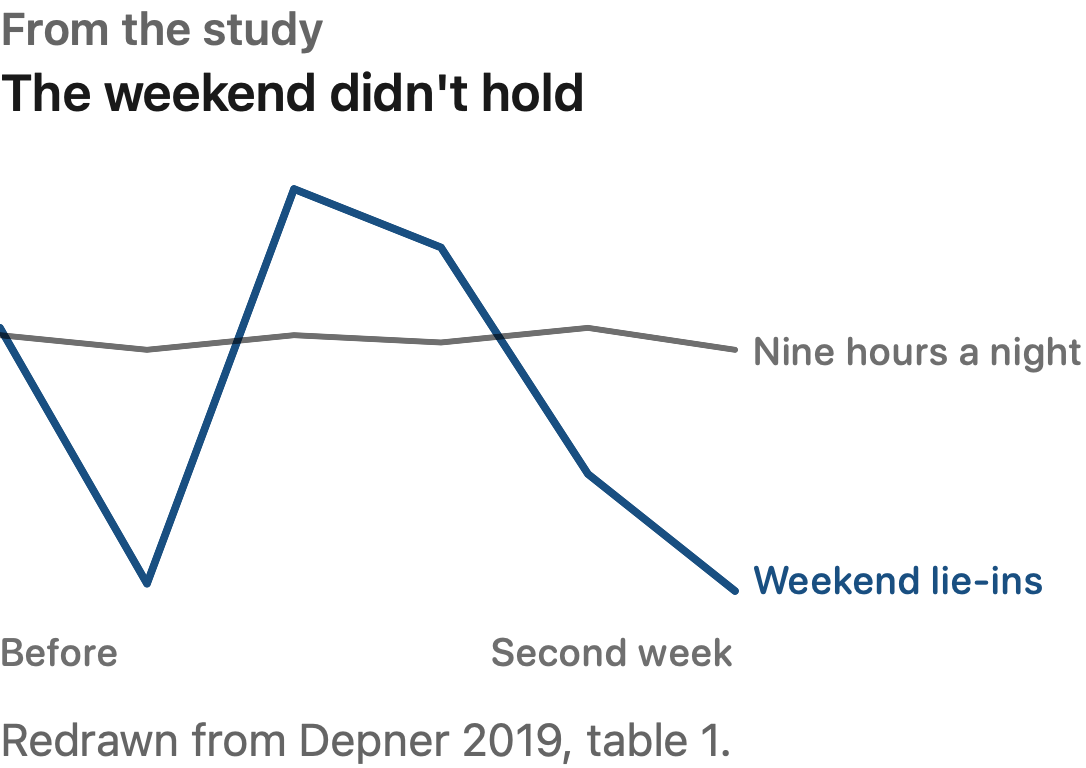
The weekend group did sleep in: about 10 hours on Friday night and about 9 on Saturday. On Sunday they kept their usual bedtime, knowing Monday's alarm was set, and slept about 6.1
Add it up and they ended the weekend about 1.1 hours ahead of their usual sleep. The workweek had cost them more than 12 hours.1
Brain recordings agreed. Slow-wave activity, a brain-wave marker of how much pressure to sleep has built up, was still raised on Saturday night. The authors read that as a sign the group was not fully recovered.1
If your own sleep log shows a tall Saturday bar and a short Sunday one, it has the same shape. Their Sunday was cut off by a Monday alarm, as many are.1
What did the lie-in do to the body clock?
In the weekend group it ran later, so Monday's alarm landed closer to the body's night.
Melatonin is the hormone that rises when the body's night begins and falls as it ends. By the Monday after the weekend, the weekend group's night had slid later: its start by about 1.7 hours and its end by about 1.4, against their own baseline.1
In the group with 5-hour nights all the way through, the end of the night did not shift clearly. Some of the weekend group's shift was already there early in the first short week: by its second day, the start was about 1.2 hours later.1
The authors think later light likely contributed. The weekend group had more light late in the evening and less in the morning, and both of those push the clock later.1
Social jetlag is the gap between that body clock and the alarm. By the authors' account, a clock that has slid later raises the chance that Monday's wake-up lands in the body's night.1
If your Monday feels like a night shift after a lie-in, the lab hints at why: for these volunteers the alarm stayed put while the clock moved later.1
Did the weekend protect eating, weight and blood sugar?
Not once it ended. Both short-sleep groups gained about the same weight, and insulin sensitivity fell in both.
Short sleep pushed up eating after dinner. The authors report snacks then rising from about 290 kcal at baseline to more than 771.1
During the lie-in weekend, the weekend group ate less after dinner than on the short nights. When the 5-hour nights came back, after-dinner eating rose by about 100%.1
Both short-sleep groups gained weight over the study: about 1.4 kg in the group that never slept in, and 1.3 kg in the weekend group. That is a bag of sugar and a bit more.1
The group with 9 hours in bed also ate more in the second week and gained 1.0 kg, which was too small to be sure of. Food was free for everyone, and the meals offered were bigger than at baseline.1
Insulin sensitivity is how well the body responds to insulin, the hormone that moves sugar out of the blood. Against their own baseline it fell about 13% in the group that never slept in and about 27% in the weekend group.1
Once the extra weight was allowed for, the fall in the weekend group was too small to be sure of. The authors suggest weight gain explains part of it.1
You would not necessarily feel any of this. Hunger ratings fell during the short nights, even as people ate more.1
Does catch-up sleep show up in how long people live?
Not clearly. In tens of thousands of UK adults, extra sleep at the weekend showed no clear link with dying or heart disease.
Researchers in Canada, Australia and the UK used wrist sensors worn by tens of thousands of UK adults. They counted catch-up sleep as longer average sleep at weekends than on weekdays, then followed the adults for about 8 years.2
Even the group with at least 2 hours of catch-up showed no clear difference in the risk of dying, or of new heart and circulation disease, against people with none. The same held for those sleeping under 6 hours on weekdays.2
That group's risk of dying was 17% higher, a share of the risk, not a count of people. Its range ran from slightly lower to 41% higher, so chance could explain it.2
A Swedish study followed 43,880 people for over a decade and split them at age 65. In the younger group, sleeping 5 hours or less at weekends went with a death rate about half as high again as sleeping 7.3
People who slept short on weekdays but long at weekends had a death rate that did not differ from people sleeping a steady 6 to 7 hours. In people over 65, weekend sleep showed no link with dying.3
These studies counted deaths and heart disease, not mood or blood sugar. They also watched people, so other habits could lie behind any pattern.2,3
The first study took its weekday and weekend numbers from wrist sensors, as your watch does.2
Could catch-up sleep help in other ways?
Possibly. Studies of depression and early artery changes linked catch-up sleep with better outcomes, but they cannot show cause.
A 2025 review pooled ten studies covering over 300,000 people. Catch-up sleep went with about 20% lower odds of depression.4
The link was seen with 0 to 2 hours of catch-up and was limited beyond that. All ten were cross-sectional: each person was looked at once. That cannot show which came first, sleeping in or feeling better.4
A study in Brazil used wrist sensors in 1,832 middle-aged adults and followed them for about 5 years. It looked for new calcium in the heart's arteries, an early, symptom-free sign of artery disease.5
Among people with more than 90 minutes of catch-up sleep, about 19% developed new calcium, against about 32% of the rest. The link held after allowing for other factors.5
The review of 41 articles told in the article on regular sleep also linked catch-up sleep with better health, on evidence graded very low to moderate.6
These answers look opposite. The UK study's authors note that earlier benefits rested on a few cross-sectional studies of self-reported sleep. Catch-up sleep may also matter for some outcomes and not others, and every link here comes from watching people, not from changing their sleep.2,4,5
If you sleep short on weekdays, you are the group the depression review said its link fitted best. In the Brazilian study the link held only for shorter sleepers.4,5
What does this mean for you?
A lie-in repays only part of a short week. Whether it protects health is open.
- Treat it as partial. The lab weekend repaid a small part of the week, and the week's changes came back once the short nights did.1
- Mind the Monday gap. A lie-in moved the clock later while the alarm stayed put. That gap is what the lab group woke up to.1
- Size. The depression review linked 0 to 2 extra hours with lower odds of depression, and less beyond that. It looked at people once, so it cannot say that is the best size.4
- The missing test. None of these studies compared a lie-in with an earlier weeknight bedtime, so they cannot say which does more.1,2,4
- Check your log. Your watch's sleep log shows weekday and weekend nights side by side. The difference between them is your catch-up sleep.2
Sources
Every number in this article comes from these studies. Checked 12 November 2026.
- Depner CM, Melanson EL, Eckel RH, et al. (2019). Ad libitum weekend recovery sleep fails to prevent metabolic dysregulation during a repeating pattern of insufficient sleep and weekend recovery sleep. Current Biology. doi:10.1016/j.cub.2019.01.069 · PubMed
- Chaput JP, Biswas RK, Ahmadi M, et al. (2024). Device-measured weekend catch-up sleep, mortality, and cardiovascular disease incidence in adults. Sleep. doi:10.1093/sleep/zsae135 · PubMed
- Åkerstedt T, Ghilotti F, Grotta A, et al. (2019). Sleep duration and mortality: does weekend sleep matter? Journal of Sleep Research. doi:10.1111/jsr.12712 · PubMed
- Zhou Y, Sun Y, Pan Y, et al. (2025). Association of weekend catch-up sleep with depression: a systematic review and meta-analysis. Journal of Affective Disorders. doi:10.1016/j.jad.2025.02.080 · PubMed
- Peixoto de Miranda ÉJF, Parise BK, Santos RB, et al. (2025). Weekend sleep extension, social jetlag, and incidence of coronary calcium score: the ELSA-Brasil study. Sleep. doi:10.1093/sleep/zsaf039 · PubMed
- Chaput JP, Dutil C, Featherstone R, et al. (2020). Sleep timing, sleep consistency, and health in adults: a systematic review. Applied Physiology, Nutrition, and Metabolism. doi:10.1139/apnm-2020-0032 · PubMed