
Recovery
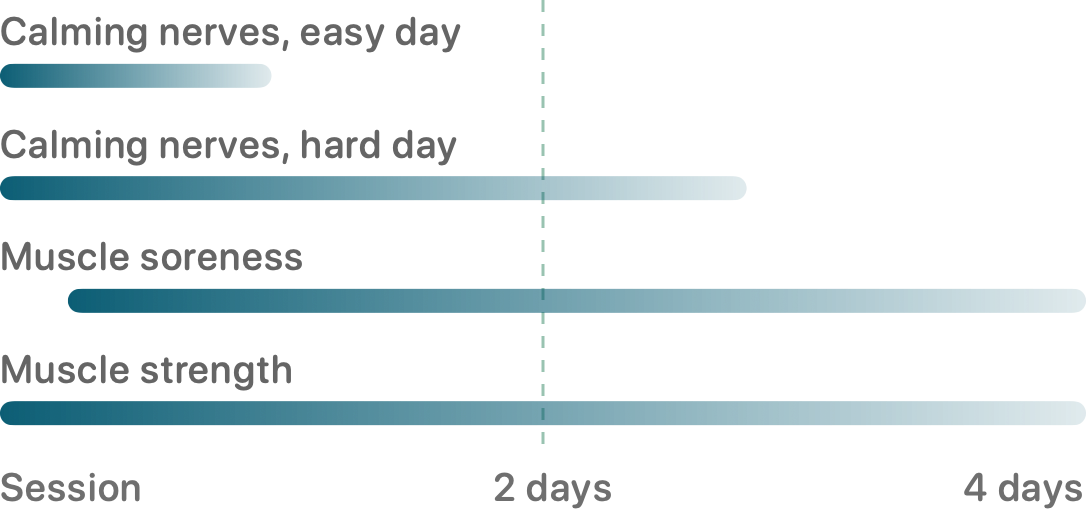
Recovery is the rebuilding that follows hard work, and it is not one job. Fuel, the heart's calming nerves and muscle each finish on their own clock, from about a day to a week or more.
What is recovery?
The rebuilding that follows hard work. It is several jobs, not one, and each finishes on its own day.
In 1966 two researchers cycled with one leg only, until that leg gave out. Then they ate a carbohydrate-rich diet for three days and measured the fuel stored in each thigh. The rested leg showed no overshoot. The worked leg's store roughly doubled.1,2
The fuel is glycogen, the form in which muscle stores carbohydrate. At the level of fuel, that overshoot is a small version of the idea behind training: hard work knocks something down, and given food and time the body can rebuild it past where it was. Only two people took part. A 2025 pooled analysis of 30 studies found glycogen above its starting level after a few days of high-carbohydrate eating, more so after cycling than after running.1,2,3
Recovery is the name for that rebuilding, and it covers more than fuel. A 2018 consensus statement from sports scientists says an adequate balance between stress and recovery is essential for athletes to keep performing at a high level. It counts as stress not only training and competition but also the other demands of life.4
So, on that view, your hard week at work and your hard run draw on the same balance.4
How long does each part take?
Fuel takes about a day with enough carbohydrate, the heart's calming nerves one to two days, and muscle strength longer.
Fuel is one of the quicker jobs: a review describes muscle glycogen refilling over about the first 24 hours after exercise, if you eat enough carbohydrate. The heart keeps its own time. Its calming nerves, the ones that slow the heart after effort, take up to a day to return after an easy aerobic session. After a hard steady one it is one to two days, and after a very hard one at least two. They come back faster in fitter people. These are ranges from a review of studies in athletes and healthy people, not exact rules.3,5
A settled heart does not mean the rest has settled. The same review notes that this recovery does not appear to match that of every other system, such as energy stores or the nerves and muscles that drive movement.5
A marathon shows the far end. Ten trained runners ran one, and among those who then rested, their capacity for work had come back by day three. Their leg strength was still below its pre-race level at day seven. Ten runners in 1984 is a small sample, so read it as one example.6
Why are your legs sore two days later?
Soreness follows unfamiliar or lengthening work and peaks two to three days later. Lactic acid is largely ruled out.
Many people blame sore legs on lactic acid left in the muscle. A 2022 review says studies in the 1980s largely refuted that. The same review argues lactate may still play a part in how soreness starts, so the question is not closed.7
Soreness follows eccentric work, where the muscle lengthens while it pulls, as when you lower a heavy weight, or work you are not used to. It typically peaks 48 to 72 hours afterwards.8,9
After work like regular training, such as lifting or running downhill, a review says full recovery normally comes within a few days. After an extreme, unaccustomed effort it can take more than a week. It also expects large differences between people, so your own legs may run faster or slower.10
Then comes the useful part: a second bout hurts less. In 12 people, one session of lowering movements for the thigh muscle cut their strength to 86% of normal at most knee angles on day two. When they repeated it two weeks later, strength and pain barely changed. The study did not show how long that protection lasts.11
What speeds recovery up, and what slows it?
Sleep matters: one night without it slowed muscle building. A cold bath after strength training blunted gains in one trial.
Thirteen healthy young adults went through one night of total sleep deprivation. The next afternoon, their muscles built protein 18% more slowly than after a normal night. Cortisol, a stress hormone, was up by about a fifth and testosterone down by about a quarter.12
That was a full night awake, which is more than most bad nights, so it says little about a night that is merely short.12
A cold bath feels like recovery, and it may cost something. In 21 active men who trained their strength for 12 weeks, either 10 minutes of cold water or active recovery followed each session. Strength and muscle mass grew more with active recovery.13
Work in a strength test rose 19% with active recovery and did not rise with cold water. The authors concluded that cold water as a regular recovery habit should be reconsidered. If muscle is your goal, this is a habit with some evidence against it, though the trial used one protocol and does not cover other kinds of exercise.13
When does tiredness become a problem?
A dip that pays off clears within a couple of weeks. One that does not takes weeks or months; overtraining syndrome, possibly years.
Successful training involves overload. Athletes can then show a short dip in performance that turns into improvement after recovery, which a joint statement from European and American sports medicine bodies calls functional overreaching. When training and recovery fall out of balance, it can become nonfunctional overreaching.14
By the statement's estimates, the functional kind clears within about two weeks and the nonfunctional kind takes weeks or months. At the far end is overtraining syndrome, which it says can take months or possibly years to clear. These durations are expert estimates, not trial results.14
Telling nonfunctional overreaching from overtraining syndrome is very difficult. A separate consensus statement on recovery adds that responses differ between people and within the same person over time, and it asks for recovery to be monitored systematically.4,14
So the timetable in this article is a range, not a promise about your own legs.4
What can you do with this?
The evidence points to food, sleep and easier days between hard ones, read through more than one signal.
- Carbohydrate. In the first four hours after exercise, about 1 gram per kilogram of body weight speeds the glycogen refill. After that, the total over the day matters more than the type or the timing.3
- Sleep. One night without it lowered muscle building in the study above. No study in this article tests a merely short night.12
- A dip that will not clear. Fatigue, falling performance and low mood that persist are worth a doctor's visit. The statement describes diagnosing overtraining syndrome by exclusion: illness, infection, too little food and iron deficiency are ruled out first.14
Your watch cannot see fuel or muscle. What it can follow is the heart's side: your heart rate variability and resting heart rate, each with its own article. The rest you read yourself, from how the stairs feel the morning after a long run.5
Sources
Every number in this article comes from these studies. Checked 12 November 2026.
- Bergström J, Hultman E (1966). Muscle glycogen synthesis after exercise: an enhancing factor localized to the muscle cells in man. Nature. doi:10.1038/210309a0 · PubMed
- Solem K, Clauss M, Jensen J (2025). Glycogen supercompensation in skeletal muscle after cycling or running followed by a high carbohydrate intake the following days: a systematic review and meta-analysis. Frontiers in Physiology. doi:10.3389/fphys.2025.1620943 · PubMed
- Burke LM, van Loon LJC, Hawley JA (2017). Postexercise muscle glycogen resynthesis in humans. Journal of Applied Physiology. doi:10.1152/japplphysiol.00860.2016 · PubMed
- Kellmann M, Bertollo M, Bosquet L, et al. (2018). Recovery and performance in sport: consensus statement. International Journal of Sports Physiology and Performance. doi:10.1123/ijspp.2017-0759 · PubMed
- Stanley J, Peake JM, Buchheit M (2013). Cardiac parasympathetic reactivation following exercise: implications for training prescription. Sports Medicine. doi:10.1007/s40279-013-0083-4 · PubMed
- Sherman WM, Armstrong LE, Murray TM, et al. (1984). Effect of a 42.2-km footrace and subsequent rest or exercise on muscular strength and work capacity. Journal of Applied Physiology. doi:10.1152/jappl.1984.57.6.1668 · PubMed
- Sonkodi B (2022). Should we void lactate in the pathophysiology of delayed onset muscle soreness? Not so fast! Let's see a neurocentric view! Metabolites. doi:10.3390/metabo12090857 · PubMed
- Hotfiel T, Freiwald J, Hoppe MW, et al. (2018). Advances in delayed-onset muscle soreness (DOMS): Part I: pathogenesis and diagnostics. Sportverletzung Sportschaden. doi:10.1055/a-0753-1884 · PubMed
- Peake JM, Neubauer O, Della Gatta PA, Nosaka K (2017). Muscle damage and inflammation during recovery from exercise. Journal of Applied Physiology. doi:10.1152/japplphysiol.00971.2016 · PubMed
- Paulsen G, Mikkelsen UR, Raastad T, Peake JM (2012). Leucocytes, cytokines and satellite cells: what role do they play in muscle damage and regeneration following eccentric exercise? Exercise Immunology Review. PubMed
- McHugh MP, Tetro DT (2003). Changes in the relationship between joint angle and torque production associated with the repeated bout effect. Journal of Sports Sciences. doi:10.1080/0264041031000140400 · PubMed
- Lamon S, Morabito A, Arentson-Lantz E, et al. (2021). The effect of acute sleep deprivation on skeletal muscle protein synthesis and the hormonal environment. Physiological Reports. doi:10.14814/phy2.14660 · PubMed
- Roberts LA, Raastad T, Markworth JF, et al. (2015). Post-exercise cold water immersion attenuates acute anabolic signalling and long-term adaptations in muscle to strength training. Journal of Physiology. doi:10.1113/jp270570 · PubMed
- Meeusen R, Duclos M, Foster C, et al. (2013). Prevention, diagnosis, and treatment of the overtraining syndrome: joint consensus statement of the European College of Sport Science and the American College of Sports Medicine. Medicine and Science in Sports and Exercise. doi:10.1249/mss.0b013e318279a10a · PubMed