
Lamplight
In a study of 116 young adults, ordinary room light before bed delayed the body's night signal and shortened it by about 90 minutes. People differ widely in how much light it takes, and in one small trial an evening tablet suppressed melatonin more than a printed book did.
Does ordinary room light change the body's night signal?
Yes. In a study of 116 young adults, evening room light delayed melatonin's rise and shortened the night signal by about 90 minutes.
Melatonin is the hormone that marks night in your body, and Your body clock tells how it works. A 2019 review notes that light at night has been shown to alter circadian rhythms and sleep in people. A team at a Boston hospital asked about ordinary light: the kind in a living room.1,2
They looked back at data from 116 healthy young volunteers, who lived in a hospital research unit. In the main comparison, 104 of them spent one evening in room light, under 200 lux, and the next evening in dim light, under 3 lux. Blood samples tracked melatonin through both.1
In room light, melatonin typically began to rise 23 minutes before bedtime. In dim light it began almost two hours before. In 99% of people, the rise came earlier in dim light.1
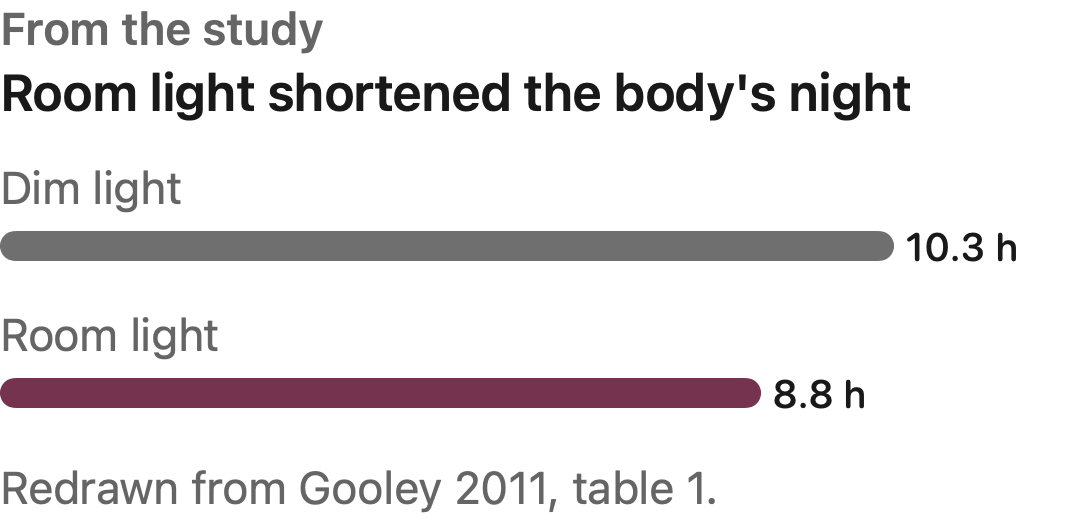
The end of the night signal did not clearly move, so the shortening came from its later start. The room-light evening always came first. The authors argue that the light held melatonin back more than it shifted the body clock, and what they measured was melatonin, not the clock itself. Between melatonin's rise and bedtime, there was about 71% less of it in room light.1
A second, smaller study kept volunteers awake in room light through their usual sleep hours. Compared with a night asleep in darkness, melatonin fell by more than 50% in most trials (85%). That was 11 of 13 trials, run in 12 volunteers.1
Millions of people sit in room light before bed, the authors point out. If you read, cook or scroll under ordinary lamps in the evening, that is the kind of light this study tested.1
How little light does it take to move your night signal?
In 55 young adults, evening light of 10 to 50 lux pushed melatonin's rise later by 22 to 109 minutes.
Before electric light, people were mostly in bright light or in dim light. Today people spend hours at the levels in between. A team in Melbourne tested those levels in 55 healthy young volunteers. Each spent evenings in the lab under a dim control light and under other lights from 10 to 2,000 lux, five hours at a time.3
Across the group, about 25 lux was enough to cut melatonin by 50%. The apparent melatonin onset, the rise seen while the light is on, came later as the light rose: 22 minutes later at 10 lux, and 109 at 50.3
The light came on four hours before each person's usual bedtime and stayed on until an hour after it. A short evening under one lamp was not tested.3
Does everyone react the same way?
No. Light that cut melatonin by 50% ranged from about 6 lux in the most sensitive person to 350 in the least.
The same study fitted a curve for each volunteer. For the 42 whose curves were reliable, the light that cut melatonin by 50% ranged from about 6 lux to about 350. That is a gap of more than tenfold.3
Two volunteers show it. The least sensitive needed about 400 lux to cut melatonin by about half. The most sensitive got the same cut at only 10 lux.3
All 55 were aged 18 to 30. The study measured the spread; it does not say why people differ.3
The same room can affect you and a friend very differently. Here each person's number came from hourly saliva samples in a lab.3
Do real homes reach those levels?
A model predicted a 50% melatonin cut in many Melbourne homes, with responses from 0 to 87% between people.
Researchers in Melbourne asked 62 adults to clip a light sensor to their clothes and record evenings at home, for up to four nights. They combined each home's light in the three hours before bed with the sensitivity curves from the young adults above.3,4
On that pairing, 48% of homes were predicted to cut melatonin by at least 50%, averaging over people. Nobody's melatonin was measured at home, so this is a model, and its curves came from young adults.4
One recorded sunset took 22 minutes to fall from the light that cuts melatonin by 50% in the least sensitive person to the level for the most sensitive. Home light stayed in that range all evening. The authors call it an extended twilight.4
Evenings brighter than a person's own usual went with more waking in the first 90 minutes after bedtime, as scored by a wrist sensor. A person's average light did not predict it.4
Bulbs differed too. Homes with energy-efficient lights had nearly double the melanopic illuminance of homes with incandescent lights. That measure shows how strongly light reaches the eye cells that tell the body clock about light. So bulb type may matter as well as how bright your room looks.4
What about screens before bed?
In one small trial, evenings reading on a light-emitting tablet suppressed melatonin and delayed the body clock more than a printed book did.
At a Boston hospital's sleep unit, 12 healthy young adults took part. For five evenings they read on a tablet for about four hours before bed. For five more they read printed books, in the same very dim room.5
After tablet evenings, melatonin was suppressed by about 55%. With books it was not. The next evening, melatonin began to rise more than 1.5 hours later after the tablet.5
Sleep changed a little. It took about 26 minutes to fall asleep after the tablet, against about 16 after books, and REM sleep was about 12 minutes shorter. Total sleep time did not differ.5
It was 12 people, one device and five evenings. Other screens, and evenings with lamps on, were not tested.5
The book was the comparison, in the same dim light. The trial tells you about a tablet's light, not about reading.5
What does this mean for you?
One expert panel recommends dim evenings and a dark bedroom for healthy adults. The studies here do not test that advice.
- Dim, three hours out. An expert panel, not a trial, recommends a maximum of 10 on a melanopic scale at the eye, starting at least 3 hours before bedtime. That scale counts how strongly light reaches the eye cells that tell the body clock about light. It is not the same as room lux.6
- Dark to sleep. The panel says the sleeping room should be as dark as possible, at most 1 on that scale.6
- Any source. The limit is set at the eye, whatever the source. Where possible, the panel prefers white light with less short-wavelength light.6
- Your own number. The panel's figure aims at the average healthy adult. In the lab study above, the light that cut melatonin by 50% differed more than tenfold between people.3,6
- Not for everyone. The figures come from healthy adults aged 18 to 55 on regular daytime schedules. The panel says they are not meant for night shifts, and children and older people may need other levels.6
- What is not shown. The room-light study measured melatonin, not sleep or the body clock itself. Sleep results here come from one 12-person trial and one home study that found only a link.1,4,5
Sources
Every number in this article comes from these studies. Checked 12 November 2026.
- Gooley JJ, Chamberlain K, Smith KA, et al. (2011). Exposure to room light before bedtime suppresses melatonin onset and shortens melatonin duration in humans. Journal of Clinical Endocrinology and Metabolism. doi:10.1210/jc.2010-2098 · PubMed
- Blume C, Garbazza C, Spitschan M (2019). Effects of light on human circadian rhythms, sleep and mood. Somnologie. doi:10.1007/s11818-019-00215-x · PubMed
- Phillips AJK, Vidafar P, Burns AC, et al. (2019). High sensitivity and interindividual variability in the response of the human circadian system to evening light. Proceedings of the National Academy of Sciences. doi:10.1073/pnas.1901824116 · PubMed
- Cain SW, McGlashan EM, Vidafar P, et al. (2020). Evening home lighting adversely impacts the circadian system and sleep. Scientific Reports. doi:10.1038/s41598-020-75622-4 · PubMed
- Chang AM, Aeschbach D, Duffy JF, Czeisler CA (2015). Evening use of light-emitting eReaders negatively affects sleep, circadian timing, and next-morning alertness. Proceedings of the National Academy of Sciences. doi:10.1073/pnas.1418490112 · PubMed
- Brown TM, Brainard GC, Cajochen C, et al. (2022). Recommendations for daytime, evening, and nighttime indoor light exposure to best support physiology, sleep, and wakefulness in healthy adults. PLoS Biology. doi:10.1371/journal.pbio.3001571 · PubMed