
How sleep works
A night is not one long switch-off. It runs in loops of light, deep and dreaming sleep, with deep sleep mostly early and dreaming sleep later.
What is happening while you sleep?
Your brain works through stages. Light sleep, deep sleep and dreaming sleep each have a pattern of their own.
One December evening in 1951, Eugene Aserinsky recorded the sleep of his young son. Through the night the boy's eyes moved in bursts beneath closed lids, in periods that came back again and again. Aserinsky and Nathaniel Kleitman published the finding in 1953. It showed that sleep has a pattern of its own.1
A sleep lab tells the stages apart by recording brain waves, among other signals. Light sleep is the shallowest stage. In deep sleep, big slow waves take over the brain's activity. REM sleep, the dreaming stage, is named for the rapid eye movements Aserinsky saw.1,2
In a young adult's typical night, light sleep fills about half the time or a little more. Deep sleep and dreaming sleep each take roughly a fifth.2
These are typical ranges, and your own mix will differ. In a reference study of 206 healthy adults, sleep measures varied widely from person to person and from one night to the next.3
How does a night run?
In loops of light, deep and dreaming sleep, each lasting about 80 to 120 minutes.
You do not drop into deep sleep and stay there. A sleep cycle is one trip down from light sleep into deep sleep and back up, ending in dreaming sleep before the next cycle begins. In a healthy young adult it lasts about 80 to 120 minutes.2
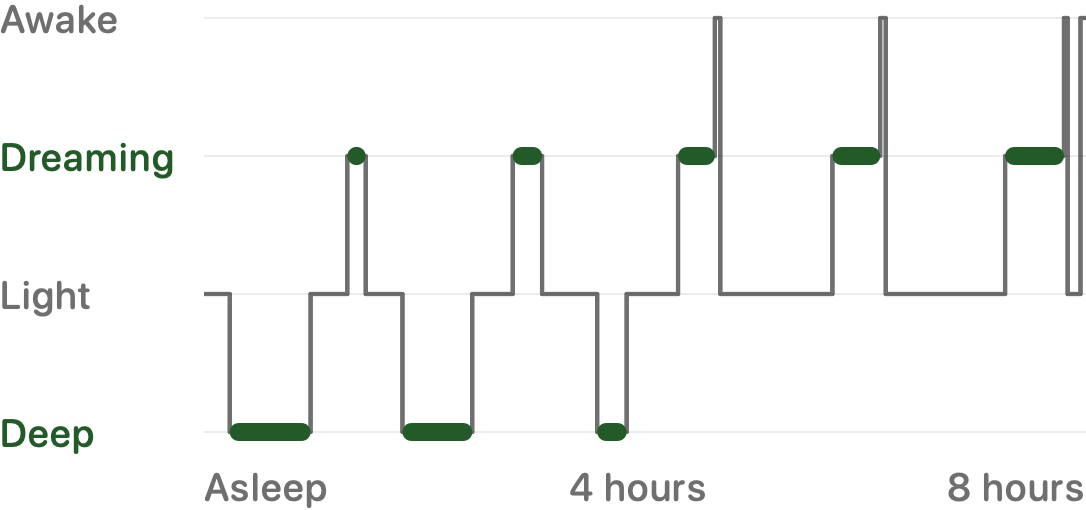
The loops are not identical. The strength of the slow waves that mark deep sleep, called slow-wave activity, climbs less high in each cycle than in the one before. Dreaming sleep peaks close to your usual waking time.2
A normal night has brief arousals, short shifts in brain activity that are not full wakings. In ten healthy young adults, recordings showed about 15 an hour, each lasting about 15 seconds. The authors describe them as a normal part of sleep.4
What is the night for?
Sleep is tied to a growth hormone pulse and to memory. Why we sleep at all is still not settled.
In young adults, a major pulse of growth hormone is released soon after you fall asleep, alongside the first deep sleep. In men, about 70% of the day's output comes in early sleep. In women the share is lower and varies more. Across a night, more deep sleep went with more growth hormone, and wakings with less.5
Sleep also helps memories settle, a process called memory consolidation. One large review argues that recent memories are reactivated during deep sleep and built into long-term memory. Dreaming sleep that follows may steady them. Older research focused on dreaming sleep, and newer work points to deep sleep.6
Another idea is that sleep cleans the brain. In mice, the space between brain cells grew by about 60% in sleep, and a waste protein called amyloid-beta cleared about twice as fast. A 2024 study in male mice measured the opposite: clearance was lower in sleep and under anaesthesia. The idea is contested, and in people the evidence is indirect.7,8
A blunter clue comes from rats kept from sleeping at all. All ten died, or were killed when death seemed near, within 11 to 32 days, and no anatomical cause was found. That is a result in rats, and it does not say what a person would lose.9
What decides when you sleep?
Two forces: sleep pressure, which builds while you are awake, and a body clock that runs on about 24 hours.
Sleep pressure is the need for sleep that builds with every hour awake and drains while you sleep. One chemical that may track it is adenosine. In cats kept awake for a long time, its level in a part of the brain rose steadily, then fell during recovery sleep.2,10
The second force is the body clock, a rhythm of about 24 hours that helps time when you sleep. It has its own article. Together, the two forces make up the two-process model, which has guided sleep research for decades.11
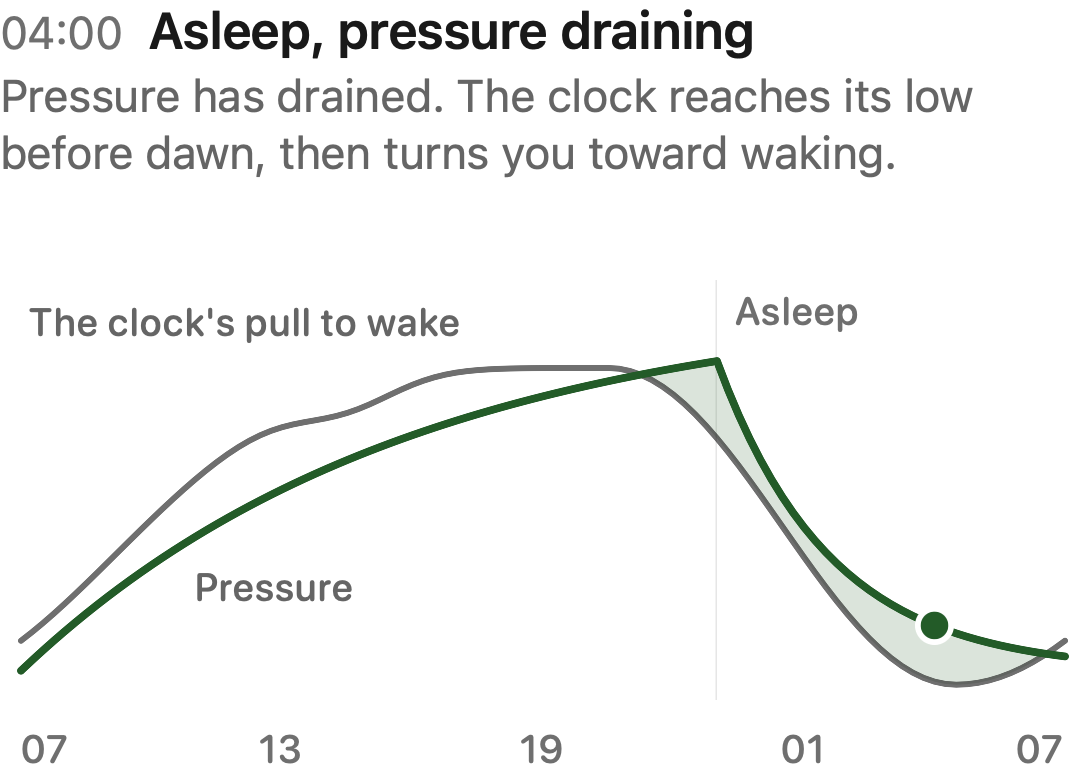
The two forces also shape the night differently. In studies that put people on 20-hour or 28-hour days, bedtime fell at every point of the body-clock cycle. Deep sleep followed mainly how long people had been awake. Dreaming sleep was shaped largely by the clock.2
Picture two dials: how tired you are, and the clock's setting for the hour. In the model, the two together predict when sleep comes and how intense it is, and they have done so across many experiments.11
What changes your sleep?
A strange bed and the passing years. A first night away is lighter, and deep sleep shrinks with age.
A first night in an unfamiliar bed is often poor. In a lab study of 35 young, healthy volunteers, a network on the left side of the brain slept less deeply on the first night. That side reacted more strongly to unusual sounds, and those sounds woke people more often. A week later the difference was gone.12
The authors read this as a brain keeping watch over unfamiliar surroundings. That is their interpretation of a small study in young adults. In dolphins, a 1977 paper reported that the two sides of the brain have different sleep patterns.12,13
If you have less deep sleep at 55 than at 25, that fits a normal drift. A meta-analysis of healthy people found that deep sleep fell about 2% a decade in adults. Time awake after first falling asleep grew about 10 minutes a decade from the 30s on. How much sleep you need as you age has its own article.14
The size of these changes depended on how carefully the volunteers were screened for illness and sleep disorders, so treat them as a rough drift.14
Brief arousals grow more frequent with age too. In the same small study as before, ten people aged 60 or over averaged about 27 an hour.4
Sex shows a difference too. In the reference study of 206 healthy adults, women had a higher share of deep sleep than men.3
What can you do with this?
Read your nights as a whole, and expect some rough ones. The evidence here is about understanding sleep, not fixing it.
- Read the whole night. Healthy sleep varies a great deal. The authors of one reference study warn that telling people how their sleep departs from a norm may cause ill-founded worry.3
- Expect a rough first night away. Troubled sleep in a new place is a known, temporary effect.12
- Treat watch stages as a sketch. In one lab comparison, consumer devices detected sleep well, but their stage calls were inconsistent.15
Sources
Every number in this article comes from these studies. Checked 12 November 2026.
- Aserinsky E, Kleitman N. (1953). Regularly occurring periods of eye motility, and concomitant phenomena, during sleep. Science. doi:10.1126/science.118.3062.273 · PubMed
- Dijk DJ. (2009). Regulation and functional correlates of slow wave sleep. Journal of Clinical Sleep Medicine. PubMed
- Hertenstein E, Gabryelska A, Spiegelhalder K, et al. (2018). Reference data for polysomnography-measured and subjective sleep in healthy adults. Journal of Clinical Sleep Medicine. doi:10.5664/jcsm.7036 · PubMed
- Boselli M, Parrino L, Smerieri A, Terzano MG. (1998). Effect of age on EEG arousals in normal sleep. Sleep. doi:10.1093/sleep/21.4.361 · PubMed
- Van Cauter E, Plat L, Copinschi G. (1998). Interrelations between sleep and the somatotropic axis. Sleep. doi:10.1093/sleep/21.6.553 · PubMed
- Rasch B, Born J. (2013). About sleep's role in memory. Physiological Reviews. doi:10.1152/physrev.00032.2012 · PubMed
- Xie L, Kang H, Xu Q, et al. (2013). Sleep drives metabolite clearance from the adult brain. Science. doi:10.1126/science.1241224 · PubMed
- Miao A, Luo T, Hsieh B, et al. (2024). Brain clearance is reduced during sleep and anesthesia. Nature Neuroscience. doi:10.1038/s41593-024-01638-y · PubMed
- Everson CA, Bergmann BM, Rechtschaffen A. (1989). Sleep deprivation in the rat: III. Total sleep deprivation. Sleep. doi:10.1093/sleep/12.1.13 · PubMed
- Porkka-Heiskanen T, Strecker RE, Thakkar M, Bjorkum AA, Greene RW, McCarley RW. (1997). Adenosine: a mediator of the sleep-inducing effects of prolonged wakefulness. Science. doi:10.1126/science.276.5316.1265 · PubMed
- Borbely AA, Daan S, Wirz-Justice A, Deboer T. (2016). The two-process model of sleep regulation: a reappraisal. Journal of Sleep Research. doi:10.1111/jsr.12371 · PubMed
- Tamaki M, Bang JW, Watanabe T, Sasaki Y. (2016). Night watch in one brain hemisphere during sleep associated with the first-night effect in humans. Current Biology. doi:10.1016/j.cub.2016.02.063 · PubMed
- Mukhametov LM, Supin AY, Polyakova IG. (1977). Interhemispheric asymmetry of the electroencephalographic sleep patterns in dolphins. Brain Research. doi:10.1016/0006-8993(77)90835-6 · PubMed
- Ohayon MM, Carskadon MA, Guilleminault C, Vitiello MV. (2004). Meta-analysis of quantitative sleep parameters from childhood to old age in healthy individuals: developing normative sleep values across the human lifespan. Sleep. doi:10.1093/sleep/27.7.1255 · PubMed
- Chinoy ED, Cuellar JA, Huwa KE, et al. (2021). Performance of seven consumer sleep-tracking devices compared with polysomnography. Sleep. doi:10.1093/sleep/zsaa291 · PubMed