
Sleep score
Your Sleep score folds one night into a single number. It asks how well the night met what your body needs, not only how long it was.
What does the Sleep score show?
How well one night met your own need, as a number with a word beside it.
On Sleep, the top card shows last night's score with a word beside it, and under it your hours asleep against your need. The words come from the score, from Excellent at 85 and up to Recovery night under 50, with Great, Good and Fair between. Home shows the same number.
Tap the card and the Sleep score page draws your scores night by night. The shaded band is your usual: the middle of your scores over the 28 days before, give or take 5 points. A night under the band is drawn in amber. Nights you marked as travel or illness are left out of your usual, and the band appears once you have 7 scored nights.
What goes into it?
The night's hours, how unbroken it was, your heart and the stage mix, each worth a different share.
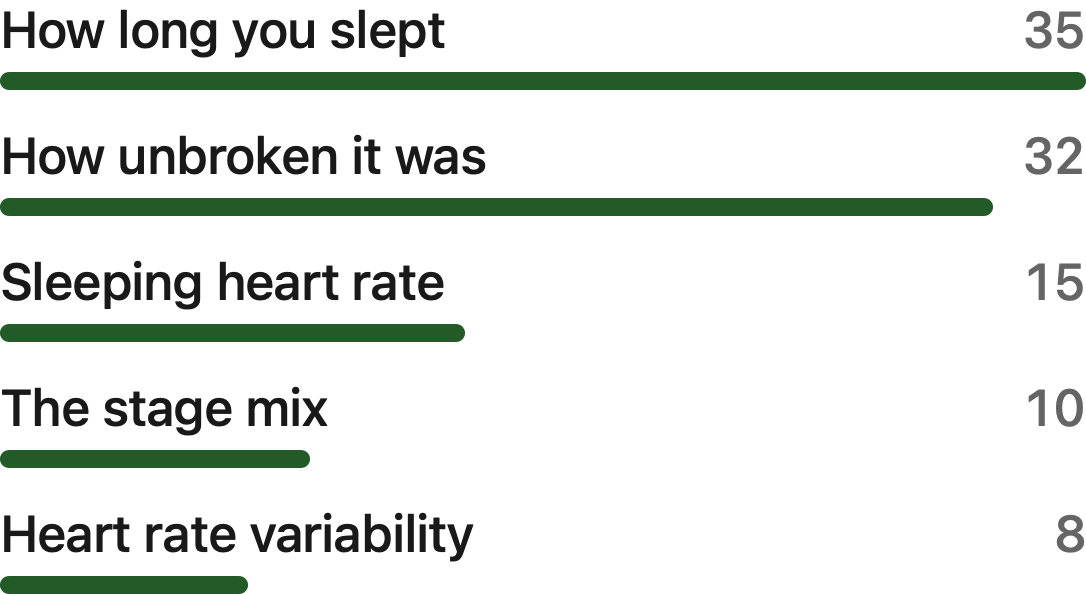
The score has 100 points, shared by five parts. How long you slept, set against your need, is worth the most, and how unbroken it was comes next. Your sleeping heart rate, the stage mix and heart rate variability, how much the gaps between heartbeats vary, share the rest, as the figure above shows.
Experts agreed more about how unbroken a night was than about its stages. A National Sleep Foundation panel agreed that time awake after falling asleep and sleep efficiency, the share of bed time spent asleep, are good signs of sleep quality at any age. It found less or no consensus on sleep architecture, the mix of stages. Consumer trackers are shaky on stages too: in a lab test of 6 wrist devices, agreement with the lab's stage scoring was fair to moderate, and a test of 11 trackers found it varied widely. That is why the stage mix counts for so little.1,2,3
How is each part worked out?
Hours against your need, the share of bed time spent asleep, then your heart and the stages against your own usual.
How long you slept is your time asleep against your need. Your need is the one the Sleep page shows, never below 7 hours, plus up to 30 minutes after a hard day: a high Strain score the day before. The Sleep page's line about nights under your need leaves that extra out.
A night from a little under your need to 45 minutes over it earns all 35 points. An hour under earns about half of them. Going well over trims it a little.
Why your own need, and not one number for everyone? In one lab study, each person's own best sleep length differed, and the gap between it and their usual sleep tracked sleepiness more strongly than hours slept alone. Aera works your need out from your usual nights, a rougher stand-in.4
How unbroken it was reads how much of your time in bed you spent asleep, and how many minutes an hour you were awake. It does not count how many times you woke. Asleep for 92% or more of your time in bed, with little waking, earns all 32 points. Less sleep, or more waking, earns less.
Your sleeping heart rate is your average heart rate while asleep, against your own usual. A little below your usual earns all 15 points, and the points fall as it rises. Heart rate variability earns all 8 points a little above your usual.
These two are kept modest on purpose. An Apple Watch takes only a handful of overnight variability readings, so one noisy reading could swing a bigger slice. A 2025 review of 11 trials found that sleep deprivation lowered one common measure of variability. Another measure, the one Aera reads from Apple Health, fell by too little to rule out chance. Counting a calm heart as a sign the night did its job is Aera's judgment, not a proven finding.5
The stage mix looks at deep and REM sleep. Each is ranked, as a share of your sleep, against your recent nights, and a night near the top of that range earns the stage's full marks. A thin stage is held to 60% of its points, whatever its rank. The line is 55 minutes of deep or 75 of REM.

What happens in your first nights, and with one odd reading?
Fixed ranges stand in until Aera has your nights, and smoothing keeps one odd reading from swinging the score.
Until you have 7 ordinary nights, your need is 8 hours. It then slides toward your own usual and is fully yours from 14 nights. Nights you marked as travel or illness do not count, nor do very short ones.
Heart rate, variability and the stage mix use fixed ranges until they have 7 nights of that reading to compare with. A sleeping heart rate of 50 beats a minute or lower earns all 15 points, then fewer as it rises. After that your own nights set the bar.
One odd reading should not swing a score. Your sleeping heart rate is a weighted average of tonight and the two nights before, with tonight counting most. Variability is averaged over up to 7 nights. A study of trained triathletes advised at least 3 valid variability readings a week to monitor training, though that was about training, not sleep.6
What happens on a short or broken night?
On a night short of your need some parts shrink, and a very short or restless night gets a ceiling.
On a night shorter than your need, the stage mix and variability are scaled down: a little at half an hour short, and by a quarter at 2 hours short. This is Aera's own rule: on a short night they sample only part of the night, so they cannot earn full credit.
Some nights have a ceiling, however good the rest looks. Under 6 hours asleep, your score cannot pass 55. The ceiling steps down with each hour less, to 20 at the shortest.
A broken night has its own ceiling: more than 75 minutes awake holds the score to 50.
These cut-offs are Aera's own choice, not taken from a study. The sleep ones are there so that a 4-hour night with a calm heart cannot score 75.
When does it show nothing?
When a night has no recorded time asleep or in bed. Aera does not guess; a missing part hands its points to the others.
Without both a time asleep and a time in bed, a night has no score. The Sleep page shows the hours it has instead, with the word Full night or Short night, and the card does not open the score page.
Not every watch records every part. Aera does not guess a missing one. Its points move to the parts that were recorded, in proportion to their size, so a full night can still reach 100. A night with hours only, and no stages, wake-ups or heart readings, gets a score from your hours alone.
Some devices write only asleep and in-bed time to Apple Health, with no stages and no wake-ups. On such a night zero minutes awake means unknown, not unbroken, so the unbroken-night part sits out. A night with stages but no wake-ups counts as unbroken. A daytime variability reading is never a stand-in for the overnight one.
What can't it tell you?
How rested you feel, or whether you have a sleep problem. One night's number is an estimate.
Wrist devices rarely miss sleep, but they often call quiet waking sleep. In a lab test of 6 devices, all caught over 90% of sleep, yet they identified only about a third to a half of the waking. Another lab test found devices tended to do worse on disrupted nights. So a restless night may read as more unbroken than it was.2,7
The score is built from what a watch can sense. It cannot say how rested you feel, and it cannot spot a sleep problem. If you are worried about your sleep, talk to a doctor.
Sources
The studies behind this article. Where a number is Aera's own choice, the text says so. Checked 12 November 2026.
- Ohayon M, Wickwire EM, Hirshkowitz M, et al. (2017). National Sleep Foundation's sleep quality recommendations: first report. Sleep Health. doi:10.1016/j.sleh.2016.11.006 · PubMed
- Schyvens AM, Peters B, Van Oost NC, et al. (2025). A performance validation of six commercial wrist-worn wearable sleep-tracking devices for sleep stage scoring compared to polysomnography. Sleep Advances. doi:10.1093/sleepadvances/zpaf021 · PubMed
- Lee T, Cho Y, Cha KS, et al. (2023). Accuracy of 11 Wearable, Nearable, and Airable Consumer Sleep Trackers: Prospective Multicenter Validation Study. JMIR mHealth and uHealth. doi:10.2196/50983 · PubMed
- Kitamura S, Katayose Y, Nakazaki K, et al. (2016). Estimating individual optimal sleep duration and potential sleep debt. Scientific Reports. doi:10.1038/srep35812 · PubMed
- Zhang S, Niu X, Ma J, et al. (2025). Effects of sleep deprivation on heart rate variability: a systematic review and meta-analysis. Frontiers in Neurology. doi:10.3389/fneur.2025.1556784 · PubMed
- Plews DJ, Laursen PB, Le Meur Y, Hausswirth C, Kilding AE, Buchheit M (2014). Monitoring training with heart rate-variability: how much compliance is needed for valid assessment? International Journal of Sports Physiology and Performance. doi:10.1123/ijspp.2013-0455 · PubMed
- Chinoy ED, Cuellar JA, Huwa KE, et al. (2021). Performance of seven consumer sleep-tracking devices compared with polysomnography. Sleep. doi:10.1093/sleep/zsaa291 · PubMed