
Sleep need and debt
Your need is the sleep Aera learns from your own nights. Your debt is a running balance of how far recent nights have left you from it.
What do your need and debt show?
A nightly amount learned from you, and a running balance against it that short nights add to and long nights ease.
On Sleep, your hours asleep sit against your need. A night that comes within half an hour of your need, or beats it, is a Full night. A night further under is a Short night. The Sleep debt section adds up what recent nights have left you owing.
Debt is a balance, not last night alone. A short night adds to it, a longer night takes a little off, and old debt fades. The page says None owed when you are within 15 minutes of your need either way, Owed when you are further behind and To spare when you are further ahead.
The 30 minutes and the 15 minutes are Aera's choices, not taken from a study.
What goes into your need?
Your own ordinary nights from recent weeks. Their middle is your need, held between a floor and a ceiling.
Aera takes your nights over the last 8 weeks and finds their median: put them in order and take the one in the middle. Half your nights run longer than that middle and half run shorter. The window is calendar days, so weeks without your watch do not drag in older nights.
Only ordinary nights count. A night under 3 hours is left out, and so is a night you marked as sick or away. Naps never lower your need, because it is read from night sleep alone.
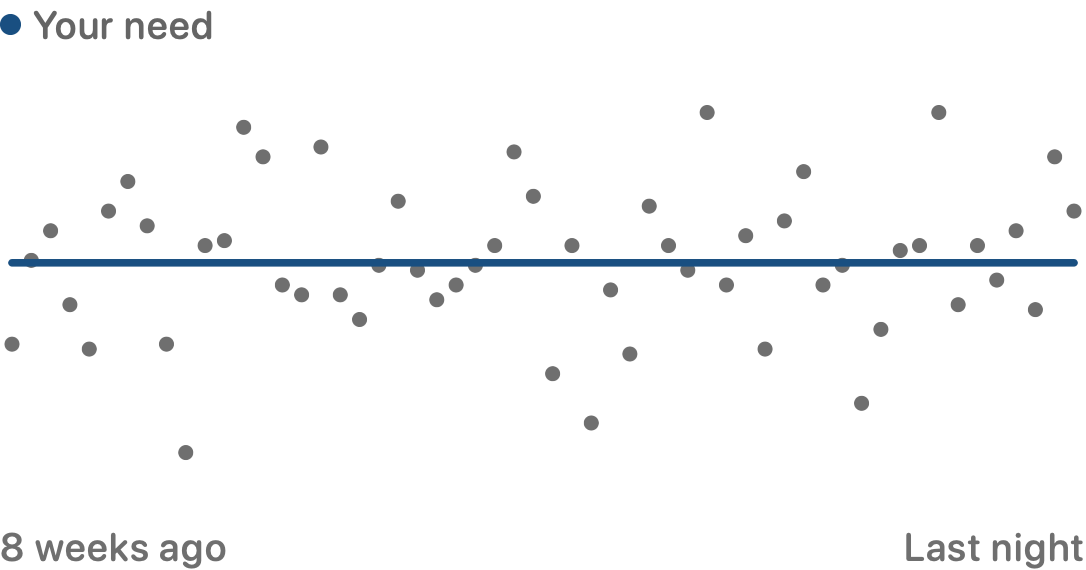
Why the middle and not your best nights? Your need is also the line your debt is measured from. Set above most of your nights, it would put an ordinary week in deficit, and the debt would never clear.
A floor and a ceiling hold your need between 7 and 10 hours, so a short habit never becomes your target.
Aera's 7 hour floor is the low end of the adult range a National Sleep Foundation panel advised. The article How much sleep you need covers that range. The 10 hour ceiling is not taken from a study.1
How is your debt counted?
Night by night. A short night is charged in full, a long night repays only part of its extra, and old debt fades.
Aera keeps one running balance, like a bank account. Each night it sets your sleep against your need plus any hard-day extra. A shortfall is charged in full. A surplus is banked at half, and one night's surplus counts for at most 90 minutes.
Lab studies suggest that catching up is the slow direction. In one, even a ten-hour night in bed did not fully repay a run of four-hour nights. Another found recovery incomplete after a week of restricted nights. The Six hours of sleep article tells both.2,3
How much a long night repays is Aera's choice, not taken from a study. The studies show the direction, not the size.
Debt also fades. Each recorded night 85% of the old balance carries over, so about 15% fades. Sleep exactly your need and what you owe falls by half in about four nights.
Lab results differ on how fast debt clears. In one, an hour of debt took four days of extended sleep to recover. In another, deficits kept building across a whole run of restricted nights. Aera's fade rate is its own choice, not taken from either study.4,5
Two limits hold the balance in range. Debt never reads worse than 10 hours owed, and your balance can get at most 3 hours ahead of your need. Both are Aera's choices, not taken from a study.
Naps count too. A nap of 20 minutes or more counts for half of the time you slept in it, on a day that also has a recorded night. On Sleep, the nap line says what the nap counted as, or Too short to count.
The 20 minutes and the share counted are Aera's choices, not taken from a study. In a small lab study of 11 young men, two 30 minute naps after a night cut to 2 hours normalised some stress-hormone and immune changes.6
What does tonight ask for?
Your need, a little more after a hard day, and a small extra when you are well behind.
The Tonight page adds it up line by line: Your need, Training, Paying back and Asleep tonight. Training, Paying back and the total show only when they add something.
Training is the extra after a hard day. A Strain score of 25 or lower adds nothing, and the extra rises with the score to 30 minutes at 85 or higher. These amounts are Aera's choice, not taken from a study.
Paying back is a small extra when you are behind. Under an hour behind it adds nothing. From an hour behind it adds about 1 minute for every 12 minutes behind, up to 15 minutes a night. Aera asks for it as an earlier bedtime, not a later wake-up. These amounts are Aera's choice, not taken from a study.
When does it show nothing?
Until Aera has a week of your nights. A night your watch missed leaves the balance where it was.
Under 7 ordinary nights, your need is 8 hours, and nothing in the app sets another. The Tonight page says 8 h to start, your own by 14 nights, with a count so far.
From 7 nights your need slides toward the middle of your own nights, a step with each new one, and from 14 nights it is yours alone. One study found that total sleep time from a movement sensor needed more than 7 nights to read reliably. The 14 is Aera's choice, not taken from a study.7
Debt waits for the same first week. Until then the Sleep page says debt starts counting after a week of nights.
A night your watch missed changes nothing. Aera does not guess it and does not charge you for it: the balance holds until the next recorded night. A gap is missing information, not a night that repaid anything.
Nights you mark as sick or away stay out of your need, but they still count toward your debt.
What can't it tell you?
Whether your need is what your body would take, or why a night was short.
Your need is a pattern in your nights, not a measurement of what your body wants. In one lab study each person's best sleep length differed, and the gap between it and their usual sleep tracked sleepiness more closely than hours slept alone. Usual sleep can fall short of what you would take, so the middle of your nights may read low. The floor is Aera's guard against that.4
The same National Sleep Foundation panel said needs differ from person to person. Your balance is an estimate: the fade rate, the share a long night repays and the limits are Aera's choices, so it can read a little higher or lower than you feel.1
Aera cannot tell why a night was short. If you feel unwell, or stay sleepy while your balance says None owed, talk to a doctor.
Sources
The studies behind this article. Where a number is Aera's own choice, the text says so. Checked 12 November 2026.
- Hirshkowitz M, Whiton K, Albert SM, et al. (2015). National Sleep Foundation's sleep time duration recommendations: methodology and results summary. Sleep Health. doi:10.1016/j.sleh.2014.12.010 · PubMed
- Banks S, Van Dongen HP, Maislin G, Dinges DF (2010). Neurobehavioral dynamics following chronic sleep restriction: dose-response effects of one night for recovery. Sleep. doi:10.1093/sleep/33.8.1013 · PubMed
- Belenky G, Wesensten NJ, Thorne DR, et al. (2003). Patterns of performance degradation and restoration during sleep restriction and subsequent recovery: a sleep dose-response study. Journal of Sleep Research. doi:10.1046/j.1365-2869.2003.00337.x · PubMed
- Kitamura S, Katayose Y, Nakazaki K, et al. (2016). Estimating individual optimal sleep duration and potential sleep debt. Scientific Reports. doi:10.1038/srep35812 · PubMed
- Van Dongen HP, Maislin G, Mullington JM, Dinges DF (2003). The cumulative cost of additional wakefulness: dose-response effects on neurobehavioral functions and sleep physiology from chronic sleep restriction and total sleep deprivation. Sleep. doi:10.1093/sleep/26.2.117 · PubMed
- Faraut B, Nakib S, Drogou C, et al. (2015). Napping reverses the salivary interleukin-6 and urinary norepinephrine changes induced by sleep restriction. The Journal of Clinical Endocrinology & Metabolism. doi:10.1210/jc.2014-2566 · PubMed
- Aili K, Åström-Paulsson S, Stoetzer U, Svartengren M, Hillert L (2017). Reliability of Actigraphy and Subjective Sleep Measurements in Adults: The Design of Sleep Assessments. Journal of Clinical Sleep Medicine. doi:10.5664/jcsm.6384 · PubMed