
Your usual
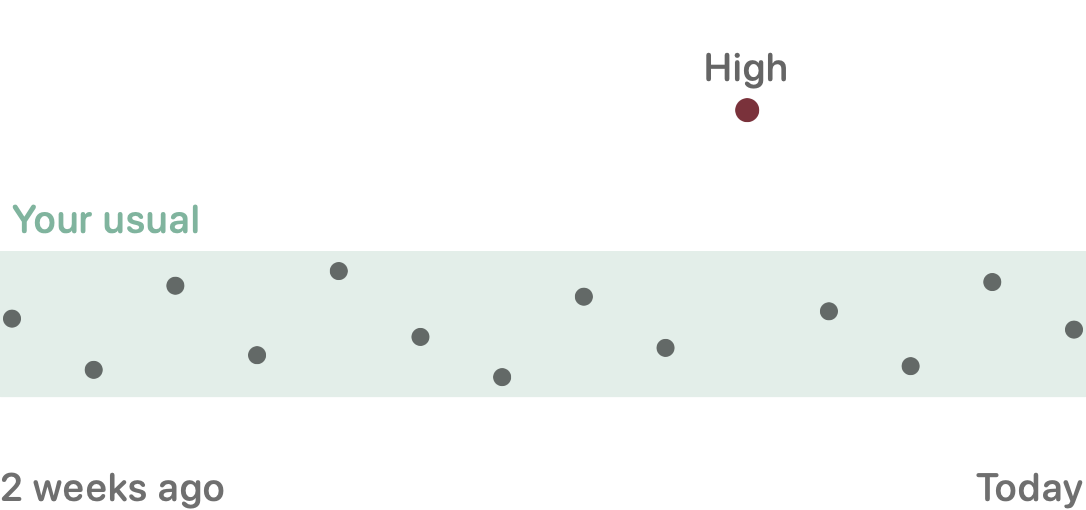
Your usual is the middle of your own recent readings, with a band around it for how much you normally swing. Aera reads each new reading against that band, never against other people.
What does your usual show?
Where each of your numbers normally sits, built from your own readings alone. Every new reading is placed against it.
Each vital's row on the Vitals page gives a word, such as Steady, then your usual range. The chart draws that range as one flat band behind your readings. On Home, Your body places last night's readings on a band the same way.
Your usual is the median of your recent readings: put them in order and take the one in the middle. The band around it is how far your readings normally stray from that middle.
Why compare you with you? In one large tracker study, a person's normal resting rate could differ from another's by as much as 70 beats a minute, while each person's own rate stayed far steadier. Even so, one person in five had a week when theirs swung by 10 beats or more, so a single reading outside your usual is not a verdict. The Resting heart rate article tells that study.1
What goes into it?
Your own readings from the days before, over a window that depends on the vital. Days with no reading are skipped.
Each vital has its own memory. Resting heart rate, HRV, breathing and blood oxygen look back 14 days. Steps, wrist temperature and most daytime readings look back 28. VO2 max, heart rate recovery, weight and body fat look back 42.
The longer window is for readings that arrive now and then. Weigh-ins and heart rate recovery would leave too few points in a shorter one. These lengths are Aera's choice, not taken from a study.
A new reading is measured against the days before it, not against itself. A night your watch missed is skipped, not counted as zero.
Aera uses the middle, not the average. An average is dragged by one wild value. The middle barely moves. A 2013 paper on spotting outliers put its advice in the title: do not use the standard deviation around the mean, use the absolute deviation around the median.2
How wide is the band?
One typical swing either side of your middle, never narrower than a floor set for each vital.
A typical swing is how far a reading usually lands from your middle. Aera takes each reading's distance from the middle, then the middle of those distances, scaled so it reads like a standard deviation. A steady person gets a tight band and a variable one a wider band.
Width differs between people. In a Fitbit study, nightly breathing rate varied more from night to night in older adults than in young ones. The Breathing rate article tells that study.3
A floor is the smallest change worth a word. It stops a quiet run of nights from making the band so thin that a tiny wobble reads as unusual. For resting heart rate it is 2 beats a minute and for HRV 6 milliseconds. Breathing and blood oxygen get 0.8, in breaths a minute and percentage points. The floors are Aera's choice, not taken from a study.
Two vitals break the rule. Wrist temperature has no swing: Steady means within 0.3 degrees Celsius of your middle. Blood oxygen counts only downward, so a reading above your usual stays Steady.
What do the words mean?
Steady, High or Low on the Vitals page. Home adds how far out a reading is, and whether that is better or worse.
On the Vitals page a reading is Steady inside your band, High above it and Low below it. It counts as outside only when its printed number sits outside the printed range, so a number never reads as outside a range that includes it.
Home's Your body uses softer words. Usual means inside the band. A bit better or A bit worse means up to 2 swings outside it, and Better or Worse means further. Under the heading, a line counts how many readings sat in your usual and how many outside it.
Which way counts as better is Aera's reading, not a medical rule: lower for resting heart rate and breathing, higher for HRV and blood oxygen. Wrist temperature outside its usual reads as worse in either direction.
After you have trained at much higher altitude than usual, a High resting heart rate or breathing reading carries a note about it. The word itself is not changed.
When does it show nothing?
Until it has enough of your own readings. Some vitals never get one at all.
Most vitals need 7 readings before a band is drawn. VO2 max, wrist temperature, heart rate recovery, weight and body fat need 5. Until then the row says Learning your usual, and the vital's page counts your readings so far and says when the usual will show.
It counts readings, not calendar days, so a night without your watch does not count. The 7 and 5 are Aera's choice, not taken from a study.
A day still going is not judged. Steps, active energy and the other whole-day totals read as So far today, and Aera reads them against your usual once the day ends.
Weight, VO2 max and the other vitals that arrive now and then keep their last reading, under its own date, on days with no new one.
Walking steadiness and mindful minutes never get a usual. Walking steadiness reads Reduced below 50%, and mindful minutes read Logged on a day with any minutes.
Do other pages keep their own usual?
Yes. Sleep, the setup read, Recovery and Stress each read their own stretch of days.
The Sleep score page draws your scores against a band. It is the middle of your scored nights in the 28 days before, 5 points either side, once you have 7. Nights you marked as travel or illness stay out.
On first opening Aera, the setup read works out a usual night from your Apple Health history. It is the middle of the last 28 nights, last night included, once there are 7. Nights under 3 hours stay out.
Is a week of nights enough? One study of a consumer sleep tracker in working adults found a month's average sleep length reached good reliability at 5 nights and very good at 10. Another found that a movement sensor needs more than 7 nights to read total sleep time reliably. So a week is a first read, not a settled one, and the 7 is Aera's choice, not a study's.4,5
The setup read also gives workouts a week: the middle of your last 8 full weeks. The week in progress stays out, and a rest week counts as zero. It needs 4 weeks since your first workout. That 4 is Aera's choice, not taken from a study.
Recovery reads each morning against the 28 days before it.
Stress reads against 21 days of daytime readings taken while you were still. Until it has 30 of them, it falls back to an earlier usual, or to a fixed 65 beats a minute.
Two reads do not use your usual at all. Body age compares you with people of your age and sex, and blood pressure uses fixed cut-offs.
What can't it tell you?
Whether your usual is healthy, or a slow drift. It knows only what has been normal for you lately.
Your usual moves with you. A number that worsens gently over months drags the middle along, so each day still looks ordinary against it. A few odd days barely shift the middle, but weeks of them can.
A usual is not a healthy range. It says what is normal for you, not whether that is good for you. A reading outside it says something changed, not what. If a change worries you or you feel unwell, talk to a doctor.
Sources
The studies behind this article. Where a number is Aera's own choice, the text says so. Checked 12 November 2026.
- Quer G, Gouda P, Galarnyk M, Topol EJ, Steinhubl SR (2020). Inter- and intraindividual variability in daily resting heart rate and its associations with age, sex, sleep, BMI, and time of year: Retrospective, longitudinal cohort study of 92,457 adults. PLoS ONE. doi:10.1371/journal.pone.0227709 · PubMed
- Leys C, Ley C, Klein O, Bernard P, Licata L (2013). Detecting outliers: Do not use standard deviation around the mean, use absolute deviation around the median. Journal of Experimental Social Psychology. doi:10.1016/j.jesp.2013.03.013
- Natarajan A, Su HW, Heneghan C, Blunt L, O'Connor C, Niehaus L (2021). Measurement of respiratory rate using wearable devices and applications to COVID-19 detection. npj Digital Medicine. doi:10.1038/s41746-021-00493-6 · PubMed
- Lau T, Ong JL, Ng BKL, Chan LF, Koek D, Tan CS, Müller-Riemenschneider F, Cheong K, Massar SAA, Chee MWL (2022). Minimum number of nights for reliable estimation of habitual sleep using a consumer sleep tracker. SLEEP Advances. doi:10.1093/sleepadvances/zpac026 · PubMed
- Aili K, Åström-Paulsson S, Stoetzer U, Svartengren M, Hillert L (2017). Reliability of Actigraphy and Subjective Sleep Measurements in Adults: The Design of Sleep Assessments. Journal of Clinical Sleep Medicine. doi:10.5664/jcsm.6384 · PubMed