
Blood oxygen
Blood oxygen is the share of your blood's oxygen carriers that are loaded, and it holds near full for a long way before it drops steeply. That shape is why a point or two means little near the top, and why a wrist reading is best taken as a rough guide.
What is blood oxygen, and how does light read it?
The share of your blood's oxygen carriers that are loaded. A sensor reads it from how red and infrared light pulse.
Pulse oximetry began with a nuisance. In December 1972 Takuo Aoyagi, an engineer at the Japanese company Nihon Kohden, was tracing a dye injected into a vein by shining light through an ear. A small pulsing kept spoiling his recording. He saw that the pulses carried a message about the oxygen in arterial blood, and in 1974 he presented a device built on that idea in Osaka.1
A pulse oximeter reports how much of your haemoglobin, the protein in red blood cells that carries oxygen, is loaded. A reading of 97% means about 97 of every 100 carriers are loaded and 3 are empty.2
The sensor sends two colours of light, red and infrared, into the skin. With every beat the blood in the tissue swells, and the light that comes back rises and falls. The sensor compares how strongly each colour pulses, and that ratio tracks how loaded the blood is.1
Only the pulsing part counts, and arteries are what pulse. So the number describes arterial blood, not the veins or the tissue around them. A fingertip clip sends light through the finger, while a watch catches light that bounces back from your wrist.1
Why do a few points matter more at some levels?
Fullness holds on a plateau, then falls off a cliff. Near the top a point means little; below the bend, a lot.
Blood does not fill in step with the pressure of oxygen around it. The relation is an S-shaped curve, drawn below. Where the blood is more than about 90% full, the curve is nearly flat, so a change in pressure moves the share only a little. Once the pressure falls under 60 millimetres of mercury, the share drops steeply.2
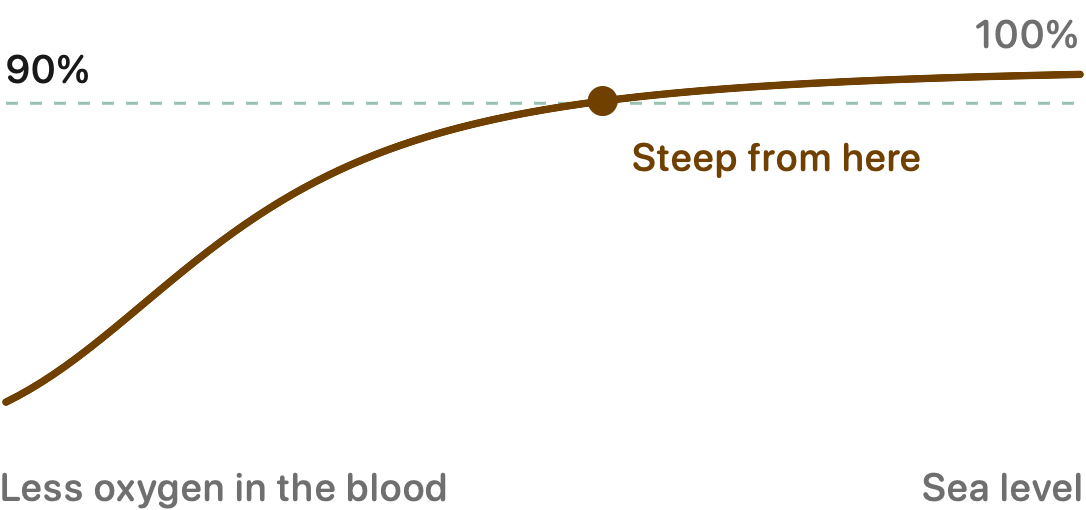
That curve rests on lab work and hospital blood, not on people wearing watches. In 3,524 hospital blood samples, a standard equation for the curve predicted saturation very accurately when acidity was normal and saturation was above 70%.2
So a 99 and a 96 on your wrist both sit on the flat part, where the percentage barely moves as the pressure changes. Below the bend the same change moves the number much further.2
What counts as a normal reading?
Most healthy people read 95% or higher awake. Asleep the number runs lower, and a low near 90 is ordinary.
If your watch shows 95 to 100% awake, you are in the range that both Apple's support page and the US Food and Drug Administration give for most people. Apple adds that some healthy people read lower. The FDA says people with lung problems can read lower too.
In a Norwegian survey of 6,317 adults, 6.3% had a resting fingertip reading of 95% or lower.3
Asleep, the number runs lower. In 350 people from babies to 85-year-olds, all with normal sleep tests, the lowest value of the night averaged about 90%.4
In a study of 33,080 people wearing one maker's watch, reported by that maker's own staff, overnight values averaged 0.8% lower, with the low point near midnight. A pooled analysis of sleep-lab studies of healthy adults found that each decade of age lowered the night's average by about 0.6%.5,6
So a lowest value near 90 on a night you slept well is not unusual for a healthy person, at least on a finger oximeter in a sleep lab.4
What does a low number mean for your health?
Low readings go with lung disease and, in sleep, with breathing pauses. One low reading on a watch is not a diagnosis.
In the Norwegian survey, the strongest links with a low reading were a body mass index of 35 or more and weak lung function. Older age, being male and smoking came next. The survey measured people once, so these are links, not proven causes.3
Asleep, researchers measure the hypoxic burden: how deep and how long the oxygen falls during each pause in breathing. In 5,111 adults followed over the years, the fifth with the highest burden had about twice the risk of dying from cardiovascular disease. The margin of doubt around that figure was wide. That compares groups, and is not a count of deaths per 100 people.7
These studies involved middle-aged and older adults, with breathing pauses measured by medical equipment. None used a watch, so they do not show that one low night on your wrist predicts anything.3,7
How far can you trust a wrist reading?
Awake and still, a watch usually lands within a few points of a medical oximeter. Outliers are larger, and low readings are least reliable.
In a review of five studies, the Apple Watch Series 6 typically landed within a few points of medical oximeters, and a later review of 82 studies found a similar spread. In the first, outliers reached 15 points and there was no strong lean to read high or low.8,9
In 49 patients, with and without lung disease, several smartwatches were compared with a clinical oximeter. The Apple Watch Series 7 came closest, with an average error of about 2%. The Garmin Venu 2s was furthest, at about 6%.10
Researchers then lowered oxygen on purpose and checked an Apple Watch Series 7 and a finger oximeter against blood samples. Both tended to read too high. Below 88%, the watch's typical error was about 6%, against about 3.5% for the finger device.11
The authors say the watch may miss low oxygen close to 88%. The study was small, with limited range in skin tone and age. We found no independent test of a wrist sensor across a whole night of sleep, so these say less about a wrist asleep.10,11
What can fool an oximeter?
Oximeters can read too high on darker skin, mostly at low oxygen. Severe carbon monoxide poisoning fools them too.
At the University of Michigan, researchers checked thousands of oximeter readings against blood tests. Among readings in the low to mid 90s, the true level was under 88% in 11.7% of tests in Black patients. In White patients it was 3.6%.12
A review of 44 studies found that most reported readings too high in people with darker skin tones, or assumed to have them. The gap was likely larger when oxygen is low. Many of those studies had a high risk of bias. One pooled analysis found that readings ran high on light skin too, by 0.7% against 1.3% on dark skin, and judged that this may not be clinically relevant.13,14
For watches the evidence is thinner. In the 49-patient test, the size of the errors did not differ clearly across skin tones, though the group was small. The direction of the error, too high or too low, may have varied with skin tone.10
So if your skin is darker, the hospital findings point to clip readings that run high, mostly at low oxygen. Whether a watch does the same is not settled, and we found no large independent test of a wrist sensor across skin tones.13
Skin is not the only trap. In 30 people with severe carbon monoxide poisoning, oximeter readings were consistently too high, and the error grew as the carbon monoxide level rose. These were hospital cases, not everyday exposure.15
What can you do with this?
Read a watch's oxygen number as a rough guide, and look at your own pattern rather than one night.
- Your own range. Your usual numbers, awake and asleep, are the fairer comparison, because healthy values shift with age and from person to person.5,6
- One night proves little. Wrist readings can miss low oxygen and can drop out, so a night lower than usual is not a diagnosis. A normal night does not rule out sleep apnoea or lung disease.10,11
- A wellness number. Apple's page says its readings are for general fitness and wellness, not medical use. The US Food and Drug Administration says oximeters not made for medical use skip its review.
- Breathless, or a lung or heart condition? Ask your doctor, who can set the targets that apply to you.
Sources
Every number in this article comes from these studies. Checked 12 November 2026.
- Quaresima V, Ferrari M, Scholkmann F (2024). Ninety years of pulse oximetry: history, current status, and outlook. Journal of Biomedical Optics. doi:10.1117/1.JBO.29.S3.S33307 · PubMed
- Collins JA, Rudenski A, Gibson J, Howard L, O'Driscoll R (2015). Relating oxygen partial pressure, saturation and content: the haemoglobin-oxygen dissociation curve. Breathe. doi:10.1183/20734735.001415 · PubMed
- Vold ML, Aasebo U, Hjalmarsen A, Melbye H (2012). Predictors of oxygen saturation 95% or below in a cross-sectional population based survey. Respiratory Medicine. doi:10.1016/j.rmed.2012.06.016 · PubMed
- Gries RE, Brooks LJ (1996). Normal oxyhemoglobin saturation during sleep. How low does it go? Chest. doi:10.1378/chest.110.6.1489 · PubMed
- Shapiro I, Stein J, MacRae C, O'Reilly M (2023). Pulse oximetry values from 33,080 participants in the Apple Heart & Movement Study. NPJ Digital Medicine. doi:10.1038/s41746-023-00851-6 · PubMed
- Boulos MI, Jairam T, Kendzerska T, et al. (2019). Normal polysomnography parameters in healthy adults: a systematic review and meta-analysis. Lancet Respiratory Medicine. doi:10.1016/S2213-2600(19)30057-8 · PubMed
- Azarbarzin A, Sands SA, Stone KL, et al. (2019). The hypoxic burden of sleep apnoea predicts cardiovascular disease-related mortality: the Osteoporotic Fractures in Men Study and the Sleep Heart Health Study. European Heart Journal. doi:10.1093/eurheartj/ehy624 · PubMed
- Windisch P, Schroder C, Forster R, Cihoric N, Zwahlen DR (2023). Accuracy of the Apple Watch oxygen saturation measurement in adults: a systematic review. Cureus. doi:10.7759/cureus.35355 · PubMed
- Lambe R, Baldwin M, O'Grady B, Schumann M, Caulfield B, Doherty C (2026). The accuracy of Apple Watch measurements: a living systematic review and meta-analysis. NPJ Digital Medicine. doi:10.1038/s41746-025-02238-1 · PubMed
- Jiang Y, Spies C, Magin J, Bhosai SJ, Snyder L, Dunn J (2023). Investigating the accuracy of blood oxygen saturation measurements in common consumer smartwatches. PLOS Digital Health. doi:10.1371/journal.pdig.0000296 · PubMed
- Jiang Y, Spies C, Roghanizad AR, et al. (2026). Performance of wearable pulse oximetry during controlled hypoxia induction: instrument validation study. JMIR Formative Research. doi:10.2196/85253 · PubMed
- Sjoding MW, Dickson RP, Iwashyna TJ, Gay SE, Valley TS (2020). Racial bias in pulse oximetry measurement. New England Journal of Medicine. doi:10.1056/NEJMc2029240 · PubMed
- Martin D, Johns C, Sorrell L, et al. (2024). Effect of skin tone on the accuracy of the estimation of arterial oxygen saturation by pulse oximetry: a systematic review. British Journal of Anaesthesia. doi:10.1016/j.bja.2024.01.023 · PubMed
- Singh S, Bennett MR, Chen C, Shin S, Ghanbari H, Nelson BW (2024). Impact of skin pigmentation on pulse oximetry blood oxygenation and wearable pulse rate accuracy: systematic review and meta-analysis. Journal of Medical Internet Research. doi:10.2196/62769 · PubMed
- Hampson NB (1998). Pulse oximetry in severe carbon monoxide poisoning. Chest. doi:10.1378/chest.114.4.1036 · PubMed