
Calories
Most of the energy you burn each day goes on staying alive, not on moving. In some studies, even very active lives did not burn as much extra as the sums suggest.
Where do the calories you burn go?
Mostly into staying alive. Resting metabolism is the biggest share, digesting food takes a smaller one, and movement is the part that changes.
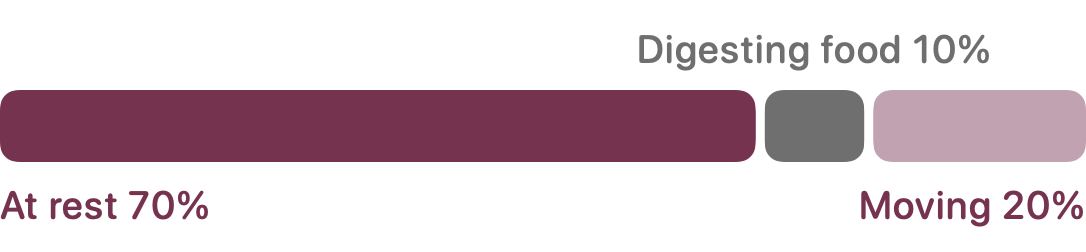
A calorie is a unit of energy: food holds it, and your body spends it every hour, asleep or awake. The energy you use lying still, just to keep going, is your resting metabolism. In sedentary adults it takes about 70% of the day, and digesting food takes about 10%.1
A house's bill works the same way: mostly heating and the fridge, which run all day, not the lamps you switch on. Movement is the changeable part. It runs from about 15% of the day in very sedentary people to as much as 50% in highly active ones, so an active person's resting share is lower.1
The brain is a bill you never feel. In an average adult it is about 2% of body weight but uses about 20% of the body's calories, and that rate stays nearly constant whatever you are thinking about. In childhood it takes far more: the brain's sugar use peaks at about two thirds of the body's resting energy, a figure modelled from brain scans.2,3
How do scientists measure the energy a body burns?
First in a room-size chamber, later with specially labelled water that follows a person through ordinary days.
In 1892 a scientist named Wilbur Atwater began building a room-size chamber at Wesleyan University in Connecticut. People lived inside it for a day or more while it measured the energy they used. With it, he and his colleagues showed that energy is neither lost nor made inside a human body.4
A sealed room is not ordinary life. Doubly labelled water gets around that. You drink water made with rarer forms of hydrogen and oxygen. The two leave your body at different speeds, and the gap between them shows how much energy you burn.5
The first human test, in 1982, gave it to four healthy adults. Its answer differed from what they ate, allowing for changes in their bodies, by 2% on average. Later checks put its precision at 8 to 9%, which is good for groups and not yet good enough for one person.5,6
Does an active life make you burn much more?
Less than you would expect: in one study, size for size, active hunter-gatherers burned no more a day than Westerners do.
The Hadza are hunter-gatherers, and they are more active than Western adults. Researchers measured the energy that 30 Hadza adults burned over 11 days. A busier life should show up as a bigger daily total.7
It did not. Size for size, their daily total was no different from Western adults'. Walking cost them the same, and so did resting. It was one small group, and the Hadza are leaner and smaller, which is why the comparison allows for body size.7
A second study set doubly labelled water against movement sensors in 332 adults from five populations. Total burn rose with activity at low levels, then levelled off among the most active. That finding is debated, and training studies that add exercise usually do raise energy use at least a little.8
At the extreme, a study of seven professional cyclists in the 24-day Giro d'Italia found they burned more than 6,900 calories a day.9
Nobody keeps that up for months. A 2019 analysis of long endurance events, including a transcontinental race, found a ceiling at about 2.5 times the basal rate. That is the energy the body uses at complete rest. Beyond that, the body has to draw on its own stores.10
How does your energy use change across a life?
Size for size, it peaks at about age 1, holds steady from 20 to 60, then slowly falls.
More than 6,000 people, from babies to people in their nineties, have had their daily energy use measured with labelled water. Once body size is allowed for, a one-year-old burns about 50% more than an adult. The extra fades slowly and is gone by about 20.11
Then comes a long flat stretch. From 20 to 60, energy use for a given body size holds steady, even in pregnancy. So in these data, people in their fifties burned about what people in their twenties did, for the same size.11
After 60 it falls, by about 0.7% a year for a given body size. Total use drops further, because lean tissue shrinks too and less tissue needs less energy.11
How much does fidgeting change what you burn?
A lot between people: unplanned movement accounted for 100 to 800 calories a day across people.
Researchers had 177 people spend a day in a whole-room chamber that measured their energy use. With body size set aside, fidgeting and other spontaneous movement still accounted for 100 to 800 calories a day across people.12
A second study tested what happens when people overeat. Sixteen volunteers who were not obese ate 1,000 calories a day more than they needed for eight weeks. The fat they stored differed about tenfold between them.13
Two thirds of the extra energy they burned came from NEAT, the fidgeting, posture and everyday movement nobody plans. Those who raised it most stored the least fat. It was a small study, and a link between the two is not proof.13
Why does exercise change your weight less than the sums say?
Reviews point to small doses of exercise and extra eating. In one trial, the largest dose took off less weight than predicted.
A review of trials concluded that weight lost through exercise tends to be lower than predicted. It put the small losses in most trials down mainly to low doses of exercise, made worse by people eating more. It named other possible causes: lower resting use, more lean tissue and less unplanned movement.14
A trial in 411 inactive, overweight women past menopause tested the sums directly: supervised exercise for six months at different doses. At the two smaller doses they lost about what the arithmetic predicted. At the largest, about 194 minutes a week, they lost only about half. Waists shrank in every exercise group, whatever happened to weight.15
It was one trial in one group of women, so it says little about men or younger people. It does not say exercise fails: it says the arithmetic can overstate the weight it takes off.14,15
What can you do with this?
The evidence supports treating a calorie number as a rough guide: most of the burn follows body size, and movement is the smaller part.
- Expect the bill to follow your size. In the chamber study, fat-free mass, the weight of everything but fat, explained 81% of the differences in daily energy use between people.12
- Your usual burn changes little day to day. In the same chamber, one person's energy use over 24 hours varied by only 2.4%. Movement was limited there, so ordinary days may vary more.12
- Treat a watch's calories as an estimate. In one 2017 test, no wrist device kept its typical calorie error under 20%.16
- Pregnant, unwell, or changing how you eat? Ask your doctor before relying on any calorie figure.
Sources
Every number in this article comes from these studies. Checked 12 November 2026.
- Lam YY, Ravussin E (2016). Analysis of energy metabolism in humans: a review of methodologies. Molecular Metabolism. doi:10.1016/j.molmet.2016.09.005 · PubMed
- Raichle ME, Gusnard DA (2002). Appraising the brain's energy budget. Proceedings of the National Academy of Sciences. doi:10.1073/pnas.172399499 · PubMed
- Kuzawa CW, Chugani HT, Grossman LI, et al. (2014). Metabolic costs and evolutionary implications of human brain development. Proceedings of the National Academy of Sciences. doi:10.1073/pnas.1323099111 · PubMed
- Bray GA (2020). In the footsteps of Wilbur Olin Atwater: the Atwater Lecture for 2019. Advances in Nutrition. doi:10.1093/advances/nmz128 · PubMed
- Speakman JR (1998). The history and theory of the doubly labeled water technique. American Journal of Clinical Nutrition. doi:10.1093/ajcn/68.4.932S · PubMed
- Schoeller DA, van Santen E (1982). Measurement of energy expenditure in humans by doubly labeled water method. Journal of Applied Physiology. doi:10.1152/jappl.1982.53.4.955 · PubMed
- Pontzer H, Raichlen DA, Wood BM, Mabulla AZP, Racette SB, Marlowe FW (2012). Hunter-gatherer energetics and human obesity. PLoS One. doi:10.1371/journal.pone.0040503 · PubMed
- Pontzer H, Durazo-Arvizu R, Dugas LR, et al. (2016). Constrained total energy expenditure and metabolic adaptation to physical activity in adult humans. Current Biology. doi:10.1016/j.cub.2015.12.046 · PubMed
- Plasqui G, Rietjens G, Lambriks L, Wouters L, Saris WHM (2019). Energy expenditure during extreme endurance exercise: the Giro d'Italia. Medicine and Science in Sports and Exercise. doi:10.1249/MSS.0000000000001814 · PubMed
- Thurber C, Dugas LR, Ocobock C, Carlson B, Speakman JR, Pontzer H (2019). Extreme events reveal an alimentary limit on sustained maximal human energy expenditure. Science Advances. doi:10.1126/sciadv.aaw0341 · PubMed
- Pontzer H, Yamada Y, Sagayama H, et al. (2021). Daily energy expenditure through the human life course. Science. doi:10.1126/science.abe5017 · PubMed
- Ravussin E, Lillioja S, Anderson TE, Christin L, Bogardus C (1986). Determinants of 24-hour energy expenditure in man: methods and results using a respiratory chamber. Journal of Clinical Investigation. doi:10.1172/JCI112749 · PubMed
- Levine JA, Eberhardt NL, Jensen MD (1999). Role of nonexercise activity thermogenesis in resistance to fat gain in humans. Science. doi:10.1126/science.283.5399.212 · PubMed
- Thomas DM, Bouchard C, Church T, et al. (2012). Why do individuals not lose more weight from an exercise intervention at a defined dose? An energy balance analysis. Obesity Reviews. doi:10.1111/j.1467-789X.2012.01012.x · PubMed
- Church TS, Martin CK, Thompson AM, Earnest CP, Mikus CR, Blair SN (2009). Changes in weight, waist circumference and compensatory responses with different doses of exercise among sedentary, overweight postmenopausal women. PLoS One. doi:10.1371/journal.pone.0004515 · PubMed
- Shcherbina A, Mattsson CM, Waggott D, et al. (2017). Accuracy in wrist-worn, sensor-based measurements of heart rate and energy expenditure in a diverse cohort. Journal of Personalized Medicine. doi:10.3390/jpm7020003 · PubMed