
A week of camping
Volunteers who spent a week camping with only daylight and campfire light had body clocks about two hours earlier than after a week of ordinary life. A weekend outdoors moved the clock part of the way.
What does a week of camping do to your body clock?
In one small study it ran earlier, and the body's night began near sunset.
Modern life brings less sunlight by day and more electric light after sunset. A team at the University of Colorado Boulder asked what the body clock does in the light it evolved with. Eight adults, aged about 30, lived one normal week of work, school and social life. The next week they camped in tents in the Rocky Mountains in July, with sunlight and campfires but no flashlights or electronic devices.1
The team followed the body's night through melatonin, the night-signal hormone that Your body clock explains. The moment melatonin starts to rise is taken as the start of that night, and the moment it falls as the end. They measured it in saliva after each week.1
In camp, they got more than four times as much light while awake. Between sunset and bedtime it flipped: about 21 lux at home and about 8 in camp.1
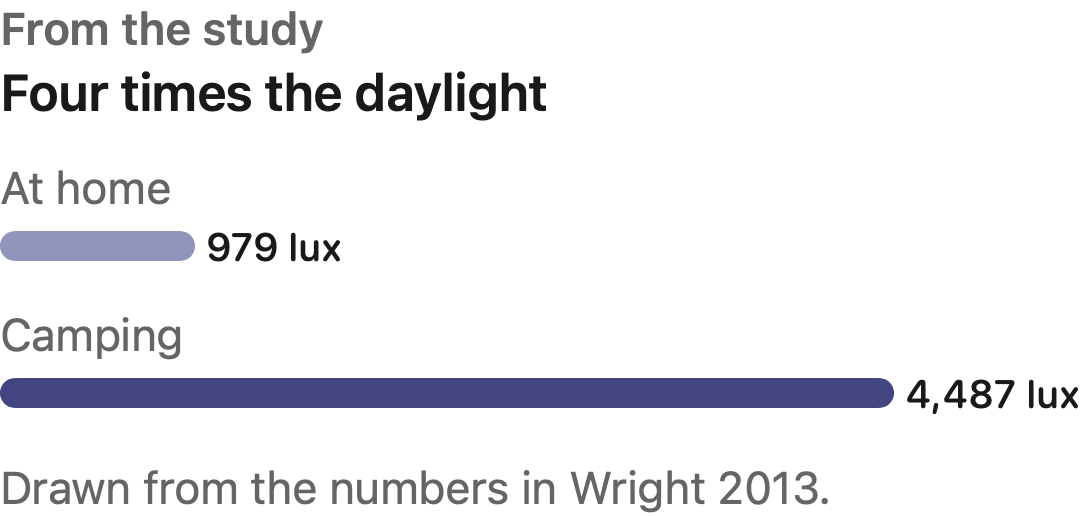
These volunteers lived outdoorsy lives in a sunny region, so their home light was already higher than is typical, the authors say.1
After the home week, melatonin began to rise about two hours before bed, and bed was around half past midnight. After the camp week, every timing marker had moved about two hours earlier. Melatonin now rose near sunset and fell before waking, which came just after sunrise.1
Sleep moved less than the clock did. Bed and wake times shifted about 1.2 hours, and sleep stayed about the same length: 6.7 hours at home and 6.8 in camp.1
A watch shows when you sleep, not where your clock sits. Here sleep timing moved by less than the clock did, so bedtime is only a rough guide to clock time.1
Did everyone move by the same amount?
No. People whose clocks started later moved the most, which pulled early and late types closer together.
At home, the volunteers' clocks spread out: the later a person's usual timing, the later their melatonin began. In camp no clear link was left. Those with the latest usual timing had moved the most, so they ended up closer to the early types.1
With so few people, "moved the most" rests on a handful of clocks. Camping also changed social life and activity, and the authors say those may have contributed to the earlier sleep timing.1
If you call yourself a night owl, some of that may be the light you live in, not only your wiring. This study cannot say how much.1
Does it work in winter?
Yes, in one small group: after camping in December, melatonin began earlier and sleep grew longer.
The same team went back near the winter solstice. Five adults camped for about six days in December, under the same rules: sunlight, moonlight and campfires only. Their light while awake was more than 13 times brighter than on their ordinary days beforehand.2
Melatonin began about 2.6 hours earlier than before camping.2
Sleep grew too, from about 7.6 hours to 9.9, as bedtime came about 2.5 hours earlier while wake time stayed about the same.2
Only the start of melatonin moved clearly. Its midpoint and end showed no clear change. The authors name the cold as a likely contributor to the longer sleep: people spent more time in warm tents and sleeping bags. The winter study did not randomise the order: home days came first.2
The body's night also ran longer in winter. Against the summer group of the earlier study, who were different people, melatonin lasted about 14 hours rather than 10. The authors liken this to seasonal changes seen in other animals.2
Their home days were ordinary days in everyday electric light. If your winter days are mostly indoors, those are the days to compare yourself with.2
Is a weekend enough?
Partly: a weekend outdoors did about 69% of what the week did, in a small group not assigned by chance.
Fourteen adults spent a July weekend either camping or at home. Nine camped and five stayed in their usual surroundings. The campers could use headlamps.2
The campers' melatonin began about 1.4 hours earlier than on a weekday, with no change in their sleep times. In the home group it began almost an hour later, as bed and wake times drifted about an hour later.2
Set against the full week reported earlier by the same team, the weekend did about 69% of the shift. That compares different people in different studies.1,2
People were not assigned to groups by chance, headlamps were allowed, and the group was small. The authors call for randomised crossover trials, which would also show how long the effect lasts once people are back indoors.2
Your weekends may run later than your weekdays, as the home group's did. The authors link that weekend drift to social jetlag, the gap between a late clock and an early alarm, which Weekend lie-ins covers.2
Can you get this without a tent?
One trial moved night owls about two hours earlier at home, but it changed several habits at once.
A randomised trial from the Universities of Birmingham and Surrey tried it in daily life. Its volunteers were night owls, people whose clocks run unusually late. The steps were earlier wake and sleep times to bring light earlier, fixed meal times, and changes to caffeine and exercise.3
Overall, sleep and wake times and two markers of the body clock moved about 2 hours earlier. Sleep length did not suffer. People also reported less depression and stress, and did better on reaction time and grip strength in the morning.3
The programme bundled four changes, so it cannot say how much came from light. The camping studies did not measure how long the shift lasts back indoors.2,3
In camp, the first two hours after waking were about three times brighter than at home. The authors note that the clock is most sensitive to clock-advancing light in that window. If you spend those hours indoors, that is one place where the weeks differed.1
What does this mean for you?
In these small studies, bright days and dark evenings went with earlier clocks. None showed that you need a tent.
- Mornings. Light in the first hours after waking was far brighter in camp, when clocks ran earlier. Nothing here separates it from the rest of the week.1
- Evenings. Home evenings were brighter than camp evenings, and the clock sat later. The Lamplight article tells that side.1
- Weekends. In a small group, a weekend outdoors moved the clock earlier, while a home weekend moved it later.2
- At home. No study here tested daylight alone without a camp, and the night-owl programme changed several things at once.3
- A very late clock? The authors suggest natural light may one day help people with delayed sleep phase, a condition of very late sleep timing. Neither camping study tested patients, so ask your doctor.1,2
Sources
Every number in this article comes from these studies. Checked 12 November 2026.
- Wright KP Jr, McHill AW, Birks BR, Griffin BR, Rusterholz T, Chinoy ED (2013). Entrainment of the Human Circadian Clock to the Natural Light-Dark Cycle. Current Biology. doi:10.1016/j.cub.2013.06.039 · PubMed
- Stothard ER, McHill AW, Depner CM, et al. (2017). Circadian Entrainment to the Natural Light-Dark Cycle across Seasons and the Weekend. Current Biology. doi:10.1016/j.cub.2016.12.041 · PubMed
- Facer-Childs ER, Middleton B, Skene DJ, Bagshaw AP (2019). Resetting the late timing of 'night owls' has a positive impact on mental health and performance. Sleep Medicine. doi:10.1016/j.sleep.2019.05.001 · PubMed