
How muscle grows
Your muscles are taken apart and rebuilt a little every day, whether you train or not. Lifting tips the balance toward building, and it makes you stronger even in your nineties.
What is muscle doing all day?
Rebuilding itself: every day it replaces roughly 1 to 2% of its protein.
Picture a brick wall that is repaired while people still live in the house. A few old bricks come out every day and a few new ones go in. As long as the two match, the wall keeps its size. Hard work against resistance speeds up the building for a day or two. Keep that up for weeks, with enough to eat, and the wall grows thicker.1,2,3
This is going on in you right now, on rest days too. Treat the 1 to 2% as a rough size: measured rates vary a lot with the method.4,5
Muscle grows by thickening the fibres it already has, each packed with more of the proteins that pull. Small helper cells beside each fibre, called satellite cells, help repair and rebuild it. In 23 young men who trained for 16 weeks, those whose helper cells multiplied most around their fast fibres, the ones made for strong, quick efforts, tended to gain the most thigh muscle.6,7,8
What tells muscle to grow?
Hard work against resistance. The strong pull on each fibre is the leading suspect.
Doctors put that pull to work long before anyone knew how it works. In 1945 an army doctor, Thomas DeLorme, had injured soldiers lift the heaviest weight they could manage ten times, for several sets, to win back their strength. By 1948 he called it progressive resistance exercise: three sets of ten, each heavier than the last.9
Sensors inside a fibre are thought to feel that pull and switch on the machinery that builds protein. A 2019 review called these pulling forces the prime candidates, while admitting that nobody fully understands the sensors yet.10
You don't need to feel wrecked. The small injuries that hard, unfamiliar work causes are probably not what makes muscle grow: one review concludes they do not drive growth, another calls them probably not essential.10,11
When does the building happen?
Mostly in the day or two after you train.
In a 1997 study, eight people who had never trained did eight sets of eight heavy reps. Three hours later, protein building in their muscle ran at more than double its resting rate. Two days later it was still up by a third. Another study found it back near normal after about a day and a half.1,2
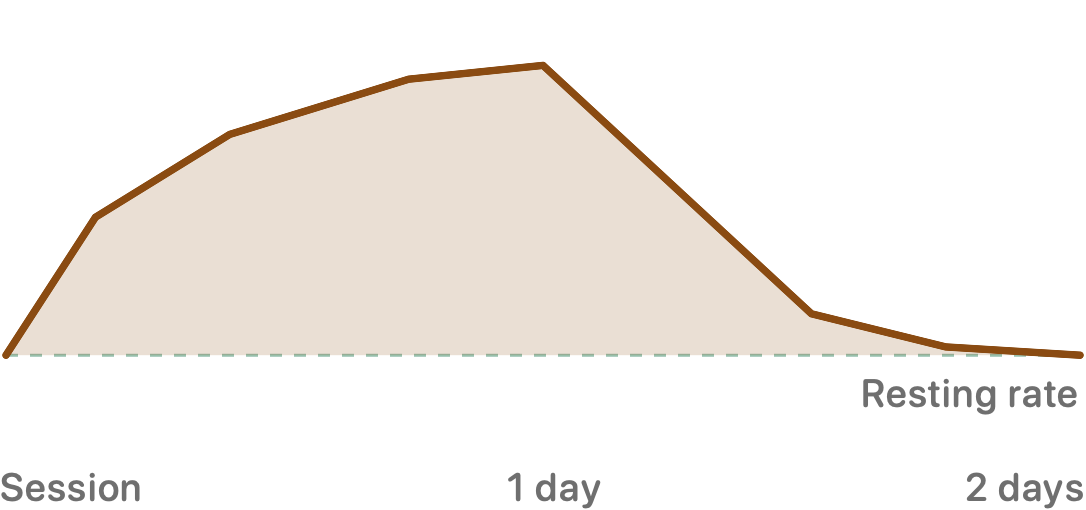
Here is the twist. The volunteers were tested on an empty stomach, and even at the peak their muscle still lost slightly more protein than it built. Without food, the session narrowed the loss but did not turn it into a gain.1
Food supplies the bricks. A pooled analysis of 49 trials found that extra protein on top of training added a little more lean mass: about 300 grams on average, a little less than a full can of soda. The benefit levelled off at a total of about 1.6 grams of protein per kilogram of body weight a day, though that point is uncertain.3
So a rest day is part of the work: the building you started is still going on.1,2
Why do I get stronger before I look different?
Because your nerves learn first. Real growth takes over after a few weeks.
In a 1979 study, seven young men and eight young women trained one arm for eight weeks. Most of the early gain came from the nerves, which learn to switch on more of the muscle at once. Growth took over after the first three to five weeks. Oddly, the arm they never trained got a little stronger too.12
Early changes in size are partly swelling. Unfamiliar work damages muscle a little, and swollen muscle is bigger without having grown. One review argues that clear growth shows only after about 18 sessions.11
So if the mirror shows little in the first weeks, the strength you feel is still real. And people differ a lot: in 585 men and women on the same 12-week programme for one arm, biceps size ranged from a small loss to a gain of almost 60%. Some gained little strength; others doubled theirs.13
Is it ever too late?
Not as far as studies have looked: muscle still answers heavy work in your nineties.
In 1990, ten nursing-home residents, 90 years old on average, lifted heavy weights for eight weeks. The oldest was 96. Nine of the ten made it to the end.14
174%more thigh strength on average after eight weeks: nearly three times as strong as before14
The muscle across the middle of the thigh grew by 9%, and their speed on a heel-to-toe walk rose 48%. But it was a tiny study with no comparison group, so on its own it proves little.14
A larger trial four years later added a comparison group. It split 100 frail nursing-home residents, 87 years old on average, into groups by chance. Those who trained for 10 weeks more than doubled their strength; those who did not barely changed.15
Records of ordinary lives point the same way. A pooled analysis of 16 studies linked muscle-strengthening activity with a 10 to 17% lower risk of dying, heart disease, cancer and diabetes, depending on the outcome. That is a share of the risk, not 10 to 17 people in every 100. For dying, heart disease and cancer the biggest drop came at about 30 to 60 minutes a week; whether more helps is unclear. These studies watched what people did rather than assigning it, so other habits may share the credit.16
What happens when you stop, or simply get older?
Muscle shrinks when it is not used, and with age, strength fades faster than size.
Lying still costs muscle fast. Twelve healthy older adults spent 10 days in bed for a study. Their legs lost about a kilogram of lean tissue, the weight of a bag of sugar, and their knee strength fell by about 16%.17
Age adds a slower drift. In 1,880 older adults followed for three years, leg strength fell by 2.6 to 4.1% a year, depending on the group, while the lean muscle in their legs fell by only about 1% a year. Even those who gained lean muscle kept losing strength.18
Does muscle remember? In mice there is a clue: fibres that gained extra nuclei, the parts of a cell that hold its instructions, kept them even after the muscle wasted away, and the researchers think the nuclei could hold that memory. In people it is less clear. In a 2019 study, 19 adults trained one leg for 10 weeks, then stopped for 20. The muscle shrank back to where it started, but part of the strength stayed, and on retraining the trained leg grew no faster than the other. Another study found that human muscle kept a chemical mark of earlier growth on some of its genes.19,20,21
What can you do with this?
Work all your big muscles against resistance on two or more days a week.
- Every big muscle. That is the World Health Organization's advice for adults: all the major muscle groups, at moderate or greater intensity. Older adults are advised to train balance and strength together on three or more days a week.22
- Heavy for strength. A 2023 analysis pooled 119 trials of muscle size and 178 of strength. Every kind of programme built muscle about equally, but loads above about 80% of your one-rep max, the heaviest weight you can lift once, built the most strength.23
- Light works for size. Another analysis found the same gains in size from light and heavy loads when every set was taken to failure, the point where you cannot do one more rep.24
- Frail, or a heart condition? Ask your doctor how to start.
Your watch cannot see any of this, only the sessions and the days between them. Whether you lifted today or not, the building and breaking down goes on.
Sources
Every number in this article comes from these studies. Checked 12 November 2026.
- Phillips SM, Tipton KD, Aarsland A, Wolf SE, Wolfe RR (1997). Mixed muscle protein synthesis and breakdown after resistance exercise in humans. American Journal of Physiology. doi:10.1152/ajpendo.1997.273.1.e99 · PubMed
- MacDougall JD, Gibala MJ, Tarnopolsky MA, MacDonald JR, Interisano SA, Yarasheski KE (1995). The time course for elevated muscle protein synthesis following heavy resistance exercise. Canadian Journal of Applied Physiology. doi:10.1139/h95-038 · PubMed
- Morton RW, Murphy KT, McKellar SR, et al. (2018). A systematic review, meta-analysis and meta-regression of the effect of protein supplementation on resistance training-induced gains in muscle mass and strength in healthy adults. British Journal of Sports Medicine. doi:10.1136/bjsports-2017-097608 · PubMed
- Morgan PT, Smeuninx B, Breen L (2020). Exploring the impact of obesity on skeletal muscle function in older age. Frontiers in Nutrition. doi:10.3389/fnut.2020.569904 · PubMed
- Smith GI, Patterson BW, Mittendorfer B (2011). Human muscle protein turnover: why is it so variable? Journal of Applied Physiology. doi:10.1152/japplphysiol.00125.2010 · PubMed
- Damas F, Phillips SM, Libardi CA, et al. (2016). Resistance training-induced changes in integrated myofibrillar protein synthesis are related to hypertrophy only after attenuation of muscle damage. Journal of Physiology. doi:10.1113/jp272472 · PubMed
- Snijders T, Nederveen JP, McKay BR, et al. (2015). Satellite cells in human skeletal muscle plasticity. Frontiers in Physiology. doi:10.3389/fphys.2015.00283 · PubMed
- Bellamy LM, Joanisse S, Grubb A, et al. (2014). The acute satellite cell response and skeletal muscle hypertrophy following resistance training. PLoS One. doi:10.1371/journal.pone.0109739 · PubMed
- Todd JS, Shurley JP, Todd TC (2012). Thomas L. DeLorme and the science of progressive resistance exercise. Journal of Strength and Conditioning Research. doi:10.1519/jsc.0b013e31825adcb4 · PubMed
- Wackerhage H, Schoenfeld BJ, Hamilton DL, Lehti M, Hulmi JJ (2019). Stimuli and sensors that initiate skeletal muscle hypertrophy following resistance exercise. Journal of Applied Physiology. doi:10.1152/japplphysiol.00685.2018 · PubMed
- Damas F, Libardi CA, Ugrinowitsch C (2018). The development of skeletal muscle hypertrophy through resistance training: the role of muscle damage and muscle protein synthesis. European Journal of Applied Physiology. doi:10.1007/s00421-017-3792-9 · PubMed
- Moritani T, deVries HA (1979). Neural factors versus hypertrophy in the time course of muscle strength gain. American Journal of Physical Medicine. PubMed
- Hubal MJ, Gordish-Dressman H, Thompson PD, et al. (2005). Variability in muscle size and strength gain after unilateral resistance training. Medicine and Science in Sports and Exercise. PubMed
- Fiatarone MA, Marks EC, Ryan ND, Meredith CN, Lipsitz LA, Evans WJ (1990). High-intensity strength training in nonagenarians. Effects on skeletal muscle. JAMA. doi:10.1001/jama.1990.03440220053029 · PubMed
- Fiatarone MA, O'Neill EF, Ryan ND, Clements KM, Solares GR, Nelson ME, Roberts SB, Kehayias JJ, Lipsitz LA, Evans WJ (1994). Exercise training and nutritional supplementation for physical frailty in very elderly people. New England Journal of Medicine. doi:10.1056/NEJM199406233302501 · PubMed
- Momma H, Kawakami R, Honda T, Sawada SS (2022). Muscle-strengthening activities are associated with lower risk and mortality in major non-communicable diseases: a systematic review and meta-analysis of cohort studies. British Journal of Sports Medicine. doi:10.1136/bjsports-2021-105061 · PubMed
- Kortebein P, Ferrando A, Lombeida J, Wolfe R, Evans WJ (2007). Effect of 10 days of bed rest on skeletal muscle in healthy older adults. JAMA. doi:10.1001/jama.297.16.1772-b · PubMed
- Goodpaster BH, Park SW, Harris TB, et al. (2006). The loss of skeletal muscle strength, mass, and quality in older adults: the Health, Aging and Body Composition Study. Journals of Gerontology Series A. doi:10.1093/gerona/61.10.1059 · PubMed
- Bruusgaard JC, Johansen IB, Egner IM, Rana ZA, Gundersen K (2010). Myonuclei acquired by overload exercise precede hypertrophy and are not lost on detraining. Proceedings of the National Academy of Sciences. doi:10.1073/pnas.0913935107 · PubMed
- Psilander N, Eftestol E, Cumming KT, et al. (2019). Effects of training, detraining, and retraining on strength, hypertrophy, and myonuclear number in human skeletal muscle. Journal of Applied Physiology. doi:10.1152/japplphysiol.00917.2018 · PubMed
- Seaborne RA, Strauss J, Cocks M, Shepherd S, O'Brien TD, van Someren KA, Bell PG, Murgatroyd C, Morton JP, Stewart CE, Sharples AP (2018). Human skeletal muscle possesses an epigenetic memory of hypertrophy. Scientific Reports. doi:10.1038/s41598-018-20287-3 · PubMed
- Bull FC, Al-Ansari SS, Biddle S, et al. (2020). World Health Organization 2020 guidelines on physical activity and sedentary behaviour. British Journal of Sports Medicine. doi:10.1136/bjsports-2020-102955 · PubMed
- Currier BS, McLeod JC, Banfield L, et al. (2023). Resistance training prescription for muscle strength and hypertrophy in healthy adults: a systematic review and Bayesian network meta-analysis. British Journal of Sports Medicine. doi:10.1136/bjsports-2023-106807 · PubMed
- Lopez P, Radaelli R, Taaffe DR, et al. (2021). Resistance training load effects on muscle hypertrophy and strength gain: systematic review and network meta-analysis. Medicine and Science in Sports and Exercise. doi:10.1249/mss.0000000000002585 · PubMed