
Steps
A step count adds up everything you do on your feet in a day. In large studies, more steps went with a lower risk of dying, steeply at first and then more slowly.
What does a step count tell you?
How much you moved on your feet in a day, with every walk and every trip across the kitchen added into one number.
A step count is the plainest measure of a day's movement. A watch or phone tallies each step, and the day's total is every walk to the bus and every trip to the fridge added together. A step is a basic unit of walking, which is one reason researchers have counted them since the mid-1900s.1
One very large count came from phones. A Stanford team gathered days of activity from over 700,000 people in 111 countries. Among the countries with enough users, the average person logged about 5,000 steps a day. That is the average of phone owners who carried their phone, not of whole countries.2
Where you live goes with how much you move. In more walkable cities the phone data showed more activity across age groups, for both sexes and across body weights. For older adults the spread is wide: in a review of pedometer studies, healthy older adults averaged anywhere from about 2,000 to 9,000 steps a day.2,3
The round number 10,000 traces back to a slogan in Japan, and later studies say little evidence backs it. Reviewers have proposed plain labels, from sedentary under 5,000 steps a day to highly active at 12,500 or more. They are labels, not health lines.4,5
How many steps go with a longer life?
In large studies, the risk of dying fell steeply over the first few thousand steps, then more slowly.
In 2022 a team pooled 15 studies in which 47,471 adults wore step counters, then followed them for about seven years. Within each study, people were split into four equal groups by their daily steps.5
Compared with the least active quarter, the second quarter had a 40% lower risk of dying, and the most active quarter had about half the risk. These are shares of the risk, not counts of people. Most of the drop came in the first step up, from about 3,500 to about 5,800 steps a day.5
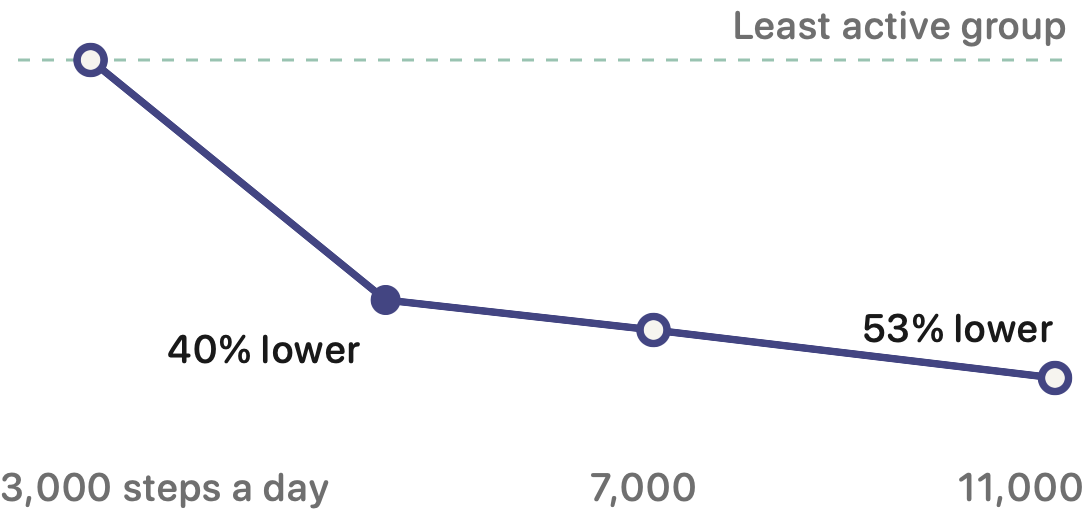
These studies watched people, so they show a link, not a cause: nothing here shows that adding steps would lower your own risk. The flat part of the curve is read off a graph, not tested in a trial, and the studies counted steps with different devices.5
Does your age change the answer?
Yes. In people 60 and over the benefit levelled off sooner, at about 6,000 to 8,000 steps a day.
In the same pooling, risk kept falling until about 6,000 to 8,000 steps a day in people 60 and over. In younger adults it kept falling until about 8,000 to 10,000.5
A US national sample of adults aged 40 and over also found lower risk with more steps: those who took 8,000 steps a day had about half the risk of those who took 4,000. That is a share of the risk, not a count of people. A study of older women found a similar curve.6,7
All of this comes from watching people. Someone already unwell may walk less, so part of the gap may be illness and not walking. The US study adjusted for other factors, but an adjustment is never perfect.6
Do steps matter for more than how long you live?
In one 2025 review, more steps also went with lower risk of heart and blood-vessel disease, dementia and type 2 diabetes.
A 2025 review gathered 57 studies of adults whose steps were measured by a device. It compared people at 7,000 steps a day with people at 2,000, using the studies that could be pooled.8
At the higher level, the risk of dying was about half. The risk of developing cardiovascular disease, meaning heart and blood-vessel disease, was 25% lower, dementia 38% lower and type 2 diabetes 14% lower. Each is a share of the risk, not a count of people.8
The reviewers rated the evidence as moderate for these four, though dementia rested on only two studies. For falls, which were 28% lower, they rated it very low. For dying, cardiovascular disease, dementia and falls, the curves bent at about 5,000 to 7,000 steps a day. The review ran no analysis by age, and its studies watched people rather than assigning them to walk.8
Does it matter how fast you walk?
Faster walkers had lower risk of dying in several studies, but it is unclear that pace adds anything once you count the steps.
In 50,225 walkers across British studies, people who called their pace average had a 20% lower risk of dying than slow walkers. Brisk walkers had a 24% lower risk. Both are shares of the risk. Pace was self-rated, and the authors write that faster walking could cut risk only if pace is the cause.9
Speed also marks health. In 34,485 older adults, each 0.1 metres a second of extra walking speed went with 12% lower risk of dying. Someone who walks fast is often already fit, so speed may be a sign more than a lever.10
Once total steps are counted, pace adds less than you might expect. In the US national sample, faster stepping was no longer clearly tied to lower risk. The 15-study pooling disagreed: the fastest 30 minutes of a day stayed linked to about a third lower risk. The studies measured fast stepping in different ways, which may explain part of the split.5,6
Cadence is your steps a minute. About 100 a minute is a rough line for moderate effort in adults: in 76 young adults on a treadmill, 91% of the stretches walked at that pace or faster were at least moderate effort.11
In 98 older adults, the pace that matched moderate effort was predicted to fall anywhere from about 70 to 114 steps a minute. So 100 is an average, not your own line.12
What changes the count you see?
Step-counter programmes raised steps in inactive people, and the device and where you wear it change the number.
One review found that programmes using step counters helped inactive people add about 2,500 steps a day. Another found a smaller average gain in older adults, about 775 steps a day. These are averages across programmes of different lengths.1,3
The device changes the number too. Researchers had 92 people wear several trackers for a week. One research-grade monitor on the wrist logged over 4,000 steps a day more than the others on the hip. Those hip trackers differed from each other by about 1,700 steps a day, yet rose and fell together closely. The paper does not settle which count is right.13
So the number on your wrist may not be the number the studies counted. If you change watch, or move from wrist to pocket, expect your usual count to shift.13
What can you do with this?
The evidence points to the first few thousand steps, not a magic number, and to your own usual days as the fair comparison.
- Read a week, not a day. Step counts vary from day to day, so a reliable picture needs 3 to 7 days.1
- Compare on one device. Trackers differ in level but move together, so your own trend on one device is the fair comparison.13
- A realistic target is open. One 2025 review suggests that 7,000 steps a day may be a more achievable target than 10,000 for some people, and that 10,000 can still suit the more active.8
- Moving is hard, or you have a condition? Ask your doctor what is realistic. A review of older adults and people with health conditions warned that an everyday baseline of 5,000 steps may be too high for some.3
Sources
Every number in this article comes from these studies. Checked 12 November 2026.
- Bassett DR, Toth LP, LaMunion SR, Crouter SE (2017). Step counting: a review of measurement considerations and health-related applications. Sports Medicine. doi:10.1007/s40279-016-0663-1 · PubMed
- Althoff T, Sosic R, Hicks JL, King AC, Delp SL, Leskovec J (2017). Large-scale physical activity data reveal worldwide activity inequality. Nature. doi:10.1038/nature23018 · PubMed
- Tudor-Locke C, Craig CL, Aoyagi Y, et al. (2011). How many steps/day are enough? For older adults and special populations. International Journal of Behavioral Nutrition and Physical Activity. doi:10.1186/1479-5868-8-80 · PubMed
- Tudor-Locke C, Hatano Y, Pangrazi RP, Kang M (2008). Revisiting "how many steps are enough?". Medicine and Science in Sports and Exercise. doi:10.1249/MSS.0b013e31817c7133 · PubMed
- Paluch AE, Bajpai S, Bassett DR, et al. (2022). Daily steps and all-cause mortality: a meta-analysis of 15 international cohorts. Lancet Public Health. doi:10.1016/S2468-2667(21)00302-9 · PubMed
- Saint-Maurice PF, Troiano RP, Bassett DR, et al. (2020). Association of daily step count and step intensity with mortality among US adults. JAMA. doi:10.1001/jama.2020.1382 · PubMed
- Lee IM, Shiroma EJ, Kamada M, Bassett DR, Matthews CE, Buring JE (2019). Association of step volume and intensity with all-cause mortality in older women. JAMA Internal Medicine. doi:10.1001/jamainternmed.2019.0899 · PubMed
- Ding D, Nguyen B, Nau T, et al. (2025). Daily steps and health outcomes in adults: a systematic review and dose-response meta-analysis. Lancet Public Health. doi:10.1016/S2468-2667(25)00164-1 · PubMed
- Stamatakis E, Kelly P, Strain T, Murtagh EM, Ding D, Murphy MH (2018). Self-rated walking pace and all-cause, cardiovascular disease and cancer mortality: individual participant pooled analysis of 50,225 walkers from 11 population British cohorts. British Journal of Sports Medicine. doi:10.1136/bjsports-2017-098677 · PubMed
- Studenski S, Perera S, Patel K, et al. (2011). Gait speed and survival in older adults. JAMA. doi:10.1001/jama.2010.1923 · PubMed
- Tudor-Locke C, Aguiar EJ, Han H, et al. (2019). Walking cadence (steps/min) and intensity in 21-40 year olds: CADENCE-adults. International Journal of Behavioral Nutrition and Physical Activity. doi:10.1186/s12966-019-0769-6 · PubMed
- Tudor-Locke C, Schuna JM Jr, Han HO, et al. (2021). Walking cadence (steps/min) and intensity in 61-85-year-old adults: the CADENCE-Adults study. International Journal of Behavioral Nutrition and Physical Activity. doi:10.1186/s12966-021-01199-4 · PubMed
- Nakagata T, Yamada Y, Taniguchi M, Nanri H, Kimura M, Miyachi M (2024). Comparison of step-count outcomes across seven different activity trackers: a free-living experiment with young and older adults. BMC Sports Science, Medicine and Rehabilitation. doi:10.1186/s13102-024-00943-0 · PubMed