
Stress
Stress is a whole-body response, not only a feeling, and one review argues a short burst of it can help. Stress that lasts is the kind linked with harm, and a watch can show the body's side of it but not the reason.
What is stress?
The body's whole response to a demand, run by nerves and hormones together. It is more than a feeling.
In 1915 the physiologist Walter Cannon described fight or flight, the body's rapid readiness to face a threat or run from it. In 1936 a short letter to the journal Nature by Hans Selye launched the modern idea of stress. A 2018 biography says he took the word from physics, where it names a force and the resistance that pushes back.1,2,3
In the body, stress means the response of two systems working together: the automatic nerves that run your organs, and hormones such as cortisol. A 2009 review describes largely overlapping circuits in the brain, tuned to the kind and strength of the demand.4
Those circuits also meet the brain's circuits for memory and reward. So your response can be tailored by what you have been through and what you expect, and the same demand may set off more or less in different people.4
What does stress do in your body?
Heart rate and cortisol rise, even when you are only being judged. Heart emergencies rose on World Cup match days.
To study the response, researchers built a standard way to set it off in a lab: a wait, then a speech and mental arithmetic in front of an audience. Across six studies, saliva cortisol rose to two to four times its starting level, and heart rate rose too. It is a lab test of being judged, not of an ordinary day.5
Cortisol is not only a response to threat: soon after you wake it rises sharply, a pattern called the cortisol awakening response. In one set of studies, free cortisol rose by 50 to 75% within 30 minutes of waking.6,7
Emotion can move the body outside a lab too. In the greater Munich area, emergency doctors recorded acute heart and blood-vessel events in 4,279 patients, during the World Cup in Germany and in comparison weeks. On days when the German team played, cardiac emergencies ran at 2.66 times the level of the comparison weeks, highest in the first two hours of each match.8
Those hit were more often people already known to be ill. Among patients with a coronary event on match days, 47% had known coronary heart disease, against 29% in the comparison weeks. The study watched one tournament in one region, so it shows a link, not proof of cause.8
So a tense meeting may not be only in your head: in the lab test, being judged was enough to move the body.5
When is stress good for you?
When it is short. One review argues short-term stress can protect, while long-term stress is generally harmful.
Stress has a bad name, yet one review argues the response exists to promote survival. Short-term stress, lasting minutes to hours, can be protective because it prepares the body for a challenge, it says. In its account, short-term stress during an immune challenge boosts the immune response, while long-term stress dampens or disrupts it.9
That is the review's proposal, not a measured rule for any one person.9
Some arousal also helps performance. In recent human and mouse pupil studies, performance typically peaked at a moderate level of arousal, not the highest. A 2025 experiment in people found that a drug raising arousal shifted the whole curve, which suggests the best level moves with your overall state. It tested decision-making, so it says little about a workout or a deadline.10
When does stress do harm?
When it lasts. Permanent stress at work is linked with heart attacks, and in one experiment more stress meant more colds.
In a quarantine study of 394 healthy volunteers, people filled in questionnaires about stress, then were given nasal drops with a cold virus. Stress was self-reported, not assigned. As it rose, the infection rate climbed from about 74% to about 90%, and so did the share who came down with a cold. Smoking, alcohol, exercise, diet and sleep quality did not explain the link.11
In a study of about 25,000 people in 52 countries, people with a first heart attack were compared with similar people without one. Permanent stress at work went with about twice the odds of a heart attack. Those are odds, not risk, and stress was judged from a few simple questions asked after the event, so recall may colour the answers.12
A pooled analysis of European studies followed almost 200,000 workers who began without heart disease. People who reported job strain, measured by questionnaires about job demands and control, had a 23% higher risk of a first heart attack or coronary death. That is a share of the risk, not 23 people in every 100.13
The effect was bigger in published studies than in unpublished ones, which hints at publication bias. The authors note that tackling stress at work would have a much smaller effect than tackling standard risk factors such as smoking. So job strain is a modest link, not a verdict on your heart.13
What can a watch see of it?
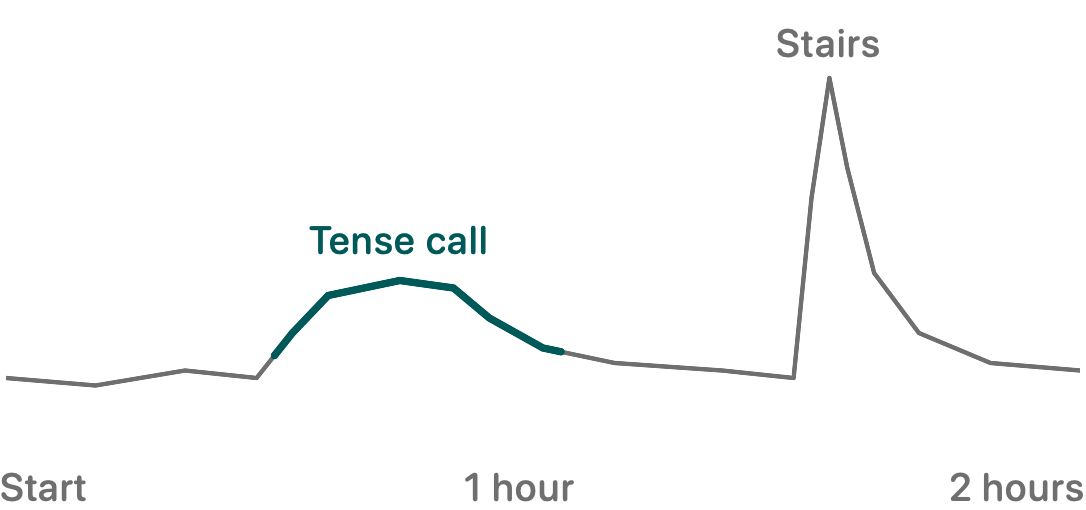
Mostly changes in heart rate variability. Average heart rate is a weaker sign, and a signal alone does not show the reason.
Heart rate variability, which has its own article, is the signal researchers use most. A review of 37 publications found it changed under stress in most of them, though it notes there is no accepted standard for judging stress this way. A systematic review of wearable devices found that studies of stress and anxiety unanimously used it.14,15
The same review found that average heart rate, which many commercial devices rely on, was not as accurate. Electrodermal activity, a measure of skin sweat, was accurate for stress in recent studies but of questionable reliability. Many of the studies were small.15
The review of stress and immunity counts psychological, physiological and physical stressors, exercise included, as triggers of the same kind of biological response. So a signal on your wrist may not say which one set it off. We found no review that measured how well wearables tell them apart.9
What can you do with this?
Studies link lasting stress, not short bursts, with harm, and a watch shows only the body's side of it.
- Length matters. The harm studies here concern stress that lasts, such as permanent stress at work and job strain, not a single hard day.12,13
- Slow breathing. Voluntary slow breathing raised the calming-nerve part of heart rate variability in a pooled analysis of 223 studies, during the breathing and after programmes of many sessions. That is a body measure, not a measure of how you feel, and the heart rate variability article covers it.16
- Heavy and lasting? If stress is heavy and does not lift, or you feel low or anxious, talk to a doctor.
Sources
Every number in this article comes from these studies. Checked 12 November 2026.
- Cannon WB (1915). Bodily Changes in Pain, Hunger, Fear and Rage. D. Appleton and Company. doi:10.1037/10013-000
- Selye H (1936). A syndrome produced by diverse nocuous agents. Nature. doi:10.1038/138032a0
- Tan SY, Yip A (2018). Hans Selye (1907-1982): founder of the stress theory. Singapore Medical Journal. doi:10.11622/smedj.2018043 · PubMed
- Ulrich-Lai YM, Herman JP (2009). Neural regulation of endocrine and autonomic stress responses. Nature Reviews Neuroscience. doi:10.1038/nrn2647 · PubMed
- Kirschbaum C, Pirke KM, Hellhammer DH (1993). The 'Trier Social Stress Test': a tool for investigating psychobiological stress responses in a laboratory setting. Neuropsychobiology. doi:10.1159/000119004 · PubMed
- Stalder T, Kirschbaum C, Kudielka BM, et al. (2016). Assessment of the cortisol awakening response: expert consensus guidelines. Psychoneuroendocrinology. doi:10.1016/j.psyneuen.2015.10.010 · PubMed
- Pruessner JC, Wolf OT, Hellhammer DH, et al. (1997). Free cortisol levels after awakening: a reliable biological marker for the assessment of adrenocortical activity. Life Sciences. doi:10.1016/s0024-3205(97)01008-4 · PubMed
- Wilbert-Lampen U, Leistner D, Greven S, et al. (2008). Cardiovascular events during World Cup soccer. New England Journal of Medicine. doi:10.1056/nejmoa0707427 · PubMed
- Dhabhar FS (2014). Effects of stress on immune function: the good, the bad, and the beautiful. Immunologic Research. doi:10.1007/s12026-014-8517-0 · PubMed
- Beerendonk L, Mejías JF, Nuiten SA, et al. (2025). Adaptive arousal regulation: pharmacologically shifting the peak of the Yerkes-Dodson curve by catecholaminergic enhancement of arousal. Proceedings of the National Academy of Sciences. doi:10.1073/pnas.2419733122 · PubMed
- Cohen S, Tyrrell DA, Smith AP (1991). Psychological stress and susceptibility to the common cold. New England Journal of Medicine. doi:10.1056/nejm199108293250903 · PubMed
- Rosengren A, Hawken S, Ounpuu S, et al. (2004). Association of psychosocial risk factors with risk of acute myocardial infarction in 11119 cases and 13648 controls from 52 countries (the INTERHEART study): case-control study. The Lancet. doi:10.1016/s0140-6736(04)17019-0 · PubMed
- Kivimäki M, Nyberg ST, Batty GD, et al. (2012). Job strain as a risk factor for coronary heart disease: a collaborative meta-analysis of individual participant data. The Lancet. doi:10.1016/s0140-6736(12)60994-5 · PubMed
- Kim HG, Cheon EJ, Bai DS, Lee YH, Koo BH (2018). Stress and heart rate variability: a meta-analysis and review of the literature. Psychiatry Investigation. doi:10.30773/pi.2017.08.17 · PubMed
- Hickey BA, Chalmers T, Newton P, et al. (2021). Smart devices and wearable technologies to detect and monitor mental health conditions and stress: a systematic review. Sensors. doi:10.3390/s21103461 · PubMed
- Laborde S, Allen MS, Borges U, et al. (2022). Effects of voluntary slow breathing on heart rate and heart rate variability: a systematic review and a meta-analysis. Neuroscience & Biobehavioral Reviews. doi:10.1016/j.neubiorev.2022.104711 · PubMed