
The taper
Before a big race, a taper cuts the amount of training and keeps the effort. In 27 pooled studies, about two weeks with 41 to 60% less training did best.
Does cutting back before a race help?
Performance rose after tapers on average, and about two weeks with volume cut by 41 to 60% did best in 27 studies.
Training builds fitness, and it also piles up tiredness that you carry to the start line. A taper is a planned stretch of lighter training before a big event, meant to shed the tiredness without losing the fitness.1
In 2007, researchers searched six databases and found 182 possible studies of tapering. Only 27 qualified: competitive athletes, a taper described in detail, and performance measured in a real race or a field test.2
They compared tapers by their length, by how much training volume was cut, and by whether intensity and sessions per week were kept. The best was a two-week taper with volume cut by 41 to 60%, and no change to intensity or frequency.2
These reviews compared athletes before and after a taper. They did not compare tapering with training on as usual, so they cannot say how much of the gain the taper itself caused.2,3
One review sums up the usual gain as about 3%. For a four-hour marathon, that would be about seven minutes.1
How long should a taper last?
About two weeks. Tapers of 8 to 14 days gained most, and the longest tapers showed no clear gain.
A 2023 review pooled 14 studies of 174 endurance athletes, mostly runners and cyclists. Their performance was measured in a time trial: a set distance covered against the clock.3
Time-trial results improved after tapering overall. Tapers of every length up to 21 days helped, and tapers of 8 to 14 days helped most.3
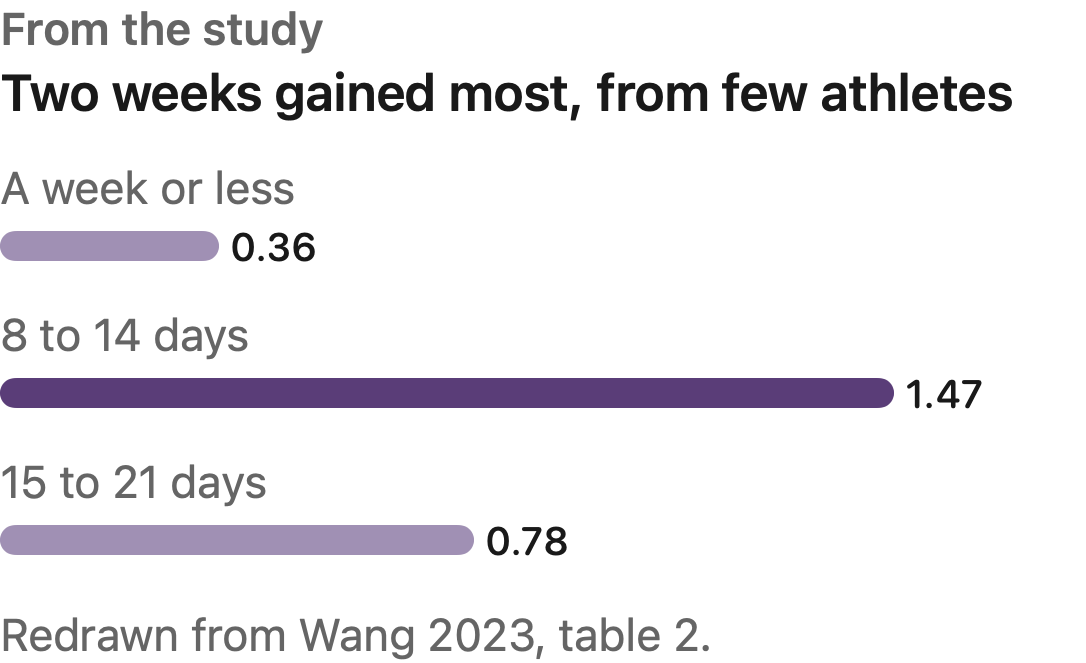
The tallest bar rests on only 18 athletes, all from a single study, with a very wide range around it, so its lead may be smaller than it looks. The 10 athletes who tapered 22 days or more, also from a single study, showed no clear gain.3
Real athletes vary. In a survey of elite British runners, the median taper was 6 days for track runners from 800 m to 10,000 m, and 14 days for marathon runners.4
A 2003 review put the best length anywhere between 4 and more than 28 days. The elite survey records what runners chose, not what worked best, so these studies cannot say what your own best length is.1,4
What do you cut, and what do you keep?
The pooled studies favoured cutting volume by 41 to 60% while keeping intensity and the number of sessions.
The 2023 review sorted tapers by what they cut. Cutting volume by 41 to 60% gave the clearest gain. Smaller cuts, and cuts of 60% or more, gave smaller gains that were not clear.3
The evidence is not all one way. A 2003 review described volume cuts reaching 60 to 90%.1
Tapers that kept intensity the same gained. The 18 athletes whose tapers cut intensity showed no clear gain. Cutting the number of sessions also gave no clear gain, while keeping them did.3
In the survey of elite runners, interval volume was cut during the taper, but the fastest interval was not slower than race pace. It was faster for the long-distance and marathon runners, and about equal for the middle-distance runners.4
The shape is less settled. A 2003 review judged tapers that ease down gradually better than a single step down. In the 2023 review both shapes helped, with no clear gap between them.1,3
A trial gave male cyclists one of three week-long tapers, which cut training volume by 30%, 50% or 80%. Training intensity was held the same.5
Only the middle cut, 50%, improved a 20 km time trial, by 5.4%. The other two showed no clear change.5
It was a small trial with only a few riders per group, so it shows a pattern more than it proves one.5
Why would doing less make you faster?
In taper studies, fitness held on much less training, while muscle fuel, strength and mood tended to improve.
Ten well-conditioned distance runners cut their weekly running by 70% for 3 weeks.6
That was a drop from about 81 km a week to about 24 km, with a little hard running kept in. It also meant one fewer running day a week.6
Their 5 km race times did not change clearly, and neither did their VO2 max. Weeks of far less training cost them no clear loss of fitness. It was a small study with no separate comparison group, and its 3 weeks is longer than the two-week taper that did best above.6
The 2023 review found something odd. VO2 max and the energy cost of a given pace did not improve after tapering, even though time trials did.3
A 2004 review lists what did change in taper studies. Muscle glycogen, the fuel stored in muscle, rose. Strength and power usually rose too, and a blood marker of muscle damage fell. Mood disturbance tended to fall and sleep quality to improve.7
Mathematical models describe this as restoring capacities that heavy training had worn down, plus a better response to the training done during the taper. They are models, not measurements.7
On your wrist, little may show. In that review, resting, maximal and submaximal heart rates did not change, unless athletes showed clear signs of overreaching, meaning more training than they could recover from, before the taper.7
Does it work for everyone?
Not always. These studies were of trained athletes, and one small trial of middle-distance runners found no clear gain from a 6-day taper.
A small trial gave eight middle-distance runners a taper of 6 days. Volume was cut by 50% in one group and 75% in the other. Neither improved its 800 m time clearly.8
With so few runners, that cannot show that a taper does nothing. It shows that a gain does not always appear.8
The 2023 review found that tapers after a block of heavier-than-usual training, called pre-taper overload, did better than conventional tapers. The gain from a taper may depend on what came before it.3
The reviews pooled competitive athletes, aged 17 to 32 in the 2023 one. The review behind the 3% above gave a usual range of 0.5 to 6%.1,3
If you run for fun, these numbers describe other people: racers in training blocks. They do not say how much taper a casual runner needs.2,3
What does this mean for you?
For a big race, the evidence points to about two weeks, volume cut by 41 to 60%, effort kept.
- Length. About two weeks is where the pooled studies point. Elite runners used shorter tapers for shorter races.2,3,4
- Volume, not effort. The pooled studies favoured cutting total volume by 41 to 60% and keeping intensity and the number of sessions.2,3
- Deeper cuts are less certain. Cuts of 60% or more showed no clear gain in the 2023 review, though a 2003 review described cuts reaching 60 to 90%.1,3
- Your watch. Aera's word for an eased-off stretch is Tapered. Cardio load explains when it appears. It cannot tell a planned taper from a quiet week.
Sources
Every number in this article comes from these studies. Checked 13 November 2026.
- Mujika I, Padilla S (2003). Scientific bases for precompetition tapering strategies. Medicine and Science in Sports and Exercise. doi:10.1249/01.mss.0000074448.73931.11 · PubMed
- Bosquet L, Montpetit J, Arvisais D, Mujika I (2007). Effects of tapering on performance: a meta-analysis. Medicine and Science in Sports and Exercise. doi:10.1249/mss.0b013e31806010e0 · PubMed
- Wang Z, Wang YT, Gao W, Zhong Y (2023). Effects of tapering on performance in endurance athletes: a systematic review and meta-analysis. PLoS One. doi:10.1371/journal.pone.0282838 · PubMed
- Spilsbury KL, Fudge BW, Ingham SA, et al. (2015). Tapering strategies in elite British endurance runners. European Journal of Sport Science. doi:10.1080/17461391.2014.955128 · PubMed
- Neary JP, Bhambhani YN, McKenzie DC (2003). Effects of different stepwise reduction taper protocols on cycling performance. Canadian Journal of Applied Physiology. doi:10.1139/h03-044 · PubMed
- Houmard JA, Costill DL, Mitchell JB, et al. (1990). Reduced training maintains performance in distance runners. International Journal of Sports Medicine. doi:10.1055/s-2007-1024761 · PubMed
- Mujika I, Padilla S, Pyne D, Busso T (2004). Physiological changes associated with the pre-event taper in athletes. Sports Medicine. doi:10.2165/00007256-200434130-00003 · PubMed
- Mujika I, Goya A, Padilla S, et al. (2000). Physiological responses to a 6-d taper in middle-distance runners: influence of training intensity and volume. Medicine and Science in Sports and Exercise. doi:10.1097/00005768-200002000-00038 · PubMed