
Strength
Strength is the most force you can make in one effort, set by your muscles and the nerves that drive them. It peaks around 30, can fade faster than muscle size, and in older adults it goes with how long people live.
What is strength?
The most force you can make in one effort, set by your muscle and by how fully your nerves switch it on.
In a study published in 1992, volunteers spent four weeks training one little finger, five sessions a week. One group pushed it sideways as hard as they could. A second group only imagined pushing, again and again. A control group did nothing.1
The pushers gained 30% in finger force. The group that only imagined it gained 22%, and the group that did nothing about 4%. When the nerve was stimulated directly with electricity, the force it produced had not changed in any group. That fits muscle that had not grown, with a better signal reaching it.1
A follow-up in 2004 ran 12 weeks, with six to eight people in each group. Imagined finger pushes raised strength by 35%, and real training by 53%. So imagining gained less than real training. The volunteers were young and healthy, and a finger is a small muscle.2
If you start lifting, strength can rise before your muscles look any bigger. The 1992 authors link such early gains to the brain's planning of the movement, not to size.1
How does strength change over a life?
It peaks in early adult life, stays level to midlife, then falls.
Grip is easy to measure: you squeeze a gauge held in the hand. A British team pooled grip measurements from about 50,000 people in 12 general-population studies, from childhood to old age. The curve rises to a peak in early adult life, stays broadly flat to midlife, and then falls.3
A typical man's grip peaks near 51 kilograms and a typical woman's near 31, both somewhere between the late twenties and early forties.3
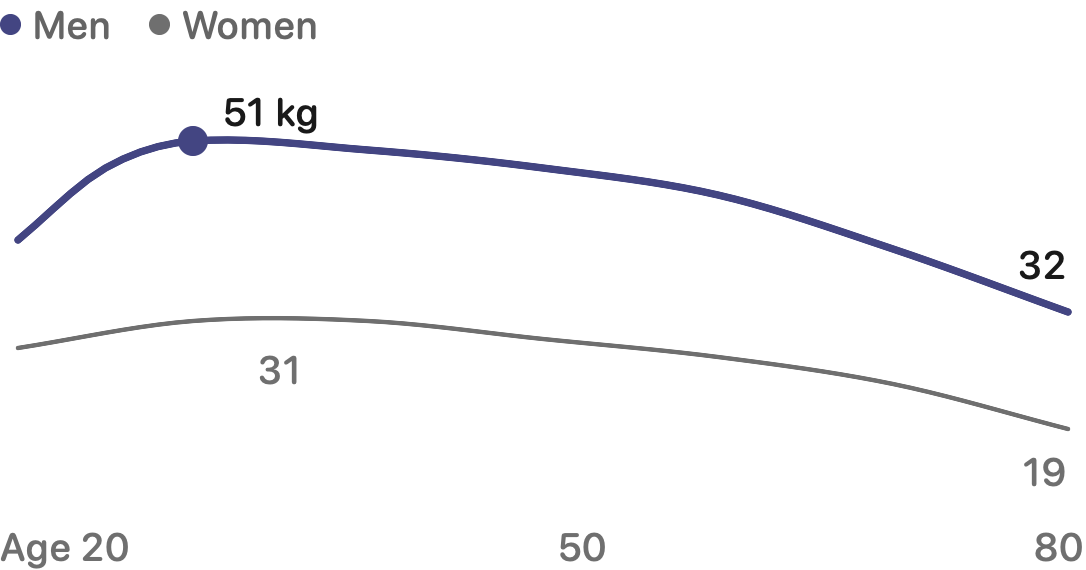
37%below the typical peak: the grip of a typical 80-year-old man (39% for a woman)3
These figures compare different people at each age, not one person followed through life, and the oldest people measured are the ones who survived. Your own curve will sit above or below the typical one.3
Does strength fade faster than muscle?
In one small study, strength fell further than muscle size. One review points to the nerves and the muscle's own force-making power.
Nine healthy men in their mid-sixties who did not exercise were measured again 12 years later. Their strength had fallen by about a quarter. In the men who were scanned, the quadriceps, the big muscle at the front of the thigh, had shrunk by about a sixth. The authors still judged lost muscle area a major contributor to the weakening. Nine men is a small group, so this is a sketch and not a norm.4
One review gave this kind of loss a name, dynapenia, from Greek for poverty of strength. It argues that muscle size plays a relatively minor role. It points instead to possible changes in the nervous system and in the muscle's own power to make force. That is an argument, not a trial result.5
If a doctor checks you for sarcopenia, the loss of muscle mass and strength with age, strength comes first. A 2019 European consensus focuses on low strength as a key sign, and uses low muscle quantity or quality to confirm it.6
Does strength go with living longer?
In older adults, stronger legs go with longer lives. This study watched people, so it shows a link, not a cause.
A US study followed about 2,300 people in their seventies for almost five years. Weaker legs, tested by straightening the knee against a machine, went with a higher risk of dying. Muscle size was not strongly linked with death, and adjusting for size barely weakened the link with strength.7
Leg strength varied from person to person by a typical amount. Looking at strength alone, each step down of that size went with a 51% higher risk of dying in men and 65% in women. That is a share of the risk, not that many people in every 100.7
Weak people may already be unwell, and 286 deaths is a modest number to learn from. These were people in their seventies. If you are younger, the study says little about you.7
What does strength do in daily life?
In these studies, weaker people had more trouble walking, caring for themselves and staying on their feet.
From 1965, a study in Hawaii measured the grip of Japanese-American men in midlife, then followed them for 25 years. Compared with the strongest third, the weakest third had nearly three times the odds of walking very slowly, under half a metre a second. Their risk of a disability in self-care was more than twice as high.8
All were men from one group, healthy at the start. The authors suggested that good strength in midlife may give a bigger safety margin above the point where daily tasks become hard. That is an interpretation, not a tested mechanism.8
In daily life, the limits the study counted included being unable to get out of a chair without pushing off with your arms.8
Weak legs also go with falls. A pooled analysis of studies that followed older adults found weak legs went with nearly twice the odds of any fall, and about three times the odds of repeated falls. Strength was measured first and falls counted afterwards.9
Yet when trials tested exercise as a remedy, balance work stood out. A pooled analysis of 88 trials found exercise alone cut the rate of falls by about a fifth in older people living at home. That is a share of the rate, not a fixed number of falls. The biggest effects came from programmes that challenged balance and ran more than 3 hours a week: a 39% cut. These trials tested whole programmes, so they do not show that strength was the active part.10
What can you do with this?
Strength still responds to training in later life. US guidelines ask for muscle-strengthening on two or more days a week.
- Strength responds to training. A pooled analysis of 47 studies of resistance training in people aged 50 and over, not all randomised, found strength gains of roughly 30% on the leg press and the knee machine. Harder training went with larger gains.11
- The guideline is two days. The 2018 US guidelines advise adults to do muscle-strengthening activity on 2 or more days a week. Older adults are advised to add balance training.12
- Strength can be measured. Strength is read with a hand gauge, a heaviest-single-lift test, or a timed chair test. The European consensus flags five chair rises taking more than 15 seconds as low strength. Repeat lift tests typically differ by about 4%, so a change of a few percent may be noise.6,13
- Frail, or a heart condition? Ask your doctor how to start.
Sources
Every number in this article comes from these studies. Checked 12 November 2026.
- Yue G, Cole KJ (1992). Strength increases from the motor program: comparison of training with maximal voluntary and imagined muscle contractions. Journal of Neurophysiology. doi:10.1152/jn.1992.67.5.1114 · PubMed
- Ranganathan VK, Siemionow V, Liu JZ, Sahgal V, Yue GH (2004). From mental power to muscle power: gaining strength by using the mind. Neuropsychologia. doi:10.1016/j.neuropsychologia.2003.11.018 · PubMed
- Dodds RM, Syddall HE, Cooper R, et al. (2014). Grip strength across the life course: normative data from twelve British studies. PLoS One. doi:10.1371/journal.pone.0113637 · PubMed
- Frontera WR, Hughes VA, Fielding RA, Fiatarone MA, Evans WJ, Roubenoff R (2000). Aging of skeletal muscle: a 12-yr longitudinal study. Journal of Applied Physiology. doi:10.1152/jappl.2000.88.4.1321 · PubMed
- Clark BC, Manini TM (2012). What is dynapenia? Nutrition. doi:10.1016/j.nut.2011.12.002 · PubMed
- Cruz-Jentoft AJ, Bahat G, Bauer J, et al. (2019). Sarcopenia: revised European consensus on definition and diagnosis. Age and Ageing. doi:10.1093/ageing/afy169 · PubMed
- Newman AB, Kupelian V, Visser M, et al. (2006). Strength, but not muscle mass, is associated with mortality in the Health, Aging and Body Composition Study cohort. Journals of Gerontology Series A. doi:10.1093/gerona/61.1.72 · PubMed
- Rantanen T, Guralnik JM, Foley D, et al. (1999). Midlife hand grip strength as a predictor of old age disability. JAMA. doi:10.1001/jama.281.6.558 · PubMed
- Moreland JD, Richardson JA, Goldsmith CH, Clase CM (2004). Muscle weakness and falls in older adults: a systematic review and meta-analysis. Journal of the American Geriatrics Society. doi:10.1111/j.1532-5415.2004.52310.x · PubMed
- Sherrington C, Michaleff ZA, Fairhall N, et al. (2017). Exercise to prevent falls in older adults: an updated systematic review and meta-analysis. British Journal of Sports Medicine. doi:10.1136/bjsports-2016-096547 · PubMed
- Peterson MD, Rhea MR, Sen A, Gordon PM (2010). Resistance exercise for muscular strength in older adults: a meta-analysis. Ageing Research Reviews. doi:10.1016/j.arr.2010.03.004 · PubMed
- Piercy KL, Troiano RP, Ballard RM, et al. (2018). The Physical Activity Guidelines for Americans. JAMA. doi:10.1001/jama.2018.14854 · PubMed
- Grgic J, Lazinica B, Schoenfeld BJ, Pedisic Z (2020). Test-retest reliability of the one-repetition maximum (1RM) strength assessment: a systematic review. Sports Medicine - Open. doi:10.1186/s40798-020-00260-z · PubMed