
Blood pressure
Blood pressure comes as two numbers. Risk climbs steadily with both, starting well below the level doctors call high.
What do the two numbers mean?
Systolic on top, diastolic below. A gauge of 1896 could read only the top number.
Your blood pressure comes as two numbers, such as 115 over 75. The top one is called systolic pressure and the bottom one diastolic. How often the heart beats is a different measure, covered in Resting heart rate.1
Measuring it began with animals. Stephen Hales, a clergyman at Teddington near London, ran experiments on animals and described in 1733 the first direct measurement of blood pressure. In the early 1800s Poiseuille brought in the mercury gauge and the millimetre of mercury, which is still the unit. Riva-Rocci's mercury gauge of 1896 could give only the top number. In 1905 Nikolai Korotkoff was the first to observe the sounds the artery makes as it is squeezed.2,3
Why does it matter?
Risk climbs steadily with pressure, starting well below the line called high. Most people with high pressure do not have it controlled.
A pooled analysis followed about a million adults with no known vascular disease. In middle age, each 20 points higher on the top number went with more than twice the stroke death rate. Risk kept falling with lower pressure, with no sign of a floor down to about 115 over 75.1
In people in their eighties the pattern was about half as steep as in their forties, though the yearly differences in risk were bigger in old age. These studies watched people rather than assigning pressure, so other things that go with high pressure may share the credit.1
1.28 billionadults aged 30 to 79 with high blood pressure in 2019, twice the number in 19904
High here meant 140 over 90 or above, or taking medicine for it. About half of those people knew, and fewer than one in four had it controlled. So high pressure often goes unnoticed: if you have never had a reading, you may be one of them.4
What counts as high?
It depends on who draws the line. The line sits on a slope of steadily rising risk.
United States guidelines from 2017 set 130 over 80 as stage 1 high blood pressure and 140 over 90 as stage 2. European guidelines from 2024 use the word hypertension only from 140 over 90. They call readings from 120 over 70 up to that point elevated. So one of your readings can be stage 1 under the American line and only elevated under the European one.5,6
One trial tested a lower line: SPRINT. It treated 9,361 adults at higher heart risk, without diabetes, toward one of two targets for the top number. A year in, one group averaged about 121 and the other about 136.7
The lower group had about a quarter fewer of the main heart and circulation events, and about a quarter fewer deaths. That is a share of the risk: 1.65% a year against 2.19%. The trial stopped early, and more of the lower group had serious side effects such as fainting and kidney injury.7
Why does your reading change?
It moves with what you are doing, and it dips in sleep. One reading in one room is a snapshot.
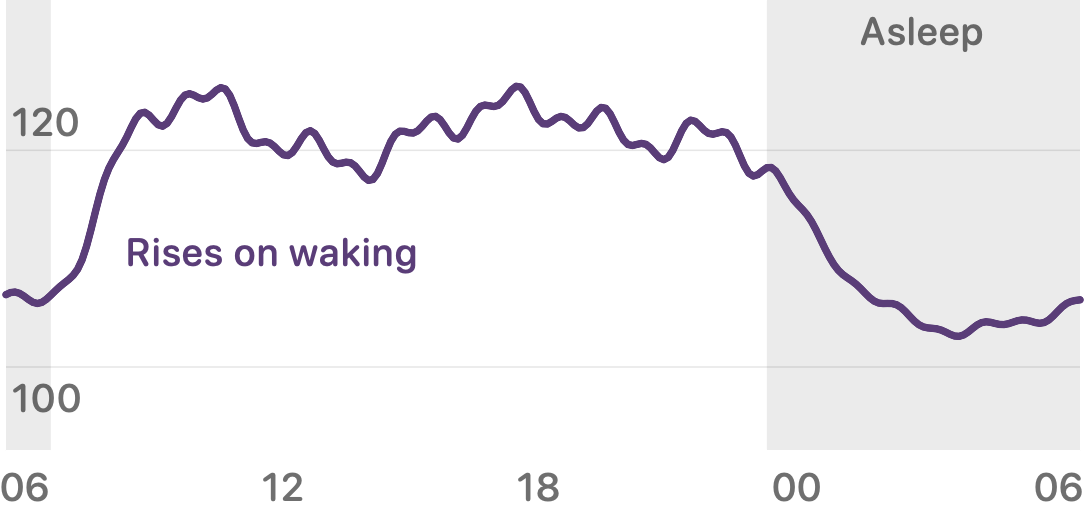
European guidelines call someone a dipper if pressure at night falls by more than 10% from the daytime average, a cut-off they call arbitrary.8
Some people's pressure is higher in the clinic than anywhere else. European guidelines from 2018 say this white-coat hypertension can account for up to 30 to 40 in every 100 people with a high clinic reading. The reverse happens too: about 15 in every 100 people with a normal clinic reading have masked high pressure, seen outside the clinic.8
Even your arm changes the number. In a trial of 133 adults, each was measured with the arm on a desk, the hand on the lap and the arm hanging at the side. Against the desk, the lap added about 4 points to the top number and the hanging arm about 6.5.9
What moves it up or down?
Exercise and food lower it, most when your own is high. In one forest community it rose only slowly with age.
A pooled analysis of 93 trials found that endurance training lowered the top number by about 8 points in people with high pressure and by under 1, which could be chance, in people with normal pressure. A later, larger analysis ranked isometric training first for the top number: holding a muscle tight without moving, with a wall sit leading. The earlier analysis noted that isometric results rested on a small number of studies. Heat is another lever, told in Sauna.10,11
Food lowers it too. In a trial that fed 459 adults for eight weeks, a diet rich in fruit, vegetables and low-fat dairy lowered the top number by 5.5 points more than a typical American diet. Among those who began with high pressure, the gap was 11.4. The trial supplied the meals, so changes at home may differ.12
Pressure rises with age in almost every population studied, but not at the same pace. Among the Tsimane forager-farmers of Bolivia, followed for eight years, the top number rose about 3 points a decade in women and under 1 in men. The authors call both rates well below those found elsewhere.13
Can a watch measure it?
Not reliably yet. European experts say cuffless devices have promise but do not recommend them to diagnose or manage high blood pressure.
A cuffless device estimates pressure without squeezing your arm. In 2022 a European Society of Hypertension working group wrote that such devices have considerable potential. Even so, its guidelines do not recommend them for the diagnosis and management of hypertension, and the tests built for cuffs do not suit them.14
A 2023 statement from the same group added that there are still no generally accepted protocols to confirm that such a device is accurate enough for clinical use.15
So a watch estimate is a hint, not a reading.14
What can you do with this?
Measure it the way guidelines describe, a few times over several days, and read the average.
- Rest, then sit properly. European guidelines describe sitting after five minutes of rest, with your back and arm supported and the cuff at heart height. The arm trial shows why: positions people often use read several points high.6,9
- Take several readings. At home, European guidelines describe two readings a minute or two apart, morning and evening, over three to seven days.6
- Know which line is used. Ask which guideline's line your doctor follows. Risk climbs steadily on both sides of any line, so a line is a decision point, not a switch.1
- A reading well above your usual? Take it to a doctor, and do not change medicines on your own.
Sources
Every number in this article comes from these studies. Checked 12 November 2026.
- Lewington S, Clarke R, Qizilbash N, Peto R, Collins R; Prospective Studies Collaboration (2002). Age-specific relevance of usual blood pressure to vascular mortality: a meta-analysis of individual data for one million adults in 61 prospective studies. Lancet. doi:10.1016/S0140-6736(02)11911-8 · PubMed
- Lewis O (1994). Stephen Hales and the measurement of blood pressure. Journal of Human Hypertension. PubMed
- Roguin A (2006). Scipione Riva-Rocci and the men behind the mercury sphygmomanometer. International Journal of Clinical Practice. doi:10.1111/j.1742-1241.2005.00548.x · PubMed
- NCD Risk Factor Collaboration (NCD-RisC) (2021). Worldwide trends in hypertension prevalence and progress in treatment and control from 1990 to 2019: a pooled analysis of 1201 population-representative studies with 104 million participants. Lancet. doi:10.1016/S0140-6736(21)01330-1 · PubMed
- Whelton PK, Carey RM, Aronow WS, et al. (2018). 2017 ACC/AHA/AAPA/ABC/ACPM/AGS/APhA/ASH/ASPC/NMA/PCNA guideline for the prevention, detection, evaluation, and management of high blood pressure in adults. Hypertension. doi:10.1161/hyp.0000000000000065 · PubMed
- McEvoy JW, McCarthy CP, Bruno RM, et al. (2024). 2024 ESC Guidelines for the management of elevated blood pressure and hypertension. European Heart Journal. doi:10.1093/eurheartj/ehae178 · PubMed
- SPRINT Research Group; Wright JT Jr, Williamson JD, Whelton PK, et al. (2015). A randomized trial of intensive versus standard blood-pressure control. New England Journal of Medicine. doi:10.1056/NEJMoa1511939 · PubMed
- Williams B, Mancia G, Spiering W, et al. (2018). 2018 ESC/ESH Guidelines for the management of arterial hypertension. European Heart Journal. doi:10.1093/eurheartj/ehy339 · PubMed
- Liu H, Zhao D, Sabit A, et al. (2024). Arm position and blood pressure readings: the ARMS crossover randomized clinical trial. JAMA Internal Medicine. doi:10.1001/jamainternmed.2024.5213 · PubMed
- Cornelissen VA, Smart NA (2013). Exercise training for blood pressure: a systematic review and meta-analysis. Journal of the American Heart Association. doi:10.1161/jaha.112.004473 · PubMed
- Edwards JJ, Deenmamode AHP, Griffiths M, et al. (2023). Exercise training and resting blood pressure: a large-scale pairwise and network meta-analysis of randomised controlled trials. British Journal of Sports Medicine. doi:10.1136/bjsports-2022-106503 · PubMed
- Appel LJ, Moore TJ, Obarzanek E, et al. (1997). A clinical trial of the effects of dietary patterns on blood pressure. New England Journal of Medicine. doi:10.1056/nejm199704173361601 · PubMed
- Gurven M, Blackwell AD, Rodriguez DE, Stieglitz J, Kaplan H (2012). Does blood pressure inevitably rise with age?: longitudinal evidence among forager-horticulturalists. Hypertension. doi:10.1161/hypertensionaha.111.189100 · PubMed
- Stergiou GS, Mukkamala R, Avolio A, et al. (2022). Cuffless blood pressure measuring devices: review and statement by the European Society of Hypertension Working Group on Blood Pressure Monitoring and Cardiovascular Variability. Journal of Hypertension. doi:10.1097/hjh.0000000000003224 · PubMed
- Stergiou GS, Avolio AP, Palatini P, et al. (2023). European Society of Hypertension recommendations for the validation of cuffless blood pressure measuring devices. Journal of Hypertension. doi:10.1097/hjh.0000000000003483 · PubMed